This video puts it in simple terms. Literacy and education should lead to a better life.
Monday, June 05, 2006
Friday, May 19, 2006
Clinical Economics (pdf)
This article by Jeffrey Sachs brought tears to my eyes. It is providing a positive way forward with the issue of poverty. He includes what he calls the big five development interventions;
Boosting agricultureKeep in mind that these interventions could change from place to place. I feel the prescriptive nature of his work is great. He is promoting a new economics, that he calls, "clinical economics";
Improving basic health
Investing in education
Bringing power
Providing clean water and sanitation
Development economics needs an overhaul in order to be much more like modern medicine, a profession of rigor, insight and practicality. The sources of poverty are multidimensional. So are the solutions.The section of Jeffrey Sachs' article that brought tears to my eyes was in regard to the education of children;
Despite disease, orphanhood and hunger, all 33 of last year's eighth-grade class passed the Kenyan national secondary-school exams. On a Sunday last July, we saw why. On their "day off" from school, this year's class of eighth-graders sat at their desks from 6:30 a.m. until 6 p.m.If there is ever any doubt to the commitment they are making; this sunday display should put an end to such doubt. You may ask, "how does all this fit within critical technology?" I see the idea of being clinical and creating interventions that are directly targeted at the local situation is in alignment with the creation of learning and curriculum that is also "clinical". Every situation is going to be multidimensional; therefore, the learning needs to also be targeted to the situation.


Monday, May 15, 2006
One person can always make a difference
This is a good video for many reasons; I like the positive content and presenation, I like its alignment with empowering women, I like its focus on engaging the american population. Christina Chan said it very well;
Yes, very lofty statements. Do not discard them because they seem too lofty, embrace them. Make a difference. There is nothing more important to humanity than this.
Ask questions, ask probing questions.
We can overcome poverty;
We have the resources;
We have the knowledge;
We have the experience;
We have the technology;
We just need to do it;
Yes, very lofty statements. Do not discard them because they seem too lofty, embrace them. Make a difference. There is nothing more important to humanity than this.
Tuesday, May 09, 2006
Critical technology has two perspectives
- The internal classroom perspective where both student and teacher must be critical of the use of all technology. They must always be asking is technology the best approach to meeting the learning outcomes and curriculum?
- The external perspective of being critical of where the technology is coming from. Is oppression, alienation, and subordination intrinsic to the provided technology. Every technology comes with ideology, values, an agenda. The technology usage must be localized and fit within the local needs. The need must come before the technology.
Monday, May 08, 2006
Critical Pedagogy by Barry Kanpol
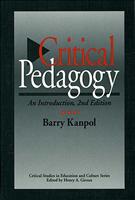
In my journey to deepen my understanding of Critical Pedagogy I have read the book Critical Pedagogy by Barry Kanpol. An excellent book with many on the ground examples of Critical Pedagogy implemented. When it comes to the development of critical technology I believe the following references really stand-out from this book; This first quote provides a description of the role of the teacher as critical pedagogue.
...then critical of the multiple forms of teaching methodologies; and the reproduction of values that oppress, alienate, and subordinate people (especially, for our concerns, students and teachers as related to race, class and gender configurations). Within this reskilling mode, critical pedagogy teachers challenge stereotyping, find ways to subvert tracking through alternative teaching methodologies, build curriculum with open and critical spirits, become involved in the policy-oriented decisions of the state and local school district, and form group solidarity over issues of value-laden importance.This second quote provides a description of the dialectic of the Me and the I with how a child exists within their community. This section of the book was powerful for it referes to the work of Herbert Mead.
Within this personal dialectic, the critical pedagogy self seeks to understand the self construction in an ongoing dialectic with oppressive social structures. How I, me and other can work dialectically both to oppress and emancipate us becomes of increasing importance to critical pedagogists.Kanpol continues with a description of a classroom environment where a teacher has a special ability to teach about differences and build upon these lessons with empathy for these differences. The book progresses through a number of schools and Kanpols descriptions of the teachers within these schools. Kanpol focuses his observations on teachers who, at differing levels, are critical pedagogists. Closer to the end of the book I find the third quote where Kanpol formalizes his description of the teacher as critical pedagogist;
Critical pedagogy is about teachers struggling for some semblance of control in their lives - control that has to do with achieving a qualitatively better life for students and teachers; control that has to do with finding a democratic path that begins to alleviate forms of oppression, alienation, and subordination.What is most important from this book is how Kanpols' writings fit within what I am calling Critical Technology. Its about the balance of challenging the existing structures of oppression, alienation, and subordination with teaching to the required curriculum. This also fits within the work of Friere where action should occur within the existing structures or the history and politics of the structures. There are two final quotes that I would like as the spirit of Critical Technology;
But the kind of criticality you will find in critical pedagogy is really different from this in that it's really about what I call critical consciousness. It is about focusing our critical capacities, our questioning capacity, on the everyday world in which we find ourselves with a purpose. And that purpose is rooted in a moral vision. It has to do with looking at the world, questioning the world as to whether, in fact, it treats people with dignity and respect; whether the world is one in which certain groups of people or individuals are limited or dominated, or whether the world that we live in, in fact, lives up to its democratic and humanistic promises.
Part of creating a critical pedagogy in teacher education is to move beyond mere cyitique or cynicism to a position where action can occur, where students can joyfully respond to structural constraints in a timely manner and in ways that create opportunities for democratic hope and critical citizenry.
Tuesday, April 25, 2006
Critical technology being implemented (pdf)
My reading of things related to what I am calling "Critical Technology" continues. My interest in the $100 laptop also continues. So in my internet searches for readings related to Critical Pedagogy and Paulo Friere these two interests came together. This paper describes the "educational content" and how the approach to developing the educational content for the $100 laptop will be very Frieriean and modeled after the succesful projects in Brasil where technology and learning were brought together. The paper confirmed that the approach toward educational content will be very grassroots and driven by the learners. Of course this is an oversimplication of what the paper said. Just the fact that they are leaning toward a Frieriean approach bodes well in the laptops success. This paper also confirmed the importance of the critical technologist, a mentor or facilitator of critical approaches to learning within a technology rich environment.
Saturday, April 22, 2006
Pedagogy of Curiosity
A discussion between Paulo Freire and Seymour Papert regarding the future of school. So much good stuff within this discussion between these two great thinkers. I believe it is best if you read the whole transcript yourself and/or watch the videos. What I have included here are what I consider the highlights of this discussion;
The pedagogy of the question, not the answer.In general, the discussion is centered around three simple stages of learning;
His (Papert) analysis seems to be metaphysical and mine (Freire) is politico-historical.
- learning through exploration (baby to toddler)
- learning by being told (k12 schooling)
- back to exploration (later university and beyond)
Friday, April 21, 2006
Critical Technologists
In my previous post I spoke to the idea of teachers well versed in the critical technology approach. It would seem that the GIIP has already begun the development of these Critical Technologists.
Critical Technology Defined
After some reflection I am going to create my first statement defining Critical Technology as I believe it to be.
Fundamentally it will be based upon Critical Pedagogy. I believe the use of technology within education should be from the grass roots (meaning; those who are using the technology, the "students"). How the technology should be used is defined by the students and the teachers well versed with the critical technology approach.More on all this after I have completed my research. Currently, I'm reading some books, papers and watching some videos. When significant pieces of information form I will write a post in this stream of conciousness blog.
Saturday, April 08, 2006
SUMMARY PAPER
This podcast summarizes the previous 18 posts. To view the transcript of this podcast visit this sites academic companion blog.
$100 laptop, microfinance, constructivism and critical pedagogy
Offer $100.00 laptops to economically resiliant microfinanced families with children available for education and combine that with constructivist learning methods and teachers well versed in critical pedogogy. Once you have all the pieces in place you can work with the local community and identify a group of cohorts (Gow, 2001) that meet the optimal laptop profile and build on the success already within these families.
Thursday, April 06, 2006
UN Millenium Goals
Two of the UN Millenium Goals have good alignment with the introduction of the $100 laptops goal of a laptop for every child in the next five to seven years. The two millenium goals are;
Goal 2. Achieve universal primary education
Goal 3. Promote gender equality and empower women
Over 30 million served
Since its inception the microfinance approach to helping people out of poverty has served between 30 and 50 million people. All these small loans amount to a total 2.5 billion dollars being loaned out by thousands of these "banks for the poor".
Wednesday, April 05, 2006
Microfinance programs are available
 All the places targeted to pilot the $100 laptop already have established microfinance programs. These locations would have the required financial infrastructure and families to utilize these laptops in their families education.
Community Source
How will all the software and curriculum get built? To begin with the operating system is based upon the open source offering of Linux, therefore all the open source software currently being built is freely available for the $100 laptop. A number of open source courseware (MIT & Educational Commons) initiatives have started up. The $100 laptop could take advantage of these or begin to create its own open courseware initiative. The courseware would be built by community source where groups of development teams come together and share the costs and efforts of building new curriculum and then share this curriculum back into the open courseware community...
$100 laptop isn't without critics
The $100 laptop initiative doesn't come without its critics. The criticism falls into four main areas;
1) People need to eat first
2) How are you going to dispose of them once they are done
3) Where is the curriculum going to come from
4) Wouldn't the billions of dollars to build these things be better spent on (low-tech) educational initiatives.
I believe the content of this blog answers 3 of the 4;
1) I'm proposing that Laptop recipients are engaged in some asset stabalization (like microfinance) and are already reading their family to send one of their children to school.
3) Leverage the ideas of Critical Pedagogy; where cohort programs are set up to create groups of teachers within each community. Constructivist learning methods are used.
4) Yes, maybe the Billions of dollars would be better spent somewhere else. But there not going to be, so better to engage and help it be a success and join in with helping the UN Millennium Development Goals be a success.
1) People need to eat first
2) How are you going to dispose of them once they are done
3) Where is the curriculum going to come from
4) Wouldn't the billions of dollars to build these things be better spent on (low-tech) educational initiatives.
I believe the content of this blog answers 3 of the 4;
1) I'm proposing that Laptop recipients are engaged in some asset stabalization (like microfinance) and are already reading their family to send one of their children to school.
3) Leverage the ideas of Critical Pedagogy; where cohort programs are set up to create groups of teachers within each community. Constructivist learning methods are used.
4) Yes, maybe the Billions of dollars would be better spent somewhere else. But there not going to be, so better to engage and help it be a success and join in with helping the UN Millennium Development Goals be a success.
Tuesday, April 04, 2006
Microfinance works
The most passionate claims always lead back to educating their children. Fortunately, education is seen as one of the keys to ending poverty.
Ending poverty has become pop culture
With all the media exposure and all the pop stars getting involved the attainment of ending poverty may be more real now than ever before.
Monday, April 03, 2006
Based upon constructivist methods
The MIT labs have stressed the importance of using constructivist (Bender, 2006) methods when building cirriculum for the $100 laptops. Its about the world teaching its children... And it will be built from the bottom up. The recipients of the laptops will determine how they use them to learn.
http://web.mit.edu/mitir/podcasts/2006-02-21_Bender_OLPC.mp3
http://web.mit.edu/mitir/podcasts/2006-02-21_Bender_OLPC.mp3
Subscribe to:
Posts (Atom)