- If you're not leading - it's free
- Web 2.0 is the gaming console for business
- Doing more with less
- Capture of tacit knowledge is business intelligence
- The reduction of rituals creates a better solution
- Nimble approaches flatten the organization
- The technology is easy, it's the process that's hard
Saturday, November 22, 2008
if you're not leading - it's free
A friend of mine suggested I use the tag line "if you're not leading - it's free". Now many aspects of this actually make sense for what I am wanting to do, but I don't believe the tag line is quite there. The ideas that I resonate with and should contribute to my tag line include;


Thursday, November 20, 2008
Why does it matter?
With the current global economic restructuring it becomes very important to do more with less. It is becoming increasingly important to be organizationally nimble while increasingly deliver quality and effectiveness. These organizational attributes will be the way forward. The ability to communicate internally, locally, regionally and internationally with inexpensive and detail rich methods are available within social media and web 2.0 technologies. What I do helps organizations develop the skills and approaches to capture and communicate knowledge using these technologies. What I do helps organizations be more information effective, move quickly into utilizing these knowledge rich tools and, therefore, be better prepared for the coming competitiveness, creativity and flatness of global economics.
* This question is being posed as an exercise created from a previous post on this blog.
* This question is being posed as an exercise created from a previous post on this blog.
Wednesday, November 19, 2008
This is what pushed me over the edge.
So I have worked as an architect in computer systems for over 10 years. I have held many titles in this role; technical architect, systems architect, end-to-end architect and enterprise architect. The technical or business focus of the role is what changes from title to title. Over the last five years I have used agile approaches within architecture and as Web 2.0 technologies mature and become increasingly accessible, a less ritualistic and agile approach to architecture makes increasing sense. I also believe architecture should be an involved part of the development culture and should be more pragmatic and aligned with agile methods. This approach creates an order of magnitute increase in communication from within the development team and with all the external stakeholders. The Web 2.0 toolset provides this increase in communication with the added advantage of providing a searchable repository for the communication. Essentially these tools replace the overly ritualized document creation that takes place in traditional architectural approaches and also creates a searchable repository that contains both the explicit and tacit knowledge in and surrounding the architecture. All good.
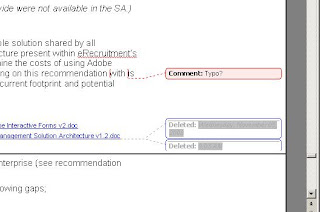 So what happened the other day that sent me over the edge... I was spinning around in the traditional document creation process and I was reviewing some changes and I came across this gem (see image). Somebody took the effort to make the comment that there was a typo. Now I can see the positive side of this in that the document quality was increasing but I couldn't believe the non-collaborative approach. My perspective was if this was in a wiki the typo would have been corrected by the first person to find it and the built-in wiki versioning would have captured the change event. The amount of cognitive cycles saved by only the finder making the change would have held big benefits. For I wouldn't be looking at it and thinking about it, the change would have been made at source of discovery. In my mind this is a micro example of the positive and cascading effects that using Agile and Web 2.0 approaches within architecture could have. Massively collaborate on developing the architecture as needed, let the technology and social media record the history and the tacit knowledge found in the related discussion.
 So what happened the other day that sent me over the edge... I was spinning around in the traditional document creation process and I was reviewing some changes and I came across this gem (see image). Somebody took the effort to make the comment that there was a typo. Now I can see the positive side of this in that the document quality was increasing but I couldn't believe the non-collaborative approach. My perspective was if this was in a wiki the typo would have been corrected by the first person to find it and the built-in wiki versioning would have captured the change event. The amount of cognitive cycles saved by only the finder making the change would have held big benefits. For I wouldn't be looking at it and thinking about it, the change would have been made at source of discovery. In my mind this is a micro example of the positive and cascading effects that using Agile and Web 2.0 approaches within architecture could have. Massively collaborate on developing the architecture as needed, let the technology and social media record the history and the tacit knowledge found in the related discussion.
Tuesday, November 18, 2008
Enterprise Architecture and Web 2.0
I'm going to be spending a fair bit of my time over the next while developing curriculum around how Web 2.0 technologies have become a required tool for enterprise architecture (EA). There are a number of influences to this newly formed realization;
- Agile (and nimble) approaches are becoming a must have for enterprise architecture.
- Documentation heavy approaches overly ritualize a process that can be duplicated and greatly improved by using wikis.
- The deep dive technical discussions that influence and describe architecture are better captured on video and with photos of the whiteboard.
- The best place for architecture should be embedded in the development culture. It cannot be mandated.
- Good enterprise architects are really hard to find. And most are attracted to emerging approaches and technologies. (there architects for god's sake)
- With all the belt tightening going on, architects need to be able to do more with less. [so get rid of the costly (and useless) rituals]
- a company, business, organization, or other purposeful endeavor; an undertaking or project, especially a daring and courageous one; a willingness to undertake new or risky projects; energy and initiative; an active participation in projects
en.wiktionary.org/wiki/enterprise - A system of business endeavor within a particular business environment. An enterprise architecture (EA) is a design for the arrangement and interoperation of business components (eg, policies, operations, infrastructure, information) that together make up the enterprise's means of operation. [ICH].
www.balancedscorecard.org
Monday, November 17, 2008
What do I do?
 I utilize Web 2.0 technologies to facilitate corporate learning, professional development and to support K12 students in developing connectivist learning skills. I encourage people to use the tools of social media and the resources from the internet cloud to capture knowledge both explicit and tacit. I believe these approaches to knowledge capture are beginning to extend the tools for Business Intelligence and Knowledge Management. I agree with Brown and Adler that understanding is socially constructed and that the Web 2.0 provides the participatory media to facilitate this social construction of understanding.
* This question is being posed as an exercise created from a previous post on this blog.
Saturday, November 15, 2008
Learning Environments (DIY)
I believe the concepts within these two images need to be thought about as anyone explores the use of Web 2.0 technologies for learning;
Progressive Inquiry

Personal Learning Environments

Progressive Inquiry

Personal Learning Environments

CMS Toolbox or Trap?
I like this article... It is part of the growing dialogue about using CMS for learning. And how they actually limit learning and course creation. Here are a couple of good quotes from the article;
the standardized nature of integrated commercial systems is limiting pedagogy.
Web 2.0 applications that encourage social construction of knowledge (Wikispaces, BubbleShare, Ning) are freely available and may provide more creative instructors with better options than any LMS currently available.
Who am I?
I'm a person who is enamored by Open Educational Resources (OERs) and free cultural works. I believe that utilizing web 2.0 and collaborative technologies is emerging to be the most effective approach to learning, life-long learning and professional development.
* This question is being posed as an exercise created from a previous post on this blog.
* This question is being posed as an exercise created from a previous post on this blog.
Friday, November 14, 2008
The Brand Gap
I came across this slideshare stack and felt it would be a good thing to look it through.
I came across three important questions;
I came across three important questions;
- Who are you?
- What do you do?
- Why does it matter?
- What are you?
- What lessons do you provide?
- Why do they matter?
Thursday, November 13, 2008
Commoncraft does a great job of explaining Web 2.0
Commoncraft really has created a good set of videos to understand the web 2.0 and all the related technologies. They also do a good job of keeping up with the new technologies as they mature and gain popularity.
Good introduction to Web 2.0
Even though this video was created a couple of years ago it still covers the subject very well. It goes through all the main concepts within the read write web.
Thursday, October 02, 2008
6:48.68 vs 0:32.36
It was just getting way to frustrating. Wanting to just quickly check my email between tasks, somewhere between putting some finish to the new windows and picking up the boy from pre-school. Booting the computer, then loading Outlook and hitting send/receive, was no longer something I could do between tasks. So I got into the habit of doing the quick check on the cell phone. Then I started to wonder what is the difference in time? So here are the timings, and the cell phone could have lapped the PC 12 times;
Laptop (6:48.68 minutes)
Laptop (6:48.68 minutes)
- press the ON button
- load XP
- login
- load Outlook
- press Send/Recieve
- press the ON button
- load Symbian
- load mobile gmail app
- accept network login
Sunday, September 28, 2008
WIkiEducator Quality Assurance
I formally announced the first draft of the WikiEducator (WE) featured works in the google group. After a considerable amount of discussion in May 2008 WE decided upon a number of aspects for the Quality within WE. The three main themes are;
Items 1 & 2 have progressed the most with some conceptual work being done by reviewing eMM from a WE perspective. I intend on reviewing the eMM again to add criteria to the featured projects and featured institution. You can see how this will fit when you review the respective featured works. I plan on providing further depth to how the eMM fits with all this in the near future.
I'd really like if people could review and provide discussion around these five featured works;
I also created a portal called the Quality Assurance Framework. The purpose of the portal is to provide the foundation (or framework) for all the QA initiatives within WE.
Please take the time to review and provide feedback. Please participate and participate often!!!
Items 1 & 2 have progressed the most with some conceptual work being done by reviewing eMM from a WE perspective. I intend on reviewing the eMM again to add criteria to the featured projects and featured institution. You can see how this will fit when you review the respective featured works. I plan on providing further depth to how the eMM fits with all this in the near future.
I'd really like if people could review and provide discussion around these five featured works;
I also created a portal called the Quality Assurance Framework. The purpose of the portal is to provide the foundation (or framework) for all the QA initiatives within WE.
Please take the time to review and provide feedback. Please participate and participate often!!!
Friday, September 05, 2008
Should twitter based spammers be called spitters
Today I become fed up with someone I was following on twitter. I started following them and the tweets I got were great and full of nuggets every now and again. Then all of a sudden they started tweeting at an increasing amount. And they weren't the personal musings you'd expect but links to here, re-tweets to this... It was obviously no longer a single person. They became spam in my tweet stream, they filled up my tweets page, how annoying. So I no longer follow them... This did prompt the question in my mind, what is a twitter based spammer called? I figure it should be spitter!
Tuesday, June 03, 2008
Most EduPunks are paid by the establishment
I have been taken by this EduPunk term. I grew up in the 70's and associated with the music scene of that time. I listened to the Sex Pistols, I still look back at the depth of rebellion Sid Vicious incarnated. I have mind blowing memories of Joey Shithead and the Skulls [before they became DOA (our most famous Vancouver punk bank)] playing during my high school graduation year. No true Punk would consciously take money from the establishment they rebelled against. Yet, this current set of EduPunks mostly work for traditional established education institutions. I strongly suggest you trace most people writing about and considering themselves EduPunks back to where they derive there livelihood. They are not EduPunks! They are masquerading as Punks, and as long as people clutter up the blogosphere claiming to be EduPunks while also being paid by the establishment can only perpetuate these flawed traditional education structures. If they were true Punks they would leave their day jobs and use their mindshare to disrupt the structures they claim to be rebelling against. Hypocrites the lot of them!!!!
Thursday, May 22, 2008
Do bounties work?
The "work" I am doing with WikiEducator is in trying to fill out the the multimedia resources available for OpenOffice / Ubuntu learning. We had offered a $1500 CDN bounty for each 3 -5 minute multimedia component developed. This seems like a good offer, but I wonder if the idea of OER and wiki collaboration includes the concept of money. I always believed that OER and wiki authorship was a volunteer activity. And when you throw $$$ into the mix everything becomes skewd...
Thursday, May 08, 2008
ScoPE [SOF2008]
This looks to be a very good conference; Shaping our Future: Toward a Pan-Canadian E-learning Research Agenda. I look forward to meeting people online.
Wednesday, April 23, 2008
Nature is a CC-BY-SA
I just finished reading a classmates post which is titled "The truth according to wikipedia". Their post embeds a great video about wikipedia and the Web 2.0 and where all this free knowledge could be going. The post and the video had some very interesting points. What it really got me thinking was; I really don't believe any of the main points get to the nut of the issue, which is, the keepers (of the last 100 years or so) of the current truth got us into the current mess of consumerism, inequitable capitalism, non-sustainable consumption of the earths resources, etc... It's no wonder there is a movement in redefining the truth and taking truth away from the current ideology. IMHO the current truth is deeply flawed and needs to be rewritten. The new truth needs to build sustainability into its core, the new truth needs to build the natural environment into its core. This idea is well discussed in a podcast/video by Dr. David Orr titled "the end to education". The new truth needs to make the stand that the natural environment is a CC-BY-SA, and not to be exploited and "owned" by the few. The natural environment was created before human arrival and should not be consumed by a truth that if you innovate nature, you not only own your innovation you also have rights to the nature you based your innovation upon. Nature is a CC-BY-SA. We live in a truth that allows companies like Monsanto to "steal" nature and make it their own and then try to sue those who have treated nature as an open resource. It's time to rewrite the truth. Flatten it out, share it, have us all accountable (and attributable) to take care of it, its a matter of our survival. This is why truth needs a collaborative rewrite so it is no longer controlled by the few who want to perpetuate an ideology (or truth) that is deeply flawed. Everything that was on earth before human arrival should have a Share-Alike license.
Tuesday, April 22, 2008
WEEK 7: Bowen Island, BC, CANADA
For this weeks activity I took a photo from the window of my house, recorded a short description of the photo using audacity, save the audio file to an ogg format and uploaded both these digital objects to the wiki commons.
- The photo: TheLionsVancouver.jpg
- The audio: BowenIslandView.ogg
- The location: Longitude: -123.347626 latitude: 47.570178
Tuesday, April 15, 2008
WEEK 6: IMHO, Canada is beautiful!
It never stops to amaze me the number of top quality and creative photos that exist on flickr. All the licenses combined add up to over 65 million photos. WOW.
This weeks activity forced me to revisit GIMP and to take a deeper look at the features already available with flickr (in particular, picnik). I still believe that GIMP is the best photo editor available (open source or otherwise). And using it to alter and improve photos is free and easy. The number of GIMP tutorials available on YouTube is impressive.
I went for a walk with my son Lucas and took some photos of our beautiful island paradise. From the photos I chose the best ones and uploaded them to flickr than I edited (mostly cropped) them with picnik. I believe the results of our Bowen Island walk-about are pretty good.
I also managed to upload a file to MediaWiki Commons. The photo is of the Battery in winter from the families one year stay in St. John's Newfoundland.
This weeks activity forced me to revisit GIMP and to take a deeper look at the features already available with flickr (in particular, picnik). I still believe that GIMP is the best photo editor available (open source or otherwise). And using it to alter and improve photos is free and easy. The number of GIMP tutorials available on YouTube is impressive.
I went for a walk with my son Lucas and took some photos of our beautiful island paradise. From the photos I chose the best ones and uploaded them to flickr than I edited (mostly cropped) them with picnik. I believe the results of our Bowen Island walk-about are pretty good.
I also managed to upload a file to MediaWiki Commons. The photo is of the Battery in winter from the families one year stay in St. John's Newfoundland.

Subscribe to:
Posts (Atom)