Over the last few months I have become increasingly drawn into this CRC discussion. The one thing that has made the most sense is; to inform myself. I've read through much of the three websites of;
I also created a custom google search engine and pointed it at these three sites. This search engine can be found on this blog.
The one thing I am trying to find information is research, reference or case studies about successful high-density eco-villages on ISLAND environments. So far I have found none in any of these three websites, I could have missed something. As I expanded my search to the internet and architectural, social planning, human geography references I found very little on this subject. What I did find was references to building upon what you already have. Nothing on creating NEW villages. And when I looked at the village concept it pointed toward FIRST building density at the islands port (in our case, snug cove) and secondary or tertiary villages at major crossroads. This also seems to be the most natural and proven approach to densification of islands.
What I am looking for is the references that people are using in regards to building high-density sustainable villages on ISLANDS. I believe our being an island is a important factor in deciding the location of such eco-villages.
Thursday, February 26, 2009
Wednesday, February 25, 2009
Cape Roger Curtis Search Engine
In my efforts to better understand this issues tied to Cape Roger Curtis I configure a custom google search engine. This custom google search points toward the following three sites;
Please suggest other relevant sites by commenting on this blog to improve this custom search engine.
Please suggest other relevant sites by commenting on this blog to improve this custom search engine.


Tuesday, February 03, 2009
OER roadmap
I've been working on a wiki based open educational resource (OER) project for a couple of years now. I work on it because I feel very well aligned with the sites main page description;
We're turning the digital divide into digital dividends using free content and open networks.As an active contributor to this wiki I feel I have benefited greatly from contributing. As a contributor I believe I have learned more than any individual content consumers (though I have no data to back this up, its just a feeling). I have come to believe that contributing to OER is the best way to learn from OER. It is the act of finding existing OER and reusing it or building upon it. If the OER doesn't exist for your chosen topic, then you have the opportunity to learn and build a new piece of OER.
I am currently involved in more than one discussion about how to encourage people to collaborate in the creation of OER. This is an interesting subject for I believe a number of factors impact OER collaboration. These factors are;
- OER saturation
- Licensing models
- Platform
- Localization
How these factors impact the growth of OER is best described within what I see as the OER roadmap. The roadmap has four phases;
- Build-up - saturation of the subject areas from both an access (bandwidth, connectivity and platform) and localization (culture, language, etc.) perspective so that re-use is all that is left
- Reuse - deepening the accuracy and diversifying the learning approaches and through a licensing approach (CC-BY-SA) that encourages reuse
- Assessment - a maturing model of open access assessment (OAA1)
- Accreditation - a globally recognized model of open access accreditation (OAA2)
I still see OER at the very beginning of the build-up phase. And given the solitary preparation methods many teachers already use, it is still a long way off to have saturation. I do believe the day will come. The other three are currently being worked on, but are dependent upon completion of the first to become mature.
Sunday, January 25, 2009
Community Involvement
So I'm preparing for my interview with ZenBiz radio. I was approached by Bruce Stewart because of my activity in using social media in community based initiatives. I believe society is just getting going with using the internet as the platform for citizen led electronic government initiatives. There is a lot going on in this space right now, and the "coronation" of President Obama has really legitimized citizens being able to ask for openness and transparency (municipal, regional and national) and for this information to be available as an API via the internet. Bruce asked that I have a quiet space and a landline for the interview. He also let me know I should expect questions in four themes. This post is my preparation for this interview.
1) Who am I, my relevant background
I would say the biggest impact upon why I am becoming increasingly involved with citizen based initiatives is a value given to me by my parents. Its the value of leaving somewhere in a better state than when you arrived. In general, I just don't see the "collective" we doing that. I believe if we increase citizen participation in caring for our neighborhoods and localizing our needs then we will be much more sustainable. I also believe government transparency will assist in this considerably.
I also believe my technology and educator background combined with my work with Information and Communication Technology for Development (ICT4D) have also influenced me. I think my work with ICT4D has influenced me in how I think the "collective" we (in the developed world) expect to much. To be blunt I think in the west we have become lazy and are overly entitled. Its time we collectively stopped consuming so much and started being more grateful for what we have and put back.
Lastly, I believe this YouTube presentation by Hans Rosling really taught me the importance of access to data and the social change it can assist.
I am involved with citizen based electronic government because I believe;
With these beliefs what am I doing about it? When I reflect, I'm doing a fair amount. I continue as a contributor and council member for WikiEducator, and this experience has taught me a lot about self-organization. I am continually assisting organizations to be successful with social media, organizational learning and technology architecture. I have brought my understanding of all these things together by initiating the use of BOWEGOV as a tag / hashtag to tie everyone's work together. As with any community there are a lot of differences among the different people, groups, neighborhoods, etc. What else would you expect!?! I felt if we chose a social media (web2.0) approach that was technology agnostic and was platform independent it would have greater appeal. So with tagging people can use the client side tools (Mac, PC, Nokia, iPhone, Browser, Linux, Etc, Etc.) they want without the whole thing getting tied to a single technology platform (Wiki, Blog, Drupal, WordPress, MediaWiki, Google, Etc, Etc.). After some discussion with others we came up with the idea that the internet is the platform. So we're not tied to any single platform and as the internet evolves, innovates and improves so do we.
3) Reaction from the powers that be
The short answer, there has been no reaction. So far this initiative is only starting. We have contacted a couple of council members and had social conversations with the mayor about BOWEGOV tagging. Its a small town of 4000 so these conversations happen. I think it is way too early to expect any traction. The idea of using social media for government really got started around the same time as Obama became a democratic candidate Though their is earlier evidence of this, it really didn't get traction/acceptance till Obama. And the conceptual learning curve is steep for people indoctrinated into traditional forms of governing. I have sent an email to our municipal council (see related post). I think this email will be most useful to refer back to in a Kolb kind of a way. I believe the learning has started... when it gets traction is the unknown.
Recently I have been seeking ways to coordinate citizen based approaches in preparation to meeting with the powers that be. I think this needs to be a good experience in a more coordinated way. In my seeking I have found the visible government website. I really like how they describe themselves;
4) Citizenship involvement
On bowen Island we are fortunate in that we have a number of citizens active and involved in the community. And a lot of the efforts are toward influencing local politics (though this could be for better or worse). I believe it is a part of living in a smaller community. I do see it increasingly important that citizens start doing more for their neighborhoods. I believe that our current expectations for what our governments will provide is unsustainable. I believe citizens need to let go of government even sustaining the current levels of service. Services are going to become increasingly expensive and the tax dollars aren't there to increase service. What this means is that citizens have to become more active at a neighborhood level to offset the need for services.
On Bowen Island we have had a number of people starting using Web 2.0 technologies to gather and communicate information. Here are a few;
1) Who am I, my relevant background
I would say the biggest impact upon why I am becoming increasingly involved with citizen based initiatives is a value given to me by my parents. Its the value of leaving somewhere in a better state than when you arrived. In general, I just don't see the "collective" we doing that. I believe if we increase citizen participation in caring for our neighborhoods and localizing our needs then we will be much more sustainable. I also believe government transparency will assist in this considerably.
I also believe my technology and educator background combined with my work with Information and Communication Technology for Development (ICT4D) have also influenced me. I think my work with ICT4D has influenced me in how I think the "collective" we (in the developed world) expect to much. To be blunt I think in the west we have become lazy and are overly entitled. Its time we collectively stopped consuming so much and started being more grateful for what we have and put back.
Lastly, I believe this YouTube presentation by Hans Rosling really taught me the importance of access to data and the social change it can assist.
I am involved with citizen based electronic government because I believe;
- Citizen based initiatives are more sustainable
- The developed world needs to give more back (or take much, much less)
- Government transparency will be created from the grassroots
With these beliefs what am I doing about it? When I reflect, I'm doing a fair amount. I continue as a contributor and council member for WikiEducator, and this experience has taught me a lot about self-organization. I am continually assisting organizations to be successful with social media, organizational learning and technology architecture. I have brought my understanding of all these things together by initiating the use of BOWEGOV as a tag / hashtag to tie everyone's work together. As with any community there are a lot of differences among the different people, groups, neighborhoods, etc. What else would you expect!?! I felt if we chose a social media (web2.0) approach that was technology agnostic and was platform independent it would have greater appeal. So with tagging people can use the client side tools (Mac, PC, Nokia, iPhone, Browser, Linux, Etc, Etc.) they want without the whole thing getting tied to a single technology platform (Wiki, Blog, Drupal, WordPress, MediaWiki, Google, Etc, Etc.). After some discussion with others we came up with the idea that the internet is the platform. So we're not tied to any single platform and as the internet evolves, innovates and improves so do we.
3) Reaction from the powers that be
The short answer, there has been no reaction. So far this initiative is only starting. We have contacted a couple of council members and had social conversations with the mayor about BOWEGOV tagging. Its a small town of 4000 so these conversations happen. I think it is way too early to expect any traction. The idea of using social media for government really got started around the same time as Obama became a democratic candidate Though their is earlier evidence of this, it really didn't get traction/acceptance till Obama. And the conceptual learning curve is steep for people indoctrinated into traditional forms of governing. I have sent an email to our municipal council (see related post). I think this email will be most useful to refer back to in a Kolb kind of a way. I believe the learning has started... when it gets traction is the unknown.
Recently I have been seeking ways to coordinate citizen based approaches in preparation to meeting with the powers that be. I think this needs to be a good experience in a more coordinated way. In my seeking I have found the visible government website. I really like how they describe themselves;
VisibleGovernment.ca is a non-partisan non-profit dedicated to promoting the planning, funding, and implementation of online tools for government transparency in Canada.The visible government group has also recently hosted change camps to get local groups to start working toward this initiative. There will be a change camp in Vancouver on 28 March 2009. I believe all this work in creating transparency to government will have an impact. Even upon our local municipal government(s).
4) Citizenship involvement
On bowen Island we are fortunate in that we have a number of citizens active and involved in the community. And a lot of the efforts are toward influencing local politics (though this could be for better or worse). I believe it is a part of living in a smaller community. I do see it increasingly important that citizens start doing more for their neighborhoods. I believe that our current expectations for what our governments will provide is unsustainable. I believe citizens need to let go of government even sustaining the current levels of service. Services are going to become increasingly expensive and the tax dollars aren't there to increase service. What this means is that citizens have to become more active at a neighborhood level to offset the need for services.
On Bowen Island we have had a number of people starting using Web 2.0 technologies to gather and communicate information. Here are a few;
- http://www.onedaybowen.ca/ - a blog for citizens sharing ideas
- http://www.onedaybowen.ca/maps/roadstat.htm - a tool for keeping people informed about road conditions
- http://bowenroads.blogspot.com/ - a companion blog for road conditions
- http://www.bimbc.ca/ - the Bowen Island Municipal website
- http://www.google.ca/search?hl=en&q=bowegov - google search of BOWEGOV
- http://delicious.com/tag/bowegov - delicious tagging of BOWEGOV
- http://search.twitter.com/search?q=BOWEGOV - hash tag for BOWEGOV
Thursday, January 22, 2009
Dear Bowen Island Council
A number of Bowen Island citizens with interest in social media are beginning to put together online citizen led approaches toward increasing citizen participation in our neighborhoods and community. The belief behind this activity is that if citizen participation increases from a grassroots level more will get done and people will feel increased responsibility and connection to their neighborhoods and community. It is also believed that citizen based neighborhood activities are a step toward lessening our environmental impact (the 100 mile diet could be considered and example, http://100milediet.org). On bowen island there have already been activities where neighbors have taken the time and energy to complete projects for the good of their neighborhood. I can see these neighborhood activities increasing and current technology trends provide online tools to assist.
All the changes occurring with politics, social media and transparency creates unprecedented opportunities for communication and openness. I believe their is an opportunity for the Bowen Island Municipality to be an exemplar in using technology to bring openness to municipal government. A project is forming to support this kind of initiative, see visible government; http://visiblegovernment.ca/index.php
A simple example of how this could work, could be for Bob (and or other council members) give brief online conferences of the provincial and federal rules and policies for running a municipal gov't. I am sure their are many simple and important municipal administrative topics that could occupy a 15 - 30 learning experience for the citizenship of Bowen Island. Increasing citizens knowledge in such matters could help in understanding how tax dollars are spent, how BIM adminsitrative processes work, public works function, etc... DimDim (http://www.dimdim.com) is a free social media service that could be used for such an activity.
There is already a building knowledge base using social media. This is being facilitated with the use of tagging, in particular the BOWEGOV tag. If you were to click the following links you would see how this tagging approach is connecting knowledge and allowing people to engage in ways they feel comfortable.
1) A search on Google (a shared reference to information related to bowen e-government); http://www.google.ca/search?hl=en&q=bowegov
2) Delicious tagging (the beginning of a taxonomy for electronic government); http://delicious.com/tag/bowegov
3) Twitter (a number of brief conversations about bowen e-government and related issues); http://search.twitter.com/search?q=BOWEGOV
Where all this social media and transparency will go in relation to small municipalities is still to be seen, as it is still being "invented". I look forward to your support in building greater transparency and increasing citizen participation in local gov't. If you would like to discuss any of these topics further. Please do not hesitate to contact me,
peter@rawsthorne.org or any of the others connected to these activities.
All the changes occurring with politics, social media and transparency creates unprecedented opportunities for communication and openness. I believe their is an opportunity for the Bowen Island Municipality to be an exemplar in using technology to bring openness to municipal government. A project is forming to support this kind of initiative, see visible government; http://visiblegovernment.ca/index.php
A simple example of how this could work, could be for Bob (and or other council members) give brief online conferences of the provincial and federal rules and policies for running a municipal gov't. I am sure their are many simple and important municipal administrative topics that could occupy a 15 - 30 learning experience for the citizenship of Bowen Island. Increasing citizens knowledge in such matters could help in understanding how tax dollars are spent, how BIM adminsitrative processes work, public works function, etc... DimDim (http://www.dimdim.com) is a free social media service that could be used for such an activity.
There is already a building knowledge base using social media. This is being facilitated with the use of tagging, in particular the BOWEGOV tag. If you were to click the following links you would see how this tagging approach is connecting knowledge and allowing people to engage in ways they feel comfortable.
1) A search on Google (a shared reference to information related to bowen e-government); http://www.google.ca/search?hl=en&q=bowegov
2) Delicious tagging (the beginning of a taxonomy for electronic government); http://delicious.com/tag/bowegov
3) Twitter (a number of brief conversations about bowen e-government and related issues); http://search.twitter.com/search?q=BOWEGOV
Where all this social media and transparency will go in relation to small municipalities is still to be seen, as it is still being "invented". I look forward to your support in building greater transparency and increasing citizen participation in local gov't. If you would like to discuss any of these topics further. Please do not hesitate to contact me,
peter@rawsthorne.org or any of the others connected to these activities.
Monday, January 19, 2009
Sunday, January 18, 2009
Teaching with Web 2.0, long-tail applied.
I created a power point stack two years ago for a series of workshops I was providing to the faculty and graduate students of Memorial University. This stack has since been used a few times to assist in describing how the Web 2.0 can be used for teaching. Now, two years later I will be interviewed regarding the content of this presentation. Its the long-tail applied to teaching materials... Something I created years ago still has value today. Surprisingly, the presentation does not seem dated. Though, I would add tagging, micro-blogging and Communities of Practice (CoP). The interview is to be loosely based around a number of questions regarding this power point presentation. The questions and related answers are as follows;
Q) Define Web 2.0 and how it can enhance teaching?
A) I like Tim O'Reillys' definition of "What Is Web 2.0" and I particularly like the idea of the wisdom of crowds. I am often amazed at what I learn from my social network. In a nutshell I see Web 2.0 as the read / write web with access to the collective intelligence found within the people who participate in reading and writing to the web. I believe it enhances teaching by having the learners reflect more deeply than they would if the potential for being read by millions wasn't also a part of the web. I believe it is a big motivator in deepening knowledge by being articulate and researching more thoroughly. I believe the act of writing has positive impacts to learning. The web 2.0 also connects you to people who share interests and development of understanding. Many of these people cn become mentors and cohorts in learning.
Q) The "Teaching with Web 2.0" pdf is used for professional development workshops in Colleges?
A) Yes, I have used it a few times... Mostly with Memorial University in NL. It was used for both faculty and graduate level workshops.
Q) Social Constructivism, Progressive Inquiry and the accompanying image. How do these concepts relate?
A) I believe Social Constructivism is a variety of constructivism that emphasizes the collaborative nature of learning. Progressive Inquiry models itself on proven practices in building knowledge. It includes the knowledge of expertise and the importance of engaging this expertise as a learner builds knowledge. Social constructivism, progressive inquiry and the accompanying image all relate back to knowledge building is a social activity... that can be well facilitated by Web 2.0 technologies.
Q) What are the educational uses of blogging? And what are Mash-ups?
A) Exploring the educational uses for blogging is too big a question for a single post. I believe blogging (particularly when you consider mash-ups) should also be described with RSS. Really Simple Syndication (RSS) is the technical protocol behind blogging. A great way to explore blogging and RSS is through a pdf titled "Web 2.0 Ideas for Educators" written by Quentin D’Souza. This pdf also has many great suggestions of how to use blogging in teaching. Mash-ups are the idea of re-combining and modifying existing works to create a derivative work. This has traditionally been the realm of multimedia, yet it can be a very powerful tool for learners to dive deep into content and create something new and meaningful while learning along the way. I believe the idea of the mash-up in education has yet to be explored fully, I do believe the day will soon come where learners will use mash-ups to fulfill assignment requirements.
Q) Why did you bring David Kolb (see pages 12 & 14) into this presentation?
A)I really like the immediacy of Kolb's experiential learning and how it all starts with the first exposure to a subject. Even if the exposure is a glance at an image. The idea of using the poem was to show how a blog could be used with podcasting to encourage listening to, critiquing and writing poetry. And how that would be done with a Kolb based approach. It really is about tying Web 2.0 techniques to solid pedagogical practices. The second example I used was in using the periodic table and how the teacher could post a basic periodic table and engage the students in looking at the table and providing initial reactions through commenting on a blog or creating their own blog post. this would then continue into coloring the periodic table and further examining its contents. All of the experience with the periodic table would bring a greater familiarity and experience.
To build on these topics even further I would suggest everyone read the "Minds on Fire" article by John Seely Brown to be well aligned with how I also see social media, learning and all the related changes.
Q) Define Web 2.0 and how it can enhance teaching?
A) I like Tim O'Reillys' definition of "What Is Web 2.0" and I particularly like the idea of the wisdom of crowds. I am often amazed at what I learn from my social network. In a nutshell I see Web 2.0 as the read / write web with access to the collective intelligence found within the people who participate in reading and writing to the web. I believe it enhances teaching by having the learners reflect more deeply than they would if the potential for being read by millions wasn't also a part of the web. I believe it is a big motivator in deepening knowledge by being articulate and researching more thoroughly. I believe the act of writing has positive impacts to learning. The web 2.0 also connects you to people who share interests and development of understanding. Many of these people cn become mentors and cohorts in learning.
Q) The "Teaching with Web 2.0" pdf is used for professional development workshops in Colleges?
A) Yes, I have used it a few times... Mostly with Memorial University in NL. It was used for both faculty and graduate level workshops.
Q) Social Constructivism, Progressive Inquiry and the accompanying image. How do these concepts relate?
A) I believe Social Constructivism is a variety of constructivism that emphasizes the collaborative nature of learning. Progressive Inquiry models itself on proven practices in building knowledge. It includes the knowledge of expertise and the importance of engaging this expertise as a learner builds knowledge. Social constructivism, progressive inquiry and the accompanying image all relate back to knowledge building is a social activity... that can be well facilitated by Web 2.0 technologies.
Q) What are the educational uses of blogging? And what are Mash-ups?
A) Exploring the educational uses for blogging is too big a question for a single post. I believe blogging (particularly when you consider mash-ups) should also be described with RSS. Really Simple Syndication (RSS) is the technical protocol behind blogging. A great way to explore blogging and RSS is through a pdf titled "Web 2.0 Ideas for Educators" written by Quentin D’Souza. This pdf also has many great suggestions of how to use blogging in teaching. Mash-ups are the idea of re-combining and modifying existing works to create a derivative work. This has traditionally been the realm of multimedia, yet it can be a very powerful tool for learners to dive deep into content and create something new and meaningful while learning along the way. I believe the idea of the mash-up in education has yet to be explored fully, I do believe the day will soon come where learners will use mash-ups to fulfill assignment requirements.
Q) Why did you bring David Kolb (see pages 12 & 14) into this presentation?

A)I really like the immediacy of Kolb's experiential learning and how it all starts with the first exposure to a subject. Even if the exposure is a glance at an image. The idea of using the poem was to show how a blog could be used with podcasting to encourage listening to, critiquing and writing poetry. And how that would be done with a Kolb based approach. It really is about tying Web 2.0 techniques to solid pedagogical practices.
 The second example I used was in using the periodic table and how the teacher could post a basic periodic table and engage the students in looking at the table and providing initial reactions through commenting on a blog or creating their own blog post. this would then continue into coloring the periodic table and further examining its contents. All of the experience with the periodic table would bring a greater familiarity and experience.
To build on these topics even further I would suggest everyone read the "Minds on Fire" article by John Seely Brown to be well aligned with how I also see social media, learning and all the related changes.
Tuesday, January 13, 2009
Current events and BOWEGOV
I have recently been involved in a number of discussions about citizen led and electronic government. In one of these engagements I wrote the following reply to an email. I feel it was worthy of a blog post.
It is hard for me to disagree with most of what you say here. So I wont. I will tell you my story and what I am doing about community issues. Over the last few years my beliefs regarding centralized government have changed. I see Gov't as more concerned with getting re-elected and servicing special interests. They no longer serve the basic needs of citizenship. And with the environmental and economic realities we are all faced with we need to start living with less and think about becoming small, self sufficient communities (Neighborhoods). I also see most people more concerned about what they can get out of a system instead instead of what they can put into it. I believe history will look at the human species at the end of the 20th century at its most selfish and overly entitled. I believe the level of comfort we in the west have become used to is no longer sustainable. This dissonance of what we expect with what we can afford will cause infrastructures to increasingly fail. Our society can no longer afford garbage collection and street clearing like we have been used to... I believe this is just the reality of our time. I also believe there is a huge upside for people at all levels (mental, emotional, financial, spiritual...) to be more involved at a grassroots level with their neighborhood. In a way its all about love.
So what am I doing about it?
I try to put into the system more than I take out. This is difficult for it seems to go against the status quo. If something needs to be done i try to do it myself and if people show up to help, that is good. I try to be transparent with what i do by publishing it to the internet as public record and to attract interest. This is what I did with snow clearing in our cul-de-sac. I just started doing it, slowly I was making progress. Others joined in... eventually the municipality also helped. I am learning as much as I can about e-Gov't and self-sustaining communities. I have engaged the internet and others from Bowen who also use the internet to encourage self-sustaining activities and to look for ways the support each other in getting things done. I tag everything related to this with the BOWEGOV tag. This provides a way to begin building a body of knowledge. I choose tagging because it does not force people to use any single platform (the bowen forum is a platform) it gives people the freedom to choose how they engage and if they want their activities to become a part of the collective online Bowen Island intelligence, all they have to do is tag it with BOWEGOV. What comes of this tagging approach, i don't know... I do know it is an ongoing longterm project and i have faith positive results will build. I believe it is a positive step in the right direction. Only time will tell.
Thanks for engaging me.
It is hard for me to disagree with most of what you say here. So I wont. I will tell you my story and what I am doing about community issues. Over the last few years my beliefs regarding centralized government have changed. I see Gov't as more concerned with getting re-elected and servicing special interests. They no longer serve the basic needs of citizenship. And with the environmental and economic realities we are all faced with we need to start living with less and think about becoming small, self sufficient communities (Neighborhoods). I also see most people more concerned about what they can get out of a system instead instead of what they can put into it. I believe history will look at the human species at the end of the 20th century at its most selfish and overly entitled. I believe the level of comfort we in the west have become used to is no longer sustainable. This dissonance of what we expect with what we can afford will cause infrastructures to increasingly fail. Our society can no longer afford garbage collection and street clearing like we have been used to... I believe this is just the reality of our time. I also believe there is a huge upside for people at all levels (mental, emotional, financial, spiritual...) to be more involved at a grassroots level with their neighborhood. In a way its all about love.
So what am I doing about it?
I try to put into the system more than I take out. This is difficult for it seems to go against the status quo. If something needs to be done i try to do it myself and if people show up to help, that is good. I try to be transparent with what i do by publishing it to the internet as public record and to attract interest. This is what I did with snow clearing in our cul-de-sac. I just started doing it, slowly I was making progress. Others joined in... eventually the municipality also helped. I am learning as much as I can about e-Gov't and self-sustaining communities. I have engaged the internet and others from Bowen who also use the internet to encourage self-sustaining activities and to look for ways the support each other in getting things done. I tag everything related to this with the BOWEGOV tag. This provides a way to begin building a body of knowledge. I choose tagging because it does not force people to use any single platform (the bowen forum is a platform) it gives people the freedom to choose how they engage and if they want their activities to become a part of the collective online Bowen Island intelligence, all they have to do is tag it with BOWEGOV. What comes of this tagging approach, i don't know... I do know it is an ongoing longterm project and i have faith positive results will build. I believe it is a positive step in the right direction. Only time will tell.
Thanks for engaging me.
Wednesday, January 07, 2009
Ready or not, here they come!
I am still somewhat enamored by the six classifications that the forrester writers can up with for the different participants in social media. I believe this is a solid way to look at the community surrounding your business.
Ready or not, here they come!
Ready or not, here they come!
Monday, December 01, 2008
Tagging for Bowen Island e-Government
So my friend John and I have been discussing the idea of using the social media to engage our community about local government issues or even being subversive and getting community projects done without engaging the local government (now that would be progress, grassroots community building, hands on, fully accountable, by the community, oops I'm digressing). So we talked about platform, what platform should we use to facilitate e-Government? Should we use a wiki? some blogs? set up a space using ning or something? None, of these seemed appealing to me cause they are all a barrier to entry. How do we get people to engage in e-Government and leave them alone to use whatever tool(s) they wanted... If we did this how would we bring the community together... Ahhh, then it struck me lets get started with simple tagging. And not prescribe a platform, or in other words the internet is the platform.
So to get started I'm going to propose two tags and use them as you will, the two tags are; BOWEGOV and #BOWEGOV. So how do you use these tags?
So to get started I'm going to propose two tags and use them as you will, the two tags are; BOWEGOV and #BOWEGOV. So how do you use these tags?
- When ever you write something in a wiki, blog, social space like flickr, facebook, etc. embed the BOWEGOV tag into the text, at the bottom of the content or in the associated tagging field.
- Whenever you find something on the web related, or of interest, to Bowen Island Community Government use delicious to tag it. remember to use the BOWEGOV tag.
- And if you use twitter whenever you tweet something about Bowen Island Community Government use the #BOWEGOV hashtag.
Saturday, November 22, 2008
if you're not leading - it's free
A friend of mine suggested I use the tag line "if you're not leading - it's free". Now many aspects of this actually make sense for what I am wanting to do, but I don't believe the tag line is quite there. The ideas that I resonate with and should contribute to my tag line include;
- If you're not leading - it's free
- Web 2.0 is the gaming console for business
- Doing more with less
- Capture of tacit knowledge is business intelligence
- The reduction of rituals creates a better solution
- Nimble approaches flatten the organization
- The technology is easy, it's the process that's hard
Thursday, November 20, 2008
Why does it matter?
With the current global economic restructuring it becomes very important to do more with less. It is becoming increasingly important to be organizationally nimble while increasingly deliver quality and effectiveness. These organizational attributes will be the way forward. The ability to communicate internally, locally, regionally and internationally with inexpensive and detail rich methods are available within social media and web 2.0 technologies. What I do helps organizations develop the skills and approaches to capture and communicate knowledge using these technologies. What I do helps organizations be more information effective, move quickly into utilizing these knowledge rich tools and, therefore, be better prepared for the coming competitiveness, creativity and flatness of global economics.
* This question is being posed as an exercise created from a previous post on this blog.
* This question is being posed as an exercise created from a previous post on this blog.
Wednesday, November 19, 2008
This is what pushed me over the edge.
So I have worked as an architect in computer systems for over 10 years. I have held many titles in this role; technical architect, systems architect, end-to-end architect and enterprise architect. The technical or business focus of the role is what changes from title to title. Over the last five years I have used agile approaches within architecture and as Web 2.0 technologies mature and become increasingly accessible, a less ritualistic and agile approach to architecture makes increasing sense. I also believe architecture should be an involved part of the development culture and should be more pragmatic and aligned with agile methods. This approach creates an order of magnitute increase in communication from within the development team and with all the external stakeholders. The Web 2.0 toolset provides this increase in communication with the added advantage of providing a searchable repository for the communication. Essentially these tools replace the overly ritualized document creation that takes place in traditional architectural approaches and also creates a searchable repository that contains both the explicit and tacit knowledge in and surrounding the architecture. All good.
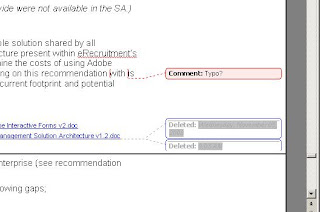 So what happened the other day that sent me over the edge... I was spinning around in the traditional document creation process and I was reviewing some changes and I came across this gem (see image). Somebody took the effort to make the comment that there was a typo. Now I can see the positive side of this in that the document quality was increasing but I couldn't believe the non-collaborative approach. My perspective was if this was in a wiki the typo would have been corrected by the first person to find it and the built-in wiki versioning would have captured the change event. The amount of cognitive cycles saved by only the finder making the change would have held big benefits. For I wouldn't be looking at it and thinking about it, the change would have been made at source of discovery. In my mind this is a micro example of the positive and cascading effects that using Agile and Web 2.0 approaches within architecture could have. Massively collaborate on developing the architecture as needed, let the technology and social media record the history and the tacit knowledge found in the related discussion.
 So what happened the other day that sent me over the edge... I was spinning around in the traditional document creation process and I was reviewing some changes and I came across this gem (see image). Somebody took the effort to make the comment that there was a typo. Now I can see the positive side of this in that the document quality was increasing but I couldn't believe the non-collaborative approach. My perspective was if this was in a wiki the typo would have been corrected by the first person to find it and the built-in wiki versioning would have captured the change event. The amount of cognitive cycles saved by only the finder making the change would have held big benefits. For I wouldn't be looking at it and thinking about it, the change would have been made at source of discovery. In my mind this is a micro example of the positive and cascading effects that using Agile and Web 2.0 approaches within architecture could have. Massively collaborate on developing the architecture as needed, let the technology and social media record the history and the tacit knowledge found in the related discussion.
Tuesday, November 18, 2008
Enterprise Architecture and Web 2.0
I'm going to be spending a fair bit of my time over the next while developing curriculum around how Web 2.0 technologies have become a required tool for enterprise architecture (EA). There are a number of influences to this newly formed realization;
- Agile (and nimble) approaches are becoming a must have for enterprise architecture.
- Documentation heavy approaches overly ritualize a process that can be duplicated and greatly improved by using wikis.
- The deep dive technical discussions that influence and describe architecture are better captured on video and with photos of the whiteboard.
- The best place for architecture should be embedded in the development culture. It cannot be mandated.
- Good enterprise architects are really hard to find. And most are attracted to emerging approaches and technologies. (there architects for god's sake)
- With all the belt tightening going on, architects need to be able to do more with less. [so get rid of the costly (and useless) rituals]
- a company, business, organization, or other purposeful endeavor; an undertaking or project, especially a daring and courageous one; a willingness to undertake new or risky projects; energy and initiative; an active participation in projects
en.wiktionary.org/wiki/enterprise - A system of business endeavor within a particular business environment. An enterprise architecture (EA) is a design for the arrangement and interoperation of business components (eg, policies, operations, infrastructure, information) that together make up the enterprise's means of operation. [ICH].
www.balancedscorecard.org
Monday, November 17, 2008
What do I do?
 I utilize Web 2.0 technologies to facilitate corporate learning, professional development and to support K12 students in developing connectivist learning skills. I encourage people to use the tools of social media and the resources from the internet cloud to capture knowledge both explicit and tacit. I believe these approaches to knowledge capture are beginning to extend the tools for Business Intelligence and Knowledge Management. I agree with Brown and Adler that understanding is socially constructed and that the Web 2.0 provides the participatory media to facilitate this social construction of understanding.
* This question is being posed as an exercise created from a previous post on this blog.
Saturday, November 15, 2008
Learning Environments (DIY)
I believe the concepts within these two images need to be thought about as anyone explores the use of Web 2.0 technologies for learning;
Progressive Inquiry

Personal Learning Environments

Progressive Inquiry

Personal Learning Environments

CMS Toolbox or Trap?
I like this article... It is part of the growing dialogue about using CMS for learning. And how they actually limit learning and course creation. Here are a couple of good quotes from the article;
the standardized nature of integrated commercial systems is limiting pedagogy.
Web 2.0 applications that encourage social construction of knowledge (Wikispaces, BubbleShare, Ning) are freely available and may provide more creative instructors with better options than any LMS currently available.
Who am I?
I'm a person who is enamored by Open Educational Resources (OERs) and free cultural works. I believe that utilizing web 2.0 and collaborative technologies is emerging to be the most effective approach to learning, life-long learning and professional development.
* This question is being posed as an exercise created from a previous post on this blog.
* This question is being posed as an exercise created from a previous post on this blog.
Friday, November 14, 2008
The Brand Gap
I came across this slideshare stack and felt it would be a good thing to look it through.
I came across three important questions;
I came across three important questions;
- Who are you?
- What do you do?
- Why does it matter?
- What are you?
- What lessons do you provide?
- Why do they matter?
Thursday, November 13, 2008
Commoncraft does a great job of explaining Web 2.0
Commoncraft really has created a good set of videos to understand the web 2.0 and all the related technologies. They also do a good job of keeping up with the new technologies as they mature and gain popularity.
Subscribe to:
Posts (Atom)