Showing posts with label ALD. Show all posts

Tuesday, July 23, 2013

The Self-Determined Learner

Most of what I do is toward deepening my abilities as a self-determined learner. I believe any adult learner can develop their own curriculum, attach accreditation to this curriculum and work towards the tasks and learning to fulfill the curriculum and earn the credentials. I believe we need to teach people to teach themselves, and these abilities should enter the education system at age fourteen (or grade 10). I believe these skills and knowledge can and do enter the education system earlier. The one big challenge is that teaching people to teach themselves is a big change from our current social order around education.

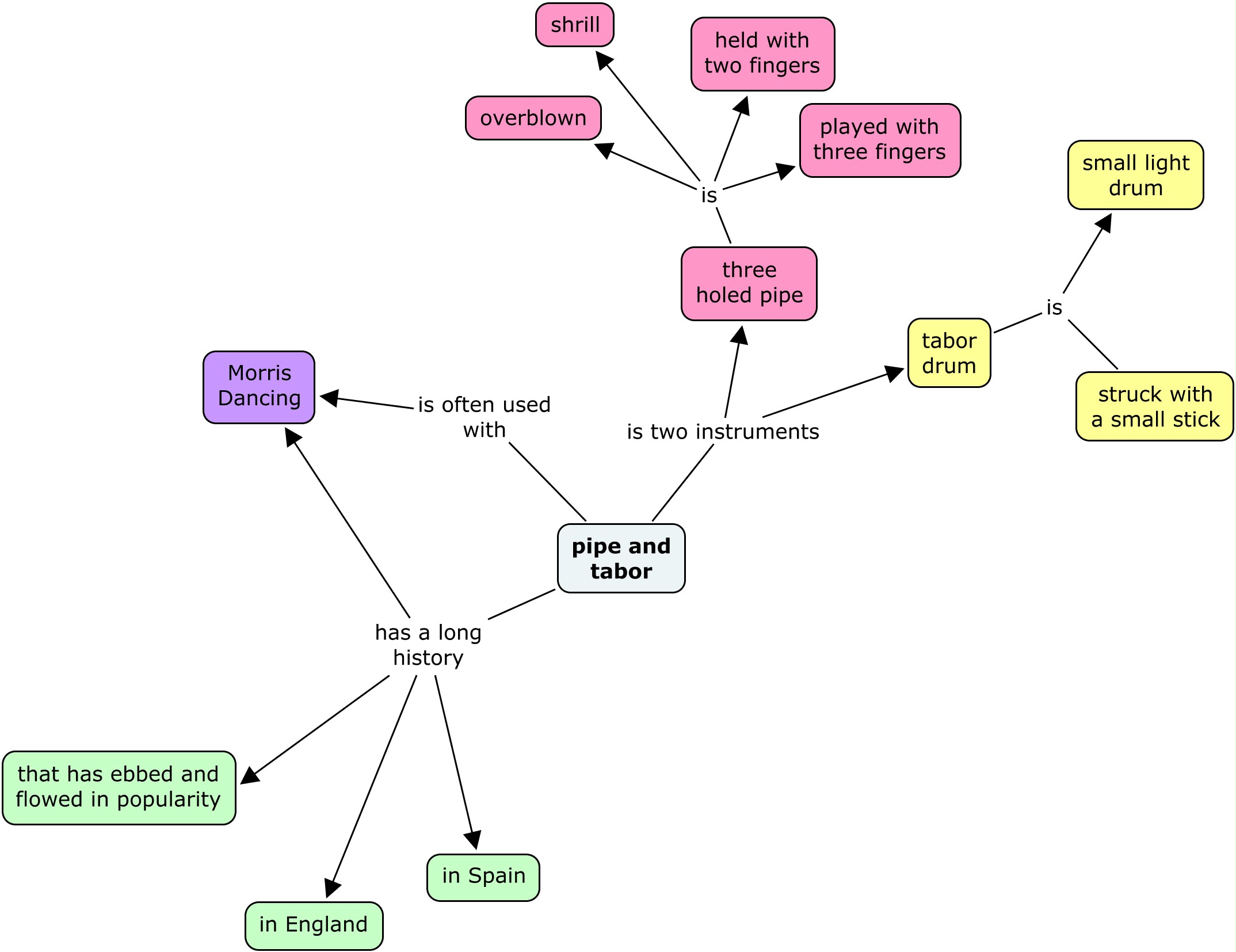
An example concept map: Learning to play the pipe and tabor.
My approach to self-determined learning has a number of basic steps
  1. Identify and commit to learning a subject domain
    And all this can start with a single word or picture written in the middle of a page. And all you have to do is start reading, researching, playing with and discussing this concept and move into step 2.
  2. Begin a creative project or concept map about the subject domain
    This where it becomes even fun, begin a creative project of some kind around the word or concept. As you learn more about your chosen subject domain through your research, reading, play and discussion, add to your creative project.
  3. Research (in detail) items or themes within the subject domain
    Identify words, concepts and themes that can be researched. Choose the ones that excite you the most, research these in detail. Invest considerable time and effort in this research.
  4. Add to your creative project or concept map as your understanding deepens
    Update your existing creative works, continue to build the concept maps and creative works. Write about your research (reflect upon all that you have done), create, publish, do your work in the open.
  5. Seek out peers and experts within your subject domain, engage these people
    Engage your learning community. Invest time in seeking out the communities of learning (both online and off), consider building your own community if ones don't exist. Seek mentorship, become a mentor.
  6. Build and utilize a personal learning ecology
    The personal learning ecology consists of the people and learning objects within reach. Connected learning works best when it is blended with learning and resources that can be found within close proximity (online , virtual and otherwise). Create and nurture your personal learning ecology.
  7. Build a personal curriculum map of how the subject would best be learned
    The personal curriculum map provides the map and learning pathways for your personalized learning journey. It is taking your concept map or creative work and identifying learning pathways and fitting them all into a personalized curriculum. This development of a personalized curriculum is an amazing way to deepen your understanding of your chosen subject.
  8. Reconcile and align your personal curriculum map with other existing curriculum
    To further deepen your understanding of your chosen subject domain try reconciling and aligning your personalized curriculum map with other related curriculum (institutional or otherwise). Other curriculum may not exactly match your personal curriculum map or your subject domain may not fall into a realm where curriculum has never been developed. This should keep you from trying an
  9. Create learning plans for items within your identified personal curriculum
    Choose items from within your personal curriculum to build learning plans. Always choose the item or items that interest you the most. Items may come in clusters, or they may stand alone. Create learning plans which describe the details and scope of the learning, make it all up if you have to, confirm it with existing learning plans. Include a schedule for your learning, make a commitment, put all this in your learning plan. If you are wondering how to create a learning plan, there are many references on the internet to help. You may even find that creating your own learning approach and related learning plan works best for you. This is how you will develop skills and approaches for how you learn best. You may even consider developing your own learning methodology, one that works best for you.
  10. Create badge systems that align with learning plans and the curriculum
    Once you have your first learning plan, be sure you have identified the learning objectives you are wanting to achieve with your learning. Be sure to describe identifiable criteria as on outcome of your learning. Publish your learning plans to the internet. Create an open badge for your learning and have the criteria linked to the badge. Invest some time in developing a badge system that is aligned with your personal curriculum.

    It may seem like a large investment of time and a lot of effort to create learning plans; The creation of these plans deepens your understanding of your chosen subject. This goes back to the idea; the best way to learn something is to have to teach it.

  11. Continuously engage your learning network, ask for feedback
    Whenever you create new learning plans or make updates to your concept map or create work, contact your learning network. Ask for feedback frequently and continuously. Be sure you have others review your learning plans and how they tie to your personal curriculum. Get feedback on your badge or badge system.
  12. Assist and provide feedback to others within the subject domain
    Practice reciprocity, engage your learning community by assisting others on their learning journeys. The more you help other who are learning similar subjects as yourself, the more you will learn about your own subject, the more you will get help.
  13. Complete learning tasks from your learning plans, earn badges
    Focus your efforts, keep to your schedule, complete tasks within your learning plans. Be sure to publish all the evidence you have in completing tasks. This evidence may come as short videos, published papers, songs, photographs, etc. Just do all you can to provide evidence of what you have done. Create blog posts about your learning and the steps you took to complete a task. Once you have gather together all your evidence of a completed task, added information about your learning journey, and summarized it all with a blog post; award yourself the related badge, or have another in your learning community award you the badge. Complete learning tasks and earn badges.
  14. Return to step 1. recommit to the subject domain, iterate. The completeness of your work will come through time and the learning will deepen and become more extensive with each iteration. Keep working on developing your learning, don't allow yourself to see this work as too much or have you stop because of effort. Small steps of progress and small iterations of learning are also very powerful through time. Life-long learning takes a life-time!
Note: an important part of this learning approach is to do it in the open. Being public and open helps others, increases the quality of your work, and deepens your own understanding.

Wednesday, July 10, 2013

Agile Learner Design

My focus on an Agile Learner Design methodology for creating and determining your own curriculum got a renewed focus over the past 18 months. It all started with my last post of 2011 where I revisited and summarized Agile Instructional Design. I have come to the conclusion that what I am doing isn't focused on instruction, but upon the self-directed learner. Therefore, what I am doing is developing an Agile Learner Design methodology, not an Agile Instructional Design methodology. An important distinction in the fundamental focus of the methodology. To build upon my last post of 2011 I kicked off the year by looking at some of the existing research and approaches to self-directed learning. And looked at some of the approaches that I would consider similar to ALD. I also considered some of the people and approaches within my inspired learner series of posts, because it is these inspired learners that drive me to further develop ALD. Listed below is a summary of Agile Learner Design implemented.

The Agile Learner Design (ALD) Methodology
ALD Reference Materials
ALD Examples and Inspirations

Thursday, March 07, 2013

Seven Billion Learners

Learning styles was a big part of my graduate studies. And since that time people increasingly shy away, from conversations about VAK (Visual, Auditory, and Kinesthetic) and other specific learning styles and how they should be applied. Mostly because the research has found that there is no significant difference in teaching to any particular learning style. Don't get me wrong, having a discussion with someone about how they learn and drawing upon previous research regarding learning styles is a great conversation to have. Any conversation that helps a person (or myself) understand how they learn is an important conversation for everyone.

Some background
I am currently involved in the Learn Creative Learning MOOC with MIT and P2Pu. We are into the fourth week and the theme of the readings is Big Powerful Ideas. The weekly readings are fantastic and really get into self-directed learning and how we learn as kids... etc., etc... please read for yourself;
The weekly reflection was to discuss a personal big idea. One that you could drive a life's work upon.

The powerful idea
My powerful idea has been building for years and is well articulated in the statement that there are seven billion learning styles. What I mean by this is that every person on the planet has their own personal learning style, and our learning and education systems need to be built around this. I come to this from a collection of personal understandings, supported by a whole bunch of research and proven theories;
  • Learning builds upon itself where people build knowing through sequential learning (cognitivism).
  • People construct knowledge (or learn) based on their previous knowledge. Sense is made by related current learning upon previous learning and experiences (constructivism).
  • People learn best by making things "outside" of the learning environment. Constructing things is important to deepening learning (constructionism).
  • The idea that people can learn things in many different ways, with many different approaches, with many different senses (learning styles).
  • Humans are social animals and learning is a social activity. All knowledge is connected via the objects or nodes within our lives (the objects are also our friends and social network) (connectivism)
  • People can be self-directed learners outside of the institution (Heutagogy or Autodidacticism)
The idea isn't that big or powerful?
Well if everyone has there own learning style then our education systems should focus on teaching people to identify and leverage their own personal learning style. People could be given the skills, knowledge and personalized approaches to learn whatever they want with an approach best suited to them. I believe we now have the knowledge, technology and openness to create learning environments that can be customized to each learner, and these learning environments will honour each persons learning style (all seven billion). I believe people have the ability to develop these skills and abilities, early in their lives, with focus toward their teen years for solidifying their personal approaches. So the big idea I continue to work toward is to inspire adult learners to recognize they can learn whatever they want (within reason) on their own with the support of the people and objects around them. And they don't have to go to school to do this. This doesn't mean school isn't a useful part of their personal learning environment.

How I am implementing the powerful idea?
  1. Develop an approach to inspire people to teach themselves. I call this Agile Learner Design (ALD), but in the end it is kinda my own personalized learning methodology. I believe everyone could also develop their own learning methodology. I believe ALD can be reused by others...
  2. Encourage people to map out their own learning journeys, and assist people in finding ways to travel on these journeys.
  3. Open up accreditation, and assessment will follow... I have believed that Open Access Accreditation is as important as Open Educational Resources. Digital and Open Badges are some of the initiatives that opens up accreditation. I am an active contributor to the digital and open badges movement.
  4. Be an example: I believe so much that people can teach themselves that I am wanting to serve as a documented example. I am involved with the Open and Networked PhD program, which endeavours to have people recognized (and accredited) in having a PhD level of knowing without having attended a traditional university to accomplish this goal. References to this journey, include;
  5. Blog extensively about my belief, activities, and learning journey.