Showing posts with label collective. Show all posts

Thursday, February 19, 2015

How does the network see your personal brand?

Branding is important. It provides an external (or public) theme for endeavours; business endeavours, professional endeavours, organizational endeavours. Personal branding has become increasingly important in the networked age where the communications technology (read: Internet) reduces the barriers to promote and communicate brand, even personal brand.

How klout perceives me... https://klout.com/prawsthorne

I have gone through my personal branding exercise a few times in the past, and what I now find most interesting is what the feedback loop in my network sees as my brand... when I traverse the keywords/themes that myself and Google+, LinkedIn, Klout, and other social media have tagged to my respective profiles I am left with the personal branding of; Technology, Architecture, and Education. And my network brands me much stronger in the technology and architecture realms than the educational. I know this branding assessment is somewhat a self-fulfilling prophecy as I have been the one who has joined the groups, followed and friended the people and organizations, blogged about subjects, added keywords, created profiles, contributed to discussions, attended events (online or otherwise), etc, etc... but there are also data analytics going into all this. So by giving a broad sweep over ALL my connections to the network and paying attention to the keywords getting bubbled to the top by the network and the related analytics should give you an idea of how the network sees you.

How my linkedin endorsers perceive me... 

Am I OK with this? Absolutely!

Having a brand of; Technology, Architecture and Education? Does my data analysed network perceive the brand I would like to be perceived with? Absolutely! Most of my professional life, over the last 15 years, has focused upon enterprise and solution architecture. I am a technologist first, with proven successes in architecture. I am also an educator with experience as college and university faculty with a number of technology projects in the edtech realm, where I have increased access to education using technology innovation and solid architectural approaches.

How do you create, alter, and promote your personal brand?

This is where it gets interesting. How do you create, alter, and promote your personal brand? This is what I believe are the steps toward branding yourself;
  1. What would you like to be? What is your personal brand? Create a vision for yourself.
  2. Be that person. Even if you are not there, yet, be that person as best you can given the real world constraints.
  3. Set up a Personal Learning Network (PLN) in the subject areas of your personal brand. Read, research, participate, engage, become.
  4. Also use traditional approaches to learning, this will also help with building expertise and grow your network.
  5. Write and engage with the social network, be broad with your use of tools. It is amazing what you can learn online with a well designed personal learning approach.
  6. Be very public with your learning. Also leverage your existing expertise and blog and engage. Curate wikipedia pages or other knowledge bases in your chosen subject area. 
  7. Wherever you participate be sure your personal profiles are up to date within that social media.
What if you are already an expert and have an established personal brand?
  1. Keep going. Engage the communities and social media, share your knowledge.
  2. Push your life-long learning, add to your personal knowledge. Write about your learning, it is one of the best ways to commit the new knowledge to long-term memory.
  3. Continue to curate your shared knowledge across knowledge bases.
  4. Be a guest blogger and seek out opportunities to write for popular sites.
  5. Participate in online learning forums and MOOCs.
  6. Don't forget that publishing is not only written. There are many ways to share; YouTube, Slideshare, Google Docs, Podcasts, etc... be sure to attach the correct keywords.
  7. Tweet, Message, Promote... all good.
What if you want to alter your personal brand?
  1. Saturate your network with the content (created and/or shared) aligned with your brand change.
  2. Be very public with your learning toward the brand change. 
  3. Publish your existing and growing expertise.
  4. Participate as broadly as possible.
  5. Find the related online communities, engage.
  6. Curate the subjects within your this new subject domain.
  7. Create and add valuable new content.


Tuesday, April 15, 2014

Virtual Community of Practice User Stories

I continue to explore the conundrum of "How do you build a Community of Practice in a closed environment where you can't reach out due to client confidentiality?" The background to this can be found in my previous post titled "Virtual Community of Practice Conundrum". In this post I list what I consider to be the user stories for this cross-boundary community of practice. The purpose of these stories is so we can design the technical infrastructure to facilitate such a community. But first we need to identify the community needs using non-technical terms.
User Roles
I see three primary user roles in which to base the user stories, these are;
  1. Steward - this role provides stewardship (and administration, when necessary) of the community. They are usually community members who mostly have an eye to keeping to community healthy and active. Sometimes they take on an administrative role when technical issues arise.
  2. Member - someone who participates by contributing and engaging with the community. This participation can come in many forms; leading discussions, adding rich media content, organizing companion face-to-face activities, speaking up and adding to discussion, linking to relevant and related materials, using the community hashtag, and consuming content from multiple devices.
  3. Lurker - someone who consumes the community content from many of their devices, yet never participates by contributing content. Don't underestimate the value of lurkers to your community!
User Stories
This is the set of user stories I have identified for the community of practice which crosses organizational boundaries while also honoring client confidentiality. Please feel free to add others as comments to this blog post...
  • As a member I want to participate in community discussion.
  • As a member I want to learn new things regarding the communities subject domain.
  • As a member I want a way to pull notifications.
  • As a member I want to be able to block notifications.
  • As a member I want to add content (text, images, video, presentations, etc) to the community.
  • As a member I want to link to external resources.
  • As a member I want to share openly without violating client confidentiality.
  • As a member I want a profile page or ability to link to a profile page so people can get to know me.
  • As a member I want to invite friends and peers to the community.
  • As a member I want a way to reach out to other members.
  • As a member I'd like multiple ways to participate (even face-to-face...)
  • As a lurker I want to view community content across all my devices.
  • As a lurker I want my read-only participation to remain anonymous.
  • As a lurker I want to have the ability to become a participating member.
  • As a lurker I'd like multiple ways to participate (even only a spectator)
  • As a steward I want a way to push notifications to community members.
  • As a steward I want to prevent confidential information entering the community.
  • As a steward I want to remove content and block members who are adding inappropriate content (ie. spam, adult content, sales information, self promotion).
  • As a steward I want to reduce internet trolls.
  • As a steward I want a common hashtag(s) for the community.

Monday, April 14, 2014

Virtual Community of Practice Conundrum

-- T L D R ----------------

What do you need to consider when building a Community of Practice (CoP) that spans organizational boundaries where client confidentiality needs to be honored. There are a plethora of things to be considered when building an online (virtual) community of practice, these include; the team and the contexts' relationship with openness, the memberships ability to be self-determined, how online communication will be broadened and followed, and how the internet is the platform.

----------------------------

How does a Community of Practice (CoP) steward itself across organizational boundaries? What are the requirements and restraints to successfully build a CoP when openness and confidentiality are in conflict with one another? What technology platforms support a closed virtual learning community but can integrate with a busy and confidential work-schedule? Can you leverage all the innovative social media technologies, which can be very well applied to learning (CoP), from a closed virtual community? This series of blog posts sets out to answer many of the questions... but first,

Some background
I've been building Communities of Practice (CoP) for over 10 years. It started during my M.Ed where I was bringing together 15 years of professional technology experience with 10 years of college level teaching and online learning. I now see my skills and knowledge being well applied with building large complex information technology systems and being a seasoned educational technologist. I also believe it is important to provide some of my personal background, beliefs, and experience on the subject of CoP. What I believe is particularly relevant to this post is my time spent with both open projects and corporate enterprise projects. These projects include; Mozilla, Mediawiki, WikiEducator, Wikiversity, P2Pu, Bowen eGovernment, UNESCO, Open Data, CLEBC, ICBC, Commonwealth of Learning, and other smaller projects. This experience has exposed me to open democracies, open spaces, open communities, open boards of directors, open, open, open. Where the sharing of information is crazy transparent and all meetings are open to everyone. This experience has also exposed me to large enterprises; closed, locked-down, proprietary, and obfuscated information exchanges. Having other people filter information is the standard practice in many of these other closed type organizations. My work has occurred at the extremes of both of these types of organizations, but also, much of my work has happened in the middle ground. From all this it is my belief that open communication is better than the alternative; particularly, when wanting to encourage learning or when building a community of practice. It is best to let employees be their own filters of information, and exchanging information helps everyone learn. The current and emerging pedagogical approaches also supports openness vs. closed. I believe it is important for learners working within a CoP to be able to reach out to the larger community and draw in resources from these other external communities.

Some history (or key technologies)
What do I consider the key information technologies and attributes of learning communities that have emerged over the last 20 years and have the biggest impact on virtual and online learning communities of practice?
  • Communities of Practice - obviously the work of Étienne Wenger is big here. The idea that "most learning does not take place with the master, it takes place among the apprentices" IMO is important to building a virtual learning community.
  • Open Approaches - Open Space, Open Leadership, Open Data, Open Etc... In my opinion, and experience, openness is very important to learning and in successfully building a community of practice. New people, new opinions, ongoing mentorship and peer learning needs to be refreshed. Without openness it becomes closed and stagnant. I have yet to experience a CoP that remains active beyond a year without having new people involved and ideas coming in from outside the group. Openness is key.
  • Autodidactism / Heutogogy - Participants in CoP need to be self-determined learners. This means you can just lurk in a community, at some point you need to participate. It is the internal commitment to learning in the subject domain that must come first. Then participation in the community becomes part of the self-determined learning. In my opinion this is one of the keys to a valuable CoP. The commitment level of the members.
  • Visual Communication - People need to share through a variety of mediums, this should not be restrained within the CoP. Often the results of a visual meeting (or otherwise) can be shared for record keeping, review and to prompt further discussion, etc...
  • Social Media - social media is not social learning, but it is important in building community and allowing people to participate online where they want and when they want.
  • Tagging - social tagging can be an excellent way to draw a community together by allowing members to share there learning and related reference materials across different social media platforms.
  • Platforms - having an online place to host the community is essential. But given a solid tagging approach this doesn't have to be a traditional platform, it could be the internet as a whole. What is important is that it is accessible by everyone - from everywhere, on any device. In the end, you need to consider the whole internet as the platform.
Some assumptions
Most learning occurs outside of traditional approaches, it occurs 24 hours a day, and is a continuous activity that includes (and should not be limited too) the use of open social media tools. A community of practice is social learning and is further enhanced with access to online and virtual communities. Blended learning is important, as face-to-face time (when available) should be encouraged. Even if the face time is among a sub-set of the community members.
Being a self-determined learner is important as it provides the intrinsic motivation to deepen the engagement within the CoP. It is a valid amount of participation to only lurk within the CoP, but there does come a point where members need to dive in and participate. Learning will be deeper and broader, but the motivation needs to be there. And most often for long term commitment to participate comes from an intrinsic motivation.

The conundrum
How do you build a Community of Practice in a closed environment where you can't reach out due to client confidentiality?

In the next post on this theme we will discuss the requirements of a community of practice where client confidentiality is key. The thinking being if we can correctly identify the requirements, we will then be able to identify a platform best suited to cross organizational boundaries.

Tuesday, November 05, 2013

Big data, winter reading and book reviews

Totally chuffed! I just lined up three books on big data and am looking forward to their being my winter tech reading and related book reviews. The theme for the collection of books is big data. I have been working with data (big and small) for all of my career, and my 1996 undergrad degree is in database management systems (DBMS). Recent projects have exposed me to big data, enterprise environments, global internet standards and open source deployments. A few years back I did a bunch of work with building online learning communities, mobile web and collective intelligence. I even found the time for a bunch of reading in the subject, and wrote reviews for the books I read. So with the acquisition of these three books I look forward to sharing my data experience through three book reviews. Stay tuned!

Data Science for Business - I particularly like how this book focuses on big data in the business environment, and how it relates it back to the traditional terms of data-mining and data-analytics. Its the business focus that really attracts me, event though I find myself with more of a socialist bent, I still see the value of competitive advantage, ROI, analytics feeding strategy, etc. This book looks to focus on all this, with the addition of the technical and algorithmic details of big data in the business environment.

Doing Data Science - I particularly like how this book focuses on the hands-on front line of data science. It has a great amount of focus on implementation and the use of the big data technologies and approaches, all of the keywords floating around in big data and present within this book. If you are thinking about Machine Learning, Naive Bayes, Modeling, MapReduce, Hadoop, etc. The number of case studies that are present in the book look to provide good reflective activities to deepen understanding.

Agile Data Science - I particularly like how this book brings together agile approaches, big data, analytics and hadoop. If you've been following my blog for any length of time you know my experiences and belief with agile approaches, so I am happy to see an agile approach to data emerging. I am also looking forward to how the following technologies are folded into the process of running an agile project for data science; SQL NoSQL, Apache Pig, MongoDB, ElasticSearch, GitHub, AWS, etc.


Tuesday, May 10, 2011

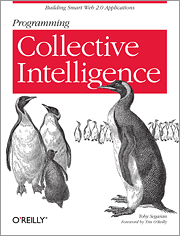
Book Review: Programming Collective Intelligence

I've been working my way through the book Programming Collective Intelligence; Building Smart Web 2.0 Applications by Toby Segaran. A very interesting read and I like the way the book tells the story of building collective intelligence into your applications. I was particularly impressed with the sample python algorithms and how grounded in theories and mathematical formula they were. Two that were used early in the book and referenced often were the Euclidean distance and Pearson correlation formula. Seeing both of these formula in code and put into the context of web 2.0 and social correlation was helpful in deepening my understanding of the math behind measuring collective intelligence.

I hesitated when I started reading the chapter describing search and how to build a search engine, I felt it was included just as filler for the book (a few chapters to add 100 pages or so). And I figured their are already too many books on how to build search engines. I am glad I pushed through, for once I started reading I began to see the point of describing and building a search engine. Descriptions (with source code) of how collective intelligence algorithms can be integrated into search were introduced. This is a huge and important topic when you think about social search and the use of the social graph is contributing and impact collective intelligence could have on search.

The next few chapters get into programming many aspects of collective intelligence using API's, existing data services and open source to get you to completed more quickly. The sections and code of most interest to me are within the social graph, making intelligent decisions for and about groups of people, utilizing data sets, decision trees and other intelligent services via programmable API's. Particularly important in these programming focused chapters were the examples and end of chapter exercises, working through these exercises provide the hands on experience to deepen understanding.

As I got into the later chapters I began to realize just how comprehensive the coverage of programming collective intelligence the book provides. I was particularly interested in the support vector machine and genetic programming. Even, though I do not commonly find myself programming in any depth I found the descriptions of these rather heady subjects well described and easy to understand. I also appreciated the closing chapters of the book where a review of the different algorithms is provided, how they are best utilized and their strengths and weaknesses. References to all the third party libraries was put into a single appendix as were all the mathematical formula.

Going through this book cover to cover, reading the examples and diving into a few (or all) of the exercises gives the reader a very good understanding of how much data and intelligent services are already available via API's on the Internet. Programming against these services and creating new services is a big part of the Internet as a research, knowledge and learning environment. Anyone interested in developing these new services, consuming these existing ones or interested in the mathematics behind collective intelligence, I strongly recommend this book.

Tuesday, April 05, 2011

Rackspace Step 4.0: The Mail Server

Setting up the mail server is the most important of steps. Not to say that securing the server and installing Apache, MySQL and PhP isn't important, it's just that a mail server set up incorrectly can become a spam server. A spam server can have a negative impact on other people; where the other servers (Apache, MySQL and PhP), incorrectly setup, mostly have a negative impact on yourself. This is why I believe correct setup of the mail server is so important. Doing a lot of reading around this is important. The following is a good list of sites and pages to read as you become more familiar with setting up a Mail Server. After having read through all these sites and a few others, I would recommend the Mail Server - Overview from rackspace.
  1. http://cloudservers.rackspacecloud.com/index.php/Mail_Server_-_Overview
  2. https://help.ubuntu.com/community/MailServer
  3. http://articles.slicehost.com/2010/3/1/barebones-postfix-install-for-ubuntu 
  4. https://help.ubuntu.com/community/PostfixBasicSetupHowto
  5. https://help.ubuntu.com/community/Postfix
I see all this reading, research and private study as step 4.0 of the mail server setup, step 4.1 describes the architecture of my mail server configuration due to it only needing to forward mail and not provide client access, step 4.2 will get into the actual process of installing, configuring and securing the mail server. I had a chat with rackspace technical support last night as I was considering using their email and apps service. After describing my need of just a few email addresses from a few of my domains all redirected to respective gmail accounts it still seems like the best idea is to setup postfix (and related mail services) on my own server. Designing / Architecting the best mail server solution is the thrust of this 4.0 step.

    Wednesday, February 16, 2011

    Polling widgets in blogger

    If you use blogger adding a poll to your blog is easy. And the way it is implemented allows polls to be associated with the whole blog or just a single post. The same poll can be used in multiple posts while the poll results stay the same.

    This can be done by adding the poll gadget to your blog from the blog design mode. While creating the poll take note of the title as you will use this to find the poll in your blogs source code.


    Once you have added the poll to your blog you will need to view the source code and find the iframe that contains the poll. The code for the poll will look something like what is displayed below, what you are after is within the iframe tags. The important part is the display number as this identifies your particular poll, in this example it is "1642576544783516899". So you can display the poll in any post as long as you use the same iframe syntax and the id number refers back to the poll as stored in blogger.

    <h2 class='title'>The fat cat sat on the </h2>
    <div class='widget-content' id='widget-content'>
    <iframe allowtransparency='true' frameborder='0' height='180' name='poll-widget1642576544783516899' src='http://www.google.com/reviews/polls/display/1642576544783516899/blogger_template/run_app?txtclr=%23634320&lnkclr=%23e2a059&chrtclr=%23e2a059&font=normal+normal+100%25+Helvetica%2CArial%2CVerdana%2C%27Trebuchet+MS%27%2C+Sans-serif&hideq=true&purl=http%3A%2F%2Fcriticaltechnology.blogspot.com%2F' style='border:none; width:100%;'></iframe>

    If you no longer want the poll displayed as a gadget on you blog page (but still within the post) you can delete it from within blogs design mode and the poll will still remain in the blog post. This is due to the id number.

    Sunday, January 30, 2011

    My changing tagging strategy

    There are five main themes to the work I will be doing while completing my OpenPhd. And each of these themes need to be tagged so they can be referenced by myself and others. The five tags I will use with be;

    Why would someone want to follow these tags?

    1. they are a follower or contributor to the open phd movement (yes, I'm calling it a movement)
    2. they are a solutions architect, systems architect or enterprise architect or aspiring to be any of these roles and want to learn more or have another view on architectural issues.
    3. they are a business person wanting to gain a greater understanding of technology architecture, business processes, the vocabulary and best practices within this realm.
    4. they are a learning systems architect or educational technologist or aspiring to be either of these roles and want to learn more or have another view on architectural issues.

    Saturday, January 29, 2011

    Home bases and Outposts

    Recently I have been thinking about how social media and hosted content relate to the organization, a companies internet presence and personal projects. This has come up for two reasons; 1. thinking about the brand and community building for a client and 2. because I have started my OpenPhD. What's important is where the content gets hosted within these realms; do you have it on a company or personal website that you are in control? Or do you put it on a shared service like facebook, wikipedia, blogger, etc... This decision is well articulated in the idea of home bases and outposts.


    For organizations / companies the home base is important so you don't lose control over your content and your brand. Content stored elsewhere can be moved, more easily copied and deleted. The policies around your content are not yours, they are the policies from the shared service. Putting content on the shared service makes sense when you are wanting to attract attention and drive traffic back to your own site. Usually, the content put on the shared service is a copy of what you have stored on your own site(s). Essentially the outposts attract attention and drive traffic back to your business (or home base).

    For myself attempting the significant endeavour of an OpenPhD needs to have an online presence I have control over the content, how it is referenced and the ability to add and alter the software features around my content. This was apparent when I wanted to use delicious to bookmark my readings and references but couldn't reference delicious bookmarks in my Wikiversity profile due to the platform not supporting JavaScript. So, in the end I will build up my personal website to be my home base and refer to all other locations as outposts.