Thursday, October 24, 2013

A call to others and my 5 professional personas

Atlantic Canada
The call: if you are interested in collaborating with the growth of the Atlantic Canada IT architecture community, please reach-out to me. I look forward to connecting with others who are already building Atlantic Canada's IT community. Let's build Atlantic Canada into one of the planets best places to bring technology projects!

A little about me and my current professional focus: (I hope this encourages you to connect)
As my journey to settling in as an exemplary IT professional in St. John's NL continues, I find my focus deepens in how I can best assist the Atlantic Canada IT sector. As I continue to utilize my experience within enterprise environments and in management and team lead positions, I believe my hands-on technical skills are where I can be of best assistance. Where I used to see my technical skills as a part of my enterprise architect toolkit, I am flipping this around to see my enterprise skills as a part of my database designer / technical lead / project manager toolkit. In other words, I can provide great assistance with the technical side of getting projects finished and if you need some strategic or enterprise assistance I can also help out within that capacity. The five main roles I can see myself most effective, are as follows;
  1. Database Administrator / Data Architect with 20 years experience in database design, implementation and administration.
  2. Solution Architect / Senior Software Developer with considerable industry experience in Microsoft Technologies, Open Source, and their integration.
  3. Technical and Team Lead with experience leading small to medium size teams to on-time on-budget, within technically challenging projects.
  4. Project Manager / Manager of IT with experience in managing all attributes of IT focused multi-stakeholder projects.
  5. Faculty and Online Educator with 15 years part-time experience teaching in colleges and universities. My teaching role has included online, face-to-face, and blended approaches. My work as a teacher has also included being the instructional designer for many online courses.
My next steps are to continue to provide exemplary IT consulting services while focusing on assisting the growth of the technology architecture community within Atlantic Canada. 

Wednesday, September 18, 2013

Defense in Depth within the Enterprise

A Technical and Solution Architecture perspective at implementing Defense in Depth within the Enterprise and Large Organizations.

I'm preparing a slide deck for my coming lightning talk on Defense in Depth within the Enterprise. The theme of the talk is what to expect when introducing a defense in depth approach into existing enterprise environments and how to respond to the issues that will arise from many different stakeholders. My reference points for this talk are from two primary enterprise level clients and a collection of smaller internet facing projects. As a solution or technical architect my perspective is mostly toward protecting personal information and how to design the solution to reduce the opportunity for an information security breach.

http://technet.microsoft.com/en-us/library/cc512681.aspx
The AGENDA:
My talk is limited to 20 minutes so I need to cover a lot of ground fairly quickly. Being succinct is my strategy to completeness.
  1. Description of Defense in Depth
    A brief description of the Defense in Depth security strategy. This is mostly to confirm understanding, set the shared vocabulary, and define the terms.
  2. Defense in Depth within the Enterprise
    Provide a holistic view of Defense in Depth within the enterprise environment, while also providing examples of implemented solution architectures. A technical and solution architect perspective will be used in this review. The talk wants to focus more on the how-to rather that the strategic.
  3. Issues toward implementation
    There are a plethora of issues that can arise when implementing defense in depth into the enterprise environment. These are not only technical and security related, but also operational and administrative or related to governance and compliance.
  4. Getting to finished
    Given the plethora of issues and their related stakeholders (sometimes tasked with conflicting missions), it is possible to find agreement on the architectural decisions required to deploy a defense in depth approach. During this talk I will discuss approaches to reaching agreement, and provide a few project examples of how we got to finished with resolving different issues.
If you are interested in attending this talk feel free to join us at our St. John's BSides event on October 18th.

Monday, September 16, 2013

Shepparding multi-stakeholder architectural decisions

What fun. I recently moved with my Family from an island off the west coast of Canada to as far east as you can get in North America; St. John's, Newfoundland. One of the benefits of this is I can become more involved in the technology community. My previous island life made it prohibitive to participate in social and technology events in the city. Now that I can participate, I will.

St. John's has a number of technology conferences (or events) in the fall. And one of these is aligned with the bsides security conference. I decided to participate by proposing a lightning talk, fortunately my talk was selected... what fun. The title and abstract of my talk is as follows; and will allow me to discuss my experience with shepparding multi-stakeholder architectural decisions to agreement.

Title: Defence in Depth: Approaches and Importance of Enterprise Architecture Security Decisions
Abstract: In this lightning talk we will explore one approach to getting multi-stakeholder agreement on Enterprise Architecture decisions focused on a defence in depth security model. Corporate enterprise technology environments can be large and complicated. And when it comes to making changes to the internet facing security environment both rigorousness and resistance to change increase. These increased challenges can be overcome with good project / process management, solid end-to-end architecture, and a comprehensive decision making template. In a nutshell, this talk explores the enterprise architecture decision.

Defence in depth is an age old practice.

Fortunately, over the last 15 years many of the projects I have worked on were internet facing and had security and privacy issues baked into the project. The bigger the project the more technical stakeholders were involved in designing, building and deploying the solution(s). utilizing all these technical people can make for a stronger and more comprehensive and well engineered solution. Coming to agreement across all the stakeholders can be difficult, for they sometimes have opposing tasks and responsibilities that are counter to another. With good process and a strong engineering mindset it is possible to find the common ground and build a solution where all stakeholders technical constraints can be met. This talk explores this process in the context of altering an existing network infrastructure and related governance groups to deepen defence in depth approaches to enterprise security.


Saturday, July 27, 2013

My curriculum models chapter proposal

I was asked to submit a chapter proposal into a coming book focused upon "Open Learning and Formal Credentialing in Higher Education: Curriculum Models and Institutional Policies." The writing of this chapter fits very well into my OnPhD work; in particular, my skills and knowledge development and my increased commitment to publishing my work.

Curriculum models that incorporate credentials for open and lifelong learning
My understanding of open is that anyone can gain entry; like an open door. Openness also means there is no barrier, other than identifying yourself. Even then, you may still enter a truly open space anonymously. This means that an open environment has no fee for entry and no security guard checking you on the way in. I believe open learning is no different, people should be able to learn wherever, whenever, with any and all resources (copyrighted or otherwise) they choose. Having a more knowledgeable and skilled population, makes open learning good for all communities, regions, countries, and the planet as a whole.
I believe life-long learning encourages people to acknowledge that they will learn for their whole lives. People need to commit to learning new things to assist and encourage them in being better friends, neighbors, community members, employees, bosses and more engaged in their own lives. Life-long learning encourages people to pursue life-long passions and interests.
Given this understanding of open and the belief in life-long learning, people should drive toward entering into their own learning with reckless abandon with a disregard for conventional restraints toward accessing the people, materials and resources available for their learning. Life-long learners should be bold and create their own personal curriculum and attach open credentials to their learning whenever milestones are achieved within their learning journey.
This book chapter will explore a model for mapping out a personalized curriculum, creating learning plans and attaching digital badges into this curriculum and learning plans. The topic of focus for this chapter will be "Curriculum models that incorporate credentials for open and lifelong learning". The curriculum development model it will follow is described in this blogs previous post titled "The self-determined learner".

A growing list of references for the writing of this book chapter are;

Tuesday, July 23, 2013

The Self-Determined Learner

Most of what I do is toward deepening my abilities as a self-determined learner. I believe any adult learner can develop their own curriculum, attach accreditation to this curriculum and work towards the tasks and learning to fulfill the curriculum and earn the credentials. I believe we need to teach people to teach themselves, and these abilities should enter the education system at age fourteen (or grade 10). I believe these skills and knowledge can and do enter the education system earlier. The one big challenge is that teaching people to teach themselves is a big change from our current social order around education.

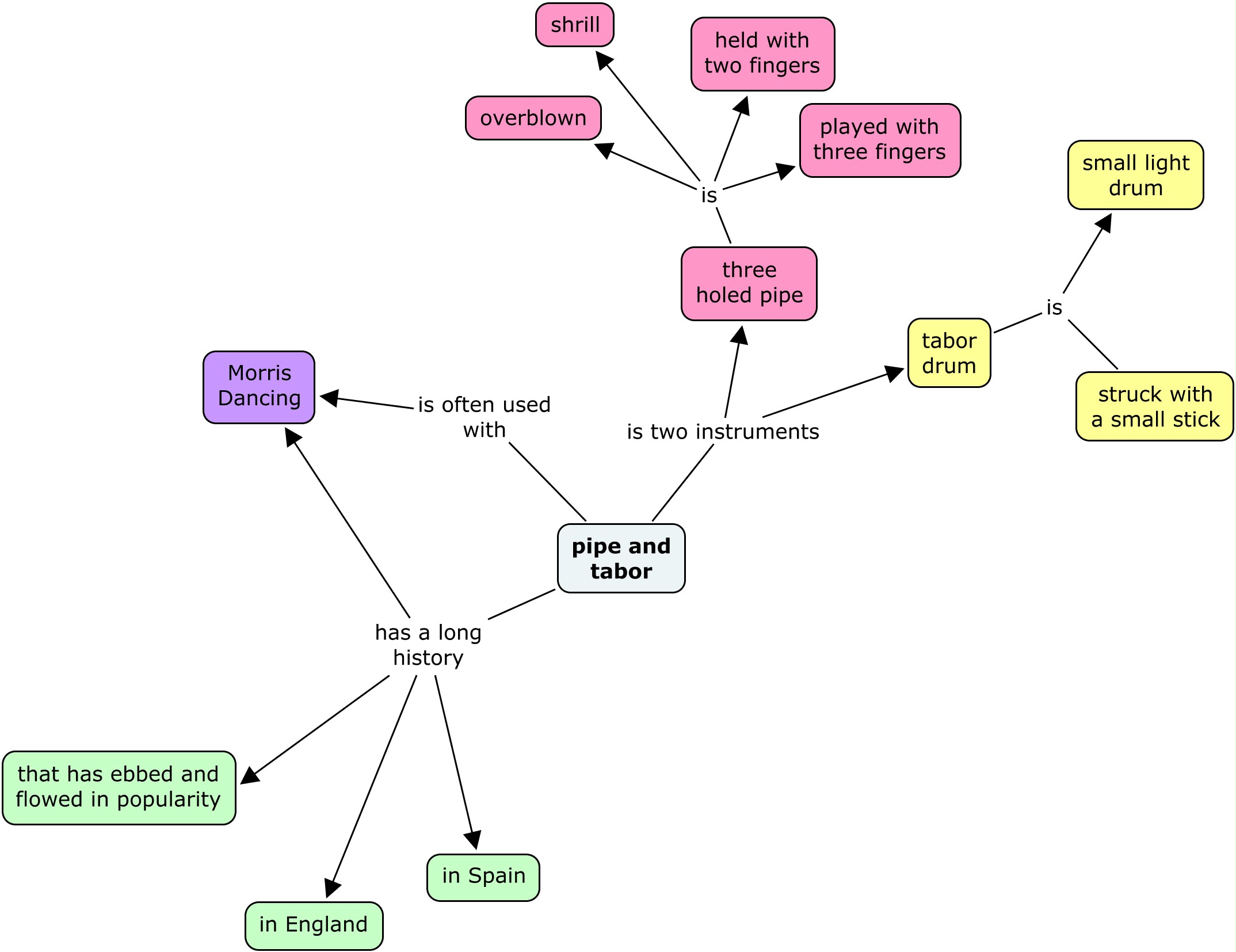
An example concept map: Learning to play the pipe and tabor.
My approach to self-determined learning has a number of basic steps
  1. Identify and commit to learning a subject domain
    And all this can start with a single word or picture written in the middle of a page. And all you have to do is start reading, researching, playing with and discussing this concept and move into step 2.
  2. Begin a creative project or concept map about the subject domain
    This where it becomes even fun, begin a creative project of some kind around the word or concept. As you learn more about your chosen subject domain through your research, reading, play and discussion, add to your creative project.
  3. Research (in detail) items or themes within the subject domain
    Identify words, concepts and themes that can be researched. Choose the ones that excite you the most, research these in detail. Invest considerable time and effort in this research.
  4. Add to your creative project or concept map as your understanding deepens
    Update your existing creative works, continue to build the concept maps and creative works. Write about your research (reflect upon all that you have done), create, publish, do your work in the open.
  5. Seek out peers and experts within your subject domain, engage these people
    Engage your learning community. Invest time in seeking out the communities of learning (both online and off), consider building your own community if ones don't exist. Seek mentorship, become a mentor.
  6. Build and utilize a personal learning ecology
    The personal learning ecology consists of the people and learning objects within reach. Connected learning works best when it is blended with learning and resources that can be found within close proximity (online , virtual and otherwise). Create and nurture your personal learning ecology.
  7. Build a personal curriculum map of how the subject would best be learned
    The personal curriculum map provides the map and learning pathways for your personalized learning journey. It is taking your concept map or creative work and identifying learning pathways and fitting them all into a personalized curriculum. This development of a personalized curriculum is an amazing way to deepen your understanding of your chosen subject.
  8. Reconcile and align your personal curriculum map with other existing curriculum
    To further deepen your understanding of your chosen subject domain try reconciling and aligning your personalized curriculum map with other related curriculum (institutional or otherwise). Other curriculum may not exactly match your personal curriculum map or your subject domain may not fall into a realm where curriculum has never been developed. This should keep you from trying an
  9. Create learning plans for items within your identified personal curriculum
    Choose items from within your personal curriculum to build learning plans. Always choose the item or items that interest you the most. Items may come in clusters, or they may stand alone. Create learning plans which describe the details and scope of the learning, make it all up if you have to, confirm it with existing learning plans. Include a schedule for your learning, make a commitment, put all this in your learning plan. If you are wondering how to create a learning plan, there are many references on the internet to help. You may even find that creating your own learning approach and related learning plan works best for you. This is how you will develop skills and approaches for how you learn best. You may even consider developing your own learning methodology, one that works best for you.
  10. Create badge systems that align with learning plans and the curriculum
    Once you have your first learning plan, be sure you have identified the learning objectives you are wanting to achieve with your learning. Be sure to describe identifiable criteria as on outcome of your learning. Publish your learning plans to the internet. Create an open badge for your learning and have the criteria linked to the badge. Invest some time in developing a badge system that is aligned with your personal curriculum.

    It may seem like a large investment of time and a lot of effort to create learning plans; The creation of these plans deepens your understanding of your chosen subject. This goes back to the idea; the best way to learn something is to have to teach it.

  11. Continuously engage your learning network, ask for feedback
    Whenever you create new learning plans or make updates to your concept map or create work, contact your learning network. Ask for feedback frequently and continuously. Be sure you have others review your learning plans and how they tie to your personal curriculum. Get feedback on your badge or badge system.
  12. Assist and provide feedback to others within the subject domain
    Practice reciprocity, engage your learning community by assisting others on their learning journeys. The more you help other who are learning similar subjects as yourself, the more you will learn about your own subject, the more you will get help.
  13. Complete learning tasks from your learning plans, earn badges
    Focus your efforts, keep to your schedule, complete tasks within your learning plans. Be sure to publish all the evidence you have in completing tasks. This evidence may come as short videos, published papers, songs, photographs, etc. Just do all you can to provide evidence of what you have done. Create blog posts about your learning and the steps you took to complete a task. Once you have gather together all your evidence of a completed task, added information about your learning journey, and summarized it all with a blog post; award yourself the related badge, or have another in your learning community award you the badge. Complete learning tasks and earn badges.
  14. Return to step 1. recommit to the subject domain, iterate. The completeness of your work will come through time and the learning will deepen and become more extensive with each iteration. Keep working on developing your learning, don't allow yourself to see this work as too much or have you stop because of effort. Small steps of progress and small iterations of learning are also very powerful through time. Life-long learning takes a life-time!
Note: an important part of this learning approach is to do it in the open. Being public and open helps others, increases the quality of your work, and deepens your own understanding.

Tuesday, July 16, 2013

auto-delete all email

My life has offered me an opportunity to go off the digital grid for an extended period of time; five weeks, or 36 days to be exact. On July 27th I fly to Calgary to join my Family as we move from Vancouver, BC to St. John's NL. On August 31st I arrive in St. John's to start a new life adventure.

How I define off the digital grid:
  • No social media - No Google+, No facebook, No linkedIn, No Twitter! Essentially, I never open a browser on any device. I will post a status update to my being off the grid, so people know to contact me on or after September 1st.
  • No email -I will not check my email ever, on any device. I will set-up an out of the office notice, and I'm going one step further; I will auto-delete all my incoming email.
  • No browsing - The only reason I will ever open a browser is to research travel details, book accommodations, or to get further information regarding a site we will be visiting. If I need to leave contact details with a booking or something, I will use my cell phone number.
Why I am auto-deleting my email?

Because I don't think there is anything so important that could be in an email. Most important information in my life is face to face or a voice conversation. But why auto-delete and not read my email when I am back on-line? Because its the past... its forever gone. If something matters to someone so much and it can't wait a few weeks, they can call me or send me a text. I also want not to have a a massive email box to go through at the beginning of September, and I don't want the possibility of thinking about the build-up of email and think about getting a jump on emptying the email box at any point in my vacation.

The morning we departed Bowen Island
I believe this gets into a conversation about mindfulness and being present. As I grow older I find that being present within a situation provides the most success for everyone involved. What I mean by present is I am not distracted by tasks and/or information from another context or situation.This holds true for when I am with my children, being with my spouse or family, when I am at work, and just going through my day. So really, why should I be concerned about an email that was sent a few weeks back. In a way, all email is spam.

What is my fear? Well not really...

That I will miss an email that is really important. If it is important they can call me or send a text. What about a work opportunity or a life opportunity that I will regret having missed. Honestly, I don't believe that these kind of opportunities come from a single unsolicited email. If it is important, it needs to be important to all involved, and therefore the others involved will honour my vacation and get back to me in September. If the opportunity is gone, then it wasn't an opportunity that would have interested me.

What is my preparation?

The two weeks leading up to my going off-line I will make status updates across all my social media, so people know of my being unresponsive. And if they want to contact me before my departure they are given an opportunity.

Why am I doing this?

Because I have five weeks with my wife and children, and I want to enjoy every moment. I don't want to find myself wondering off into some other context or perceived obligation. I don't want to be distracted by something other than exploring the amazing country of Canada, every moment. I don't want to miss something in my immediate proximity by an information thread from somewhere else. I also want to read a few paperback books... which has eluded me over the last while. I want to play in the immediate and enjoy all that my five senses have to offer. I believe all this will be more available without a digital connection to my past or my future.

Thursday, July 11, 2013

Assignments, Assessment and Badges

I was asked to quickly put some video resources together to provide an overview of my work with assignments, assessment and open badges. There is a day-long conference happening at La Trobe University in Bundoora and given I enjoy putting together resources for the work I am doing toward open education I was happy to take the time.

Deep apology for the quality of these resources. The moving trucks come tomorrow and I'm down to working off my five year old netbook. All these resources are issued with a CC-BY so feel free to use them as you will; edit them, mash them up. I believe these three videos cover the why, what and how of assignments, peer assessment and open badges.

Open Badges and Peer Assessment
Quick discussion of open badges, their meta-data and how they can be utilised within courses where peer assessment is a part of overall assessment.


Flipped Assessment
Flipped assessment has people earlier in a learning journey assess the work of someone further down the learning journey. This creates an environment where people currently involved with a subject reach-out to assist others who are also involved. This encourages peer involvement and adds to assessment.


Flipped Assessment Implemented
So this is what we did to implement flipped assessment and how the assessment criteria was grounded in the rubric that the course was based upon.


Relevant References


Creative Commons Licence
This post is licensed under a Creative Commons Attribution 2.0 Canada License.

Wednesday, July 10, 2013

Agile Learner Design

My focus on an Agile Learner Design methodology for creating and determining your own curriculum got a renewed focus over the past 18 months. It all started with my last post of 2011 where I revisited and summarized Agile Instructional Design. I have come to the conclusion that what I am doing isn't focused on instruction, but upon the self-directed learner. Therefore, what I am doing is developing an Agile Learner Design methodology, not an Agile Instructional Design methodology. An important distinction in the fundamental focus of the methodology. To build upon my last post of 2011 I kicked off the year by looking at some of the existing research and approaches to self-directed learning. And looked at some of the approaches that I would consider similar to ALD. I also considered some of the people and approaches within my inspired learner series of posts, because it is these inspired learners that drive me to further develop ALD. Listed below is a summary of Agile Learner Design implemented.

The Agile Learner Design (ALD) Methodology
ALD Reference Materials
ALD Examples and Inspirations

Tuesday, July 09, 2013

OnPhD: Skill and Knowledge Development

What areas do I want, and need, to deepen my skills and knowledge in relation to my identified areas of study? These areas fall into three domains; Heutagogy, Educational Technology, and Solution Architecture.  With each identified item I will include a brief description of how skills and knowledge will be developed. The completion of this activity is to fulfill the requirements of the related OnPhD candidacy task.

Heutagogy
  • Deepen my involvement with the Heutagogy community
    This will involve my engaging the communities of practice in and around heutagogy and autodidactism.
  • Read extensively about heutagogy and autodidactism (readings list)
  • Write about my approaches to self-determined learning (publish in the open)
Educational Technology
  • Continue development of School of Badges and focus my efforts on Badge System Design and the technical courses on integrating Open Badges with open source learning platforms (Drupal, Moodle, Wordpress, MediaWiki, etc)
  • Deepen my technical understanding (from a solutions architecture perspective) of available open source learning platforms and approaches.
  • Keep learning about Open Badges technology including alternative methods of assessment an accreditation.
  • Investigate and develop mobile learning applications with particular focus on video.
Solution Architecture

Tuesday, June 25, 2013

Badge System Design Reboot

So four weeks back I kicked off the Badge System Design course within the school of badges. We had some outstanding participants and introductions. The related discussions were thought provoking, but like many free and on-line courses participation falls off after the first few weeks. This course has been no different, and the learning was deep (at least for me, and I hope a few others). As the course designer, three main themes came from this past four weeks;
  1. the rubric designed as the foundation of the course needs to be broken into three rubrics, collectively still being the foundation. And also offering rubrics to what I now see as the three main types of badge systems.
    • for traditional education
    • for informal learning
    • for events and community
  2. the webmaker badge system should be used as the example badge system for the sample solution within the course.
  3. the first release of many things get thrown away always. This also applies to course development.
Even though the course had strong participation at the beginning and fell off quickly, I still it as a very important course. The success of open badges is dependent upon people developing skills in badge system design, and any way I can assist in this effort is time well spent. This is how I see rebooting the Badge System Design course.
  1. Create a schoolofbadges google group which will be used as a shared discussion forum for all courses within the School of Badges.
  2. Create three new badge system design rubrics, one for each of the three identified badge system design realms.
  3. Invite others to assist in the development of the three different rubrics
  4. reach out to people who have developed badge systems in each of the areas and ask for participation, assistance, and insights
  5. Alter the P2Pu Badge System Design course to utilize the three different rubrics
  6. Try running the course again in the fall of 2013

Tuesday, June 18, 2013

Three badge system design domains

The ultimate autodidact.
I've been on this badge system design journey for a while. I've been engaged with the Open Badges movement for over a year, with daily thoughts and efforts in moving this initiative forward. My commitment Open Access Accreditation (Open Badges) started five years ago during a discussion about Open Educational Resources. Recently my efforts have been in building the School of Badges on the P2Pu, with particular focus on Badge System Design. I am basing all of this design work on the things I learned while working with the open badges team and the success of a similar workshop with Scope the end of last year. When I started to build the P2Pu course it became apparent that we needed a badge system design "tool" or approach to base the course around. I came up with the idea of creating a rubric as a guide to building badge systems. The idea met with a good amount of success and a small group iterated around its development over a couple of months. The previous link shows our results. One aspect of the rubric that I have struggled with is how it was being influenced by traditional methods of curriculum development and accreditation, or that the rubric was trying to work for many different badging contexts. It seemed we were trying to build a single rubric for all badge system design domains. Too me it felt strained...

This morning during discussion within the P2Pu Badge System Design course I came to the realization that there are three domains for badge system design. These three domains are;
  1. Badge System Design for traditional curriculum
    This is really a mapping of existing curriculum to badges with the addition of co-curricular activities. There is a lot of room for innovation here, in the end all badges are associated with traditional education and related activities. The traditional could also include badges within scouting organizations or other legacy based institutions that have been issuing merit badges for a period of time before digital and open badges.
  2. Badge System Design for informal learning
    This is learning outside of the traditional curriculum. In particular, self-directed learners, autodidacts, heutagogues, and small groups engaged in informal learning. This is where people have the opportunity to develop their own badge systems.
  3. Badge System Design for events and community
    This is everything else where you would want to issue badges; participation in conferences, recognition for involvement with communities, accomplishments of merit, fun activities where tasks or activities have been achieved or participated in, this list could be anything that could be dreamed up where a badge could be issued.
The hacker scouts have brought together the tradition of scouting, with the freedom of the hacker community, the resources of adafruit, the venue and innovation of the maker movement, with open badges. This image is the hacker scouts badge system design.

Thursday, June 13, 2013

Quick issuing and organization of Badges

Working through some of the comments within the Quick Issuing course within the P2Pu School of Badges. One discussion item prompted me to answer a bunch of questions that I believe are really important. These are the questions and related answers;

Are all my badges tiered?
No not all my badges or tiered. I do believe some of my arrangements are a star or a network. I do think badge organization should follow the organization of the knowledge domain. I do think it would be more of a network of related subjects, skills, events... that as they are earned would form clusters or groupings. I organized as a tiered approach for I was wanting to relate the categorization like the color scheme of the martial arts belt system.

I do believe the work Mozilla has been doing around badge system design is excellent and I believe they are wanting to stay away from the tiered or hierarchical approach. But I do think many humans organize in hierarchies...
Mozilla Webmaker is also becoming the exemplary badge system design. Kudo's for creating a great example!

Do I create a table for all my badges, or just tiered badges?
No, I don't create a table for all my badge systems. I do believe it is important to provide some way to organize, display and describe the badge system. A table is one way... and due to my using wikiversity for the mobile app dev course, the table seemed like the best way to go.

Do I have a giant table for all badges in one course?
I don't see creating one giant table to describe all the badges. There does need to be some way of describing the badge system as a whole. I believe it would help people understand the learning pathways within the badge system if there was a "curriculum" or "learning journey" map. I do see that Mozilla Webmaker is doing great work here as an example. See Erin Knights post; http://erinknight.com/post/29830945702/webmaker-badges
I also see the badge system and approach created by the Khan academy is also an interesting example of displaying a whole badge system.

Wednesday, June 12, 2013

Badge System Design Performance Levels

It was suggested I add descriptions for each performance level within the Badge System Design rubric. This is what I came up with...
  • Exemplary
    The example for an outstanding badge system. Badge systems should aspire to be as comprehensive and as well designed.
  • Notable
    A badge system that should be reviewed for their approach toward design and implementation.
  • Working
    A badge system that is working and consist of a few badges that collectively represent an accomplishment beyond a single badge.
  • Introductory
    The minimum for a badge system.

Badge endorsement is important

During the sixth task of the Badge System Design course the participant is asked to compare and contrast three adjacent cells from within the rubric. I have chosen the three rightmost adjacent cells from the Endorsement criteria row.

the three rightmost cells from the endorsement criteria of the badge system design rubric.

Endorsement: The badge system is recognized by other organizations, communities, individuals and/or systems. It fits or is aligned with previous badge and credentialing systems of similar subject areas.

I will break my compare and contrast into three sections;
  1. how I understand each cell
    • within the introductory cell endorsement is not applicable as this performance level is about having a simple badge or badge system being issued. Having endorsements for the badge or system is not required. If a badge or badge system begins to receive endorsements it would move into the working performance level.
    • the working cell needs a couple of endorsements, and these can come from anywhere. It is that people, groups, communities or institutions have put in the effort to endorse a badge that adds the value and puts the badge or badge system into the working performance level.
    • the notable cell needs endorsements from multiple sources, it is preferable these endorsements come from different subject areas and different contexts. The people, groups, communities or organizations need to resolve back to proven entities of reputation. How the reputation is provided will vary, it needs to exist.
  2. how each cell compares to the other
    It makes sense the introductory cell does not require endorsement. The idea is to quickly create a badge or badge system and endorsement would add effort and require a third party to provide the endorsement, this would slow down release of the badge. A working system needs endorsement from a few parties, the effort of a few parties providing endorsement is adequate to move an introductory system into being a working system.The notable system is like the working system in that it has endorsements from multiple sources. These endorsements will come from across industries and subject areas.
  3. and where do the cells contrast and what is the value in their differences
    The three different cells contrast in that the introductory cell requires no endorsement, the working cell has endorsements, and the notable cell has endorsements from multiple sources from within different industries and / or subject areas.
Improvement:
I believe these three performance cells for the endorsement criteria work well together and they build toward more comprehensive endorsement. I would suggest adding that some of the sources of endorsement for the notable performance level come from organizations, communities or individuals of proven reputation. How reputation is proven becomes another issue for discussion.

Friday, June 07, 2013

The minimum for a badge system

If I was to list through all the criteria of an introductory badge from the Badge System Design Rubric I would end up with the following list of attributes. And honestly I believe this is the minimum a badge or badge system requires to be considered a starter or basic badge system.

  • Badge is awarded for accomplishing a simple task, attending an event, or participating in a community.
  • Badge has simple design, with little brand or curriculum affiliation. Mono-color badge with simple graphical themes. No integration with other internal or external badge systems. Services the basic graphical needs of a png or svg file.
  • A single badge system, where the badge is well designed from a graphical perspective. It is easily identified in how it can be earned on its own, and within other learning, achievement or recognition journeys.
  • The criteria to earn the badge is well articulated and easily understood. Criteria attribute within the badge meta-data resolves to internet location (URL).
  • Badges are issued from a 3rd party public and open badge issuing platform. Little integration with the course, community of practice, or participants sites are present. All associated URL's resolve back to working and open URL's where no login is required.
  • Each badge fits well within its own badge system and related curriculum. Standards applied are local to the organization, community, group or an individuals badge system.
  • Assertions resolve back to valid URL's.
  • The evidence of an earned badge represents the learning, achievement or recognition criteria of the badge.
  • All skills and knowledge for building the badge system reside within one to three people.

Strength: I believe the main strength of the introductory performance level for badge system design is in its simplicity. The basic levels of performance to introduce a new badge system are well articulated and easily understood.

Opportunity: The description what is a learning, achievement or recognition journey is vague. Providing some concrete examples of these three badge worthy journeys needs more explanation.

Does a badge stand on it's own?

This post sets out to describe what I believe are the strengths and weaknesses of one row from within the Badge System Design Rubric found within the P2Pu challenge of the same name. The row I have chosen to evaluate is dedicated to a badge systems criteria.

What is badge criteria: Each badge stands on its own, or is it a part of a larger learning, achievement or recognition journey. The objective is well represented in the badge or collective badge system criteria. The criteria provides flexibility so a badge can be reused in different learning, achievement or recognition contexts. The badge criteria accommodates for its potential expiration.
I believe an individual badge or badge system should be able to stand on its own. This is so it can be used across contexts. This strengthens the design of the badge and sets the badge or badge system for greater reuse. The criteria of the badge system needs to be well articulated and easily understood so people quickly know what they are working toward. I believe the badge criteria should be written in such a way that it is timeless or recognizes its expiration. If a badge does expire it should still accommodate for its assertion (validation).
Introductory badge criteria: The criteria to earn the badge is well articulated and easily understood. Criteria attribute within badge meta-data resolves to URL.
These are simple criteria to meet, and as an introductory badge gets someone to completing the design quickly. What is the outcome for earning the badge, well written and easy to understand, with a working URL. What else do you need to get started?

Working badge criteria: The criteria to earn the badge is comprehensive in that it describes different learning, achievement or recognition approaches, associated tasks and outcomes. The criteria has one or more examples or completions for reference.
The working criteria looks to be complete and has accommodated for different approaches to achievement, assessment or learning. The working criteria doesn't restrain the approaches used to create evidence toward earning the badge. Examples of how the badge was earned are easily found and understood.

Notable badge criteria: The criteria allows the badge to stand on its own, fit within the system it has been developed, and can be used within other badge systems. Criteria seems timeless in that it is constructed and worded in such a way that it does not expire. 
I like that the badge can also be used in other learning contexts and within other badge systems. One of the benefits of badges is to also reduce the duplication of accreditation for the same subjects. The design and wording of the badge should be timeless, I believe this would cause the badge to be more transferable and work well in other badge systems. This does not mean that a badge cannot expire, it just means criteria should be designed and written without an expiry type vocabulary.
Exemplary badge criteria: The criteria fits well within multiple learning, achievement or recognition contexts and applies well across communities, events, curriculum and cultures. The learning context may change and the criteria still applies. The criteria is developed and written in such a way that it is timeless; earning the badge more than once through time makes sense. The badge criteria does not expire.
If a badge or badge system could be used across contexts (in particular, across cultural contexts) and meet or exceed the previous three performance levels it should be considered exemplary.  The badge criteria should not expire. Unless, it makes sense for a badge to expire; or have a renewal cycle where skills, knowledge, learnings, and/or attendance needs to occur through time.
Strength: I believe the main strength of this criteria is in describing a badge or badge system that stands on its own. I believe it is important that any badge can be used across contexts and become a part of another badge system.

Opportunity: I believe there is an opportunity to improve the description (with working examples) of how a badge or badge system can be used across contexts. I also believe that there are times where a badge should not be used across contexts and it would dilute the badge to design it so it could be used across contexts.

Saturday, June 01, 2013

Badge System Design as a P2Pu course


Over the next eight weeks I will be facilitating the Badge System Design challenge hosted on P2Pu as a course. This eight task challenge encourages you;
  1. to explore existing badge systems 
  2. do a deep study into a rubric that guides badge systems design 
  3. review and provide feedback to your peers also studying badge system design
  4. design and create your own badge system 
During the eight weeks (starting June 1st) I will be facilitating this P2Pu Challenge as a course where I will engage each participant to complete the challenge. Upon completion of the course you will be awarded the 301 - Badge System Design badge. I look forward to deepening all our understanding of badge system design.

The course badge awarded upon completion.

Friday, May 31, 2013

Designing a badge to span contexts

Designing badges so they can span contexts is good for badges. The idea being that a badge designed for one context could fit well within another context. This context spanning should work for learning specific skills, informal learnings, accomplishments or attendance within a conference, helping out in the community, or being recognized for something of importance. There are many ways badges can be awarded and designed to be used across contexts. This is well understood through a couple of scenarios;

  1. Soldering badges
  2. There is a growing number of organizations and events that support the hacker ethos. Hacking has also been a hobby of many for generations. The idea of figuring something out and making it better, or combining it with something else, or starting from scratch and creating your own goodness is what hacking is about. Some of these organizations include; hacker scouts, maker faires, hardware hobbiests, and adafruit. They all focus on hacking, making and inventing. Mostly hacking occurs within technical environments, but things are changing where you can pretty much hack anything to better serve your needs. All four of these organizations see the ability of soldering as a skill required to be a successful hacker. And each of them offer ways to develop and recognize the skills of soldering. Hacker scouts provide lab type environment to develop soldering skills, maker faire will have workshops or table setup where a person can prove their soldering skills, home hobbiests could create a short video displaying their soldering skills, and the adafruit organization has learning reasources and toolkist to learn soldering. All these organization and approaches could issue the same badge in this capacity.

    The same badge design, criteria, validation, and endorsements could be used across these different contexts to award the same soldering badge.

  3. Lighting badges
    Many different disciplines include lighting as a part of their learning curriculum. These disciplines include;
    • Landscape architecture where lighting is important for safety and showcasing the landscape at night.
    • Theater lighting where lighting is important to the stage for the particular theater performance.
    • Band lighting where the performance band needs lighting across many different sized and shaped venues.
    • Residential lighting where lighting is designed specifically for the residence.
    • Industrial lighting where lighting is designed for the specific industrial of large public space.

    The importance here is that different contexts have the need for different (yet similar) badges. Each needs a lighting badge and each criteria would be different due to the environments they are wanting to light. Each badge should be designed for each specific environment, while each badge could be reused into another curriculum. As an example, an independent learner may want to learn all they can about the lighting of space, regardless of context or environment. They could earn badges from all five disciplines and create their own lighting specialty curriculum.

    Different badges of the same descriptions, developed for different contexts could be used within a new unique and specialized learning program.
What does this mean to badge design? What design approaches should be considered so a badge could be used across contexts?

There are five main attributes within the badge metadata that describe the badge and how it relates to other things and where its criteria is described. It is within these attributes that the badge can be designed to span different contexts and environments.
  • image - the badge image should remain issuer agnostic. There should be no branding information within the image of the badge and the badge should use universally recognized imagery that aligns with the meaning of the badge. The above soldering badge could serve as an example.
  • criteria - the wording within the badge criteria should describe the learning, achievement, or recognition using a neutral language. Within the badge criteria refrain making reference to the issuer, context or environment. Consider the badge having the abilities being issued by another organization or within a different context.
  • tags - use tags to decribe the badge across contexts. 
  • alignment - if the badge aligns with a standard other similar badge with a well articulated and similar criteria add AlignmentObjects. Keep in mind that official standards are sometimes difficult to find in areas of innovation. If other similar badges exist, add them here, and also link to thier official describtions or critiria URL.
  • endorsement - when endorsement comes available within the OBI. Seek endorsements for your badge. 

Monday, May 27, 2013

OnPhD: Research Methods Learning Plan

Within the OnPhD Candidacy challenge the candidate needs to identify there proved history as a researcher or define there approach to developing the required research skills. The candidates research skills need to be at the level where they will be able to complete the research required to a PhD level. This on an area where I need to focus. I have only taken two research methods courses in my life and I have never participated in or conducted any kind of research beyond reading for school, personal learning, or work. This is what I see as the tasks required to complete the learning I require to become a competent PhD level researcher. The following is how I will approach the three tasks identified in the OnPhD Candidacy Challenge task;

1. Learning plan to develop research skills;
  1. Readings - read two books on research methods. One on educational research methods and the other on big data computational research methods. The two books could be;
    1. Research Methods in Education
    2. Research Methods in Software Engineering

  2. OER - seek out an open educational resource focused on research methods. Review these two Open Courseware's from MIT;

  3. Identify and Review - Identify a number of research projects similar to the one I am intending, and do an in-depth review of approaches, analysis methods, etc...

  4. Volunteer - as a research assistant on a similar research project as my current thesis project.
2. Applicable research methodologies;

This will be completed as I finish the first task of developing my research skills.

3. Commitment to ethical boundaries within my research;

This will also be developed as I complete the first task in developing my research skills. And by working through all the modules found in the research ethics site created by elsevier; http://ethics.elsevier.com/index.asp

Thursday, May 23, 2013

Add to the rationale for a School of Badges

So we have created three of eight courses toward a School of Badges. If you can add anything further or have questions. It would be most appreciated...

Rationale
What are the rationale behind creating the school of badges?
  1. Comprehensiveness - provide people a complete set of courses to explore all the aspects of open and digital badges (from getting started through technical implementation). The set of courses should be run and hosted from within a shared platform that facilitates peer based learning.
  2. Learning Pathways - offer a set of courses that provide steps along a learning journey allowing the learner to build an understanding of badges best suited to their needs. The learning pathway should be flexible in that they can develop their own scenarios when deepening thier understanding of open and digital badges.
  3. Collaboration (peer based learning) - utilize a platform that encourages peer based learning and allows people to engage at a frequency and depth best suited for their personal needs. Discussion and collaboration should be a foundational feature of the learning environment.
  4. Promotion - align the school of badges with P2Pu for mutual benefit. Add content, learners and traffic to P2Pu while following the P2Pu approach in building a school. The build-out of the courses within the School of Badges is a volunteer effort; and P2Pu benefits from these added courses (content) and provides a platform for their promotion. The school also aligns with P2Pu increasing use of open badges to recognize accomplishments.
  5. Other - what else can you think of?