Showing posts with label NATI. Show all posts

Friday, March 05, 2021

ODE Newsletter - February 2021

I'm 7 people into working towards my 100 conversations. It is said that you need to have 100 conversations as you solidify your business / startup idea. So this is where I am, seven conversation in. If you know anyone who works with ocean data or works for a business that has an interest in oceans, I'd love to talk with them.

Given the time restraints of being deep into a large data / database migration project, I consider February has been a good month for conversations. It provided me a good view into the horizon of ocean data. I followed the conversations that were presented to me without me directing the focus. For this is the first month, and I have yet to gain clarity of the gaps of where I need more information. This makes sense given I am at the beginning and don't know what I don't know. Now that it is the end of February I have identified the need to talk with customers of ocean data. This could become a focus for March. The conversations for February unfolded in the following order, with the following summaries and highlights;

PropelICT (https://www.propelict.com/)

I reached out to a past co-worker in a leadership position within PropelICT. PropelICT is an Atlantic Canada e-accelerator for tech startups. The conversation was very encouraging and initiated my application to their April cohort. Looking forward to their support in the coming months (and years).

Highlights: 

  • The idea of 100 conversations.
  • My first suggested conversation contact. 
  • Being a candidate for their e-accelerator.

eOceans (https://www.eoceans.co/)

I spoke with one of the principals of eOceans. Time very well spent, Thank-you! So many details to be digested from this conversation. This organization clearly understands ocean data and where it intersects with social media! A bulleted list seems the best to call out the highlights;

  • There are many open standards and organizations working in this space. The data standards seem to be "standardizing" and there are many organizations working toward bringing the data standards together. More open organizations are contributing than the closed proprietary types. CIOOS is the standout for Canada. EU and US are much further down the standards and open data path than Canada.
  • Both ends [(data storage and end-points (IoT)] of the data collection are well serviced with lots of business and startup activity. It's the middle were the greater opportunity exists. It's with the data integration with consideration for all the standards and granularity. "It would be nice to dust off a 10 year old data set and be able to easily use it".
  • Working with ocean data initiatives is very project based and finding the revenue sources / the business model for an open reference architecture for the digitization of oceans could prove difficult.

Highlights: 

  • Many open organizations already working in the ocean data space. 
  • The business side of what you are exploring (reference architecture) may be difficult, so much work is project based and gov't funded. A reference architecture seems like an NGO or consortium kind of thing.
  • Middle ground of software and data integration could be a big need given my skillset.

Mentorship

Super fortunate to reconnect with an older friend who has loads of experience; small devices, programming, data, startups to a favorable exit, machine learning, etc... many skills that align well with what I am doing. And on top of all this, I really enjoy the meandering conversations we share!

The one area where there is a strong overlap towards my ocean data focus and the mentors previous experience with the integration of data. And yes he confirmed, integrating data from different devices to a common standard is a lot of work for creating a single view into a broad data realm.

Highlight: He agreed to provide me mentorship within this endeavour. So great!

New Brunswick Ocean Strategy: Our Opportunities in the Blue Economy

This was an excellent online conference put together by the Ocean Supercluster. What I did most was listen, and a good thing too... I have so much to learn. I really liked the breakout sessions where there was more individual participation. Some names, and acronyms are becoming more familiar too me. 

Highlight: A small list of contacts I could reach out to. All good!

TechNL (https://www.technl.ca/)

I spoke with one of the leaders in TechNL and we talked about what I am wanting to do with data, in particular, ocean data. The conversation pointed towards two relevant contacts;

Highlight: That if I am going to be successful in this endeavour I am going to need partners. The time required for setting up an organization isn't the best place for me to be focusing my time at this stage of the startup. And given the nature of this startup needing to work in the open, the partnership route may be the best way to go...

Canadian Integrated Ocean Observing System (https://cioos.ca/)

So fortunate to have the attention of two CIOOS employees! They were so gracious a provided a broad and deep amount of information regarding the state of ocean data. Super helpful! CIOOS clearly knows the data. The best way to summarize my conversation is by including the important questions and there answers;

With ocean data where is the greatest pain?

Resources as in financial and skills / knowledge.

At the more general project level; governance and the people who know how to organize and stewardship data through its lifecycle. This is more a reference to the industry in general... it's a project issue. And having the ability to integrate with a project that happened years ago...

Do open data standards have an influence?

Absolutely! There are many references to open data. Most of what we deal with are open.

How easily integrated are the existing data sets?

It’s getting better. It can be difficult to get an older data set and want to integrate it. These older sets often lack the granularity or metadata that makes it easier to ingest. There is a definite need here at a project level. Developing an expertise here could become a strong business.

Most initiatives within this space are project based. Which makes it difficult for longer initiatives that have some data sustainability. Rarely are there long term funding initiatives.

Highlights: 

  • So many acronyms, references and URLs. The CIOOS folks provided me many references all pointing in the right direction. Reference to some of the ISO standards. 
  • The need for better stewardship of data so as data ages it still has usefulness.

Pisces Research Project Management (https://piscesrpm.com/)

Another fortunate conversation with a person deep into ocean data and with the added bonus of being very technical. This was a contact I harvested from the New Brunswick Ocean Strategy Conference. There are may topics I could summarize from this outstanding conversation, much of the information confirmed things I discovered from the previous conversations described above. This is good!

I did pitch my idea about mooring buoys as a fixed points of data collection, and having these buoys like the personalized weather stations that have become so popular. This employee loved the idea.

The exciting part of this conversation was the discussion of the technical stack used within the open data within the oceans sector. It was good to add this to the knowledge I had of the proprietary technical stack used when I was managing the software engineering dept. at Provincial Aerospace.

What is the most common tech stack for Ocean Data?

This person has extensive experience working with Government Organizations and Academics. From what they have seen the most common, and emerging, technology stack includes;

    • Python
    • Assorted data storage approaches. Often NOT an RDBMS.
    • QGIS is common.

These are the tools he finds most effective and common. Using QGIS pushes you into the geo representation of data. Much ocean data requires different kinds of models, more 3d, more oceans… not necessarily geographic, etc.

The ability to prove models with real data is the biggest need from a technical perspective. This is why python has such good traction. It is easy for non-programmers and also rich enough for programmers. A good language for data, and useful across the technical skills working with data.

NetCDF is the most common data-store. Also CSV and proprietary data storage. Remember data people are mostly not programmers or overly technical.

Also take a look at CKAN (https://ckan.org/)

What are people looking for from a technical perspective?

    • Proving models with real data.
    • Integrating data

Highlights: 

  • A deep discussion about the technical stack. The preferred programming languages, data storage, integration approaches, and technical issues.
  • Confirmation that integrating data and proving models is an area of software development opportunity.

Lessons Learned

  1. A reference architecture for the digitization of oceans is not enough to hang a startup or business upon at this time! Where I do believe it is still a good idea that will form through time. There is so much work already going on for a common open architecture that another doesn't need to be started. I truly believe a reference architecture will emerge, it is a; when it will happen, not if it will happen.
  2. There is a big need for technical and software development skills and knowledge in the data engineering space of ocean data. I believe the opportunity exists for a software development / data engineering consulting firm with the specialty of ocean data.
  3. The idea of an anchored (or fixed) buoy for ocean data collection is very compelling too me. Kind of like the personal weather station but as a fixed mooring buoy. Anyone who has a mooring buoy could replace it with the data buoy, and have real-time data about the conditions at the buoy in preparation for mooring.

Next Steps

  1. March will be the month of broadening my reach. I need to talk with a broader section of people working in the oceans space. I need to find potential customers for the processing and software development in, and around, ocean data. 
  2. I need to start building software tools for the processing of ocean data. I need a reference technology stack showcasing our abilities to work with data.
  3. I need to start developing an elevator pitch for the ocean data software consulting firm. I need customers and revenue to get the real feedback to focus the business mission.

Monday, November 13, 2017

Digitization of Oceans Reference Architecture TOC

For a sense of where I am going with this series of posts describing a reference architecture for the digitization of oceans, please consider this "table of contents". As I complete items in the list, I will update this TOC;
  1. Introduction - summary of why a series of posts describing a digitization of oceans reference architecture.
  2. What is a reference architecture? - summary of the existing online descriptions of reference architecture and why it is important to building a strong technology ecosystem.
  3. A plethora of end points - with new Internet of Things (IoT) end points coming available with increasing frequency we look to how many sensor types are available to an oceans reference architecture and some examples of how they are being used. I've included a couple more posts describing end points, as I deepened my research I felt the descriptions needs to be expanded to include what is happening as end-points in the oceans and in the air.
  4. Communications - description of the current state of data communications above and below the oceans surface. And why it matters to the reference architecture.
  5. Messaging Standards - the structure of the data packages (or messages) between the endpoints is a very important attribute of a successful reference architecture.
  6. What is the digitization of oceans? - a high level description of the digitization of oceans. This will detail the breadth and depth of what is considered the digitization of oceans. This description should also consider the intersection of the different ecosystems of; business, innovation, and knowledge.
  7. What is a digitization of oceans reference architecture? - comprehensive diagram of the entities within the oceans reference architecture with detailed description of each item and their connections (digital or otherwise).
  8. The importance of good governance - the dynamic nature of innovation within the digitization of oceans will cause many elements of the reference architecture to be changing. To encourage interoperability at all levels (technical and otherwise) having good governance will be paramount for success.
  9. The economic value to be found in the oceans reference architecture - why is a reference architecture valuable for community, business, innovation, etc. And why Atlantic Canada should be a major contributor or primary steward of the reference architecture.
  10. How to create the digitization of oceans reference architecture - what is the road map in completing the first release of a digitization of oceans reference architecture. I purposely say first release as this reference architecture will need constant tending as new technologies and capabilities come available.
Keep in mind this is meant to kick off a conversation about creating a reference architecture for the digitization of oceans. This is NOT something I want to do on my own, or believe I could do effectively on my own without contributions from others and a few years of focused effort. I really want engagement across Atlantic Canada to discuss the idea of creating this reference architecture and to become stewards of the reference architecture as it is used globally for the benefit of everybody.

Disclaimer - All views expressed on this site are my own and do not represent the opinions of any entity whatsoever with which I have been, am now, or will be affiliated. They are views created by my many years as an IT professional and, more importantly, an enterprise architect responsible for building large and distributed systems.

Friday, May 12, 2017

ACAITA Inaugural Meeting St. John's

Three architecturally minded technical professionals got together at the Ship Public House to share a couple of beers, tell a few technical project yarns, and enjoy some traditional music. The conversation was also very candid and at times could have been considered cynical. But... from all this emerged some optimism and some healthy and solid work we can do to support and encourage the growth of technology architecture practices in Newfoundland and the whole of Atlantic Canada.

We all agreed it's a challenging time in Newfoundland. The economy is in decline, the population is aging, the young and up-n-comers are leaving, and the current government is overly focused on the immediate need to get the provincial house in order. So when a few architects and senior software developers get together our pragmatism gets the better of us and we trend toward being pessimistic about the senior technical opportunities available in Newfoundland. We also identified a handful of activities to be optimistic about;
  • St. John's has a growing startup ecosystem - this didn't exist 5 - 7 years ago and now it has a physical space (common ground), a few small and growing technology companies, and s small group of committed people who want to see technology startups thrive in Newfoundland.
  • A technology industry association (NATI) which is committed, effective, and strongly resourced toward building success for the province (and Atlantic Canada as a whole).
  • Strongly positioned for the digitization of two or three industry sectors (Oil and Gas, Fisheries, Arctic Environments). Newfoundland, if it put its mind too it, could be at the table in a big way for the digitization of any of these three industry sectors.
  • Our current federal government is committed to encouraging innovation and in supporting collaborative initiatives that fall well within the digitization of oceans and ocean technology.
We all agreed that participating in the local technology community is important, and we get enjoyment from sharing our technical experiences and understanding other technology project current within St. John's. Having a strong and growing technology architecture community would help in building the local technology economy and opportunities.


Sunday, April 02, 2017

A focused economic sector

Recently I have been working toward growing the Atlantic Canada Association of Information Technology Architects (ACAITA). The idea of creating this group got a lot of support and quickly had 90 members representing all four Atlantic Canadian provinces. A few weeks back a group of us got together in Halifax to discuss the association, its purpose, its road ahead, and other things architectural. I believe for this association to be successful it needs to bring value to its members and to the business communities in which it exists.

Differing ecosystems should work together to progress a focused economic sector.
Over the last few weeks I have had informal conversations with a number of intelligent and supportive people who work for ACOA, NATI, and Industry. I want to provide many thanks to these organizations and their representatives for taking the time and providing insight into how best to build the ACAITA. The subjects we discussed are focused upon growing the association and how best to engage the business community. I also believe that my knowledge as an EA combined with recent research activities around business ecosystem modeling and reference architectures had an influence over the directions these conversations took. Described below are the highlights to these conversations;
  1. ACOA - Atlantic Canada Opportunities Agency
    • The ACAITA needs to define itself and have a comprehensive set of demographic data. Not only we need to know how many members we have and which province they are located, we need to know the total number of architects in the Atlantic provinces, where their focus is, what industries they work, etc.
    • Reach out to industry / business and find out exactly what their architectural needs are and where they see gaps in the workforce or capability.
    • The Oil and Gas sector remains strong for Newfoundland and Labrador and providing architectural support here should be considered a pillar for ACAITA. Becoming champions of the Oil and Gas Reference Architecture could be one of the associations cornerstones.
    • Keeping things Atlantic would support the ACAITA mission. Identify all the main business ecosystems and reference architectures where Atlantic Canada could become internationally recognized would be a solid approach. 
  2. NATI - Newfoundland and Labrador Association of Technology Industries
    • Having ACAITA as a pan-Atlantic organization remains as a very good idea. And looking for NATI equivalents in all the other three provinces would help in getting ACAITA support.
    • From a Technology Industries perspective the Digitization of Oil and Gas is capturing increasing attention and the investments made here should have derived benefit for Atlantic Canada outside Oil and Gas for the near and long terms.
    • NL already has many technology companies within the Oil and Gas sector and identifying all the organizational ecosystems and intrinsic reference architectures would help support ACAITA success and growth.
    • Its important that NL grows technology and digitization capabilities outside of Oil and Gas. And an Association like ACAITA would fit well with growing this derived capabilities perspective.
  3. Industry - conversations with assorted industry professionals
    • Confirmed the focus of Oil and Gas for NL and that growing the architectural capabilities supporting these industries in the province of NL would assist greatly.
    • Mapping out the ecosystems (business, innovation, and knowledge) supported by the intrinsic reference architectures could further pull everything together, It could provide a technology foundation in which to build the Digitization of Oil and Gas. An expertise which NL should own internationally.
The Conclusion
Identify the main industry sectors with Atlantic Canada and begin ecosystem mapping with an eye to defining the intrinsic reference architectures. Engage both IT Architects and organizations (business, innovation, and knowledge) to define and publish documents describing ecosystems and reference architectures.

Saturday, May 03, 2014

The St. John's NL 40 million population

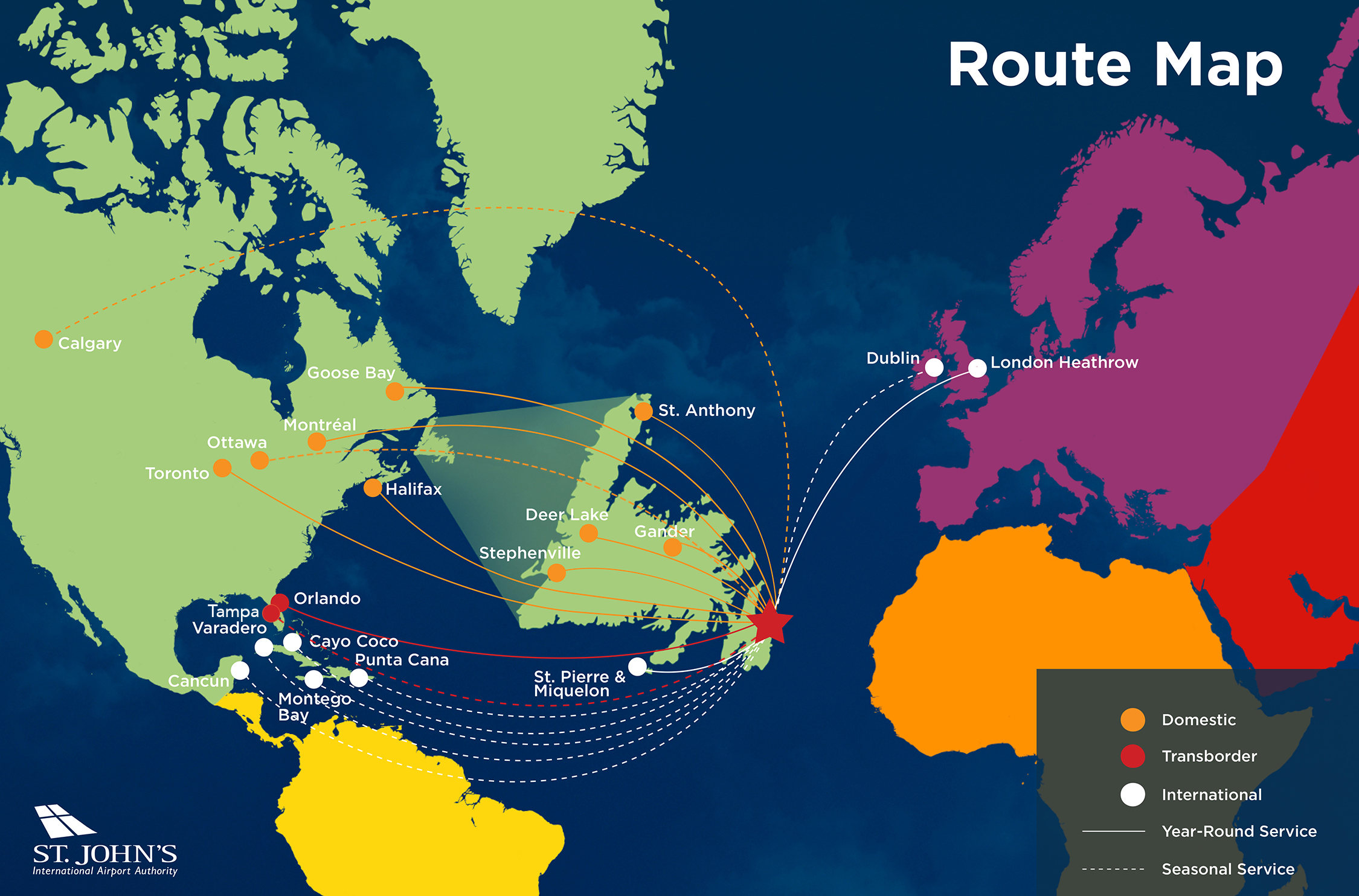
I was inspired by a conversation I had earlier this week. Actually I was inspired by many conversations this week. A really great week all around. One of the great conversations was about the size of the St. John's NL business marketplace as it is associated with what is within reach by a single hop flight. Well... I consider the St. John's population to be over 40 million and includes two of the largest business cities on the planet (London & New York).

http://stjohnsairport.com/wp-content/uploads/2018/01/SJIAA-Route-Map-Jan-2018-edit.jpg
So when looking at the direct flights available from St. John's and consider the cumulative population of these cities [ London (12.6 million), New York (19.1 million), Toronto (6.4 million), Montreal (3.8 million) ] and their collective global financial influence, the market for St. John's is massive and with solid financial footings.

If you are growing a business or thinking about starting a business in St. John's (or any city within single hop flight of your own city) the market is a lot bigger than you think. So maybe shift how you perceive your market, reach out across your cities direct flights, consider what is at the other end, and book some flights. Use the global communications network to your advantage, visit each of these cities on a regular basis, budget for it in your business planning. Given the St. John's mid-Atlantic location, the future is indeed bright!