Showing posts with label learning. Show all posts

Sunday, February 21, 2021

The Beginning of Ocean Data Endeavours (ODE)

Thirty-nine months ago I started on a deep dive into developing a reference architecture for the digitization of oceans. The idea of developing this reference architecture was initiated by the Canadian Government awarding Atlantic Canada with the Ocean Super Cluster initiative and all my recent work with leading the software engineering group at Provincial Aerospace. My writing and research into ocean data took me to the point where I needed to deepen my understanding of a number of subjects, and I needed this deeper understanding before I could continue the writing and research (even though you could consider deepening understanding as research). I needed to have an intermediate understanding of what had come before and the current state of things with a reference architecture for the digitization of oceans. In particular, I needed to work directly with ocean data and the standards that influence its structure.

Over the last three years I have been lucky to work with Triware Technologies Inc., and together we have found projects that align with this need to deepen my understanding of all things digital and all things ocean. My recent project successes include;

OCIO Digital by Design - I was fortunate to be awarded the opportunity to be the data architect for the initial phase in digitizing the NL governments citizen facing portal. I remained on the project for the first 12 months through to the portals launch. Being on the design team to create the data tier and integrate with legacy data was a great achievement. And I deeply enjoyed using a scrum / jira approach with a multi-vendor, multi-disciplined team. We achieved a lot in a short period of time.

Lessons Learned - Agile, Scrum and Jira can scale well to a government organization with multiple scrum teams working toward an integrated solution.

Ocean Sector Search - We needed a way to index the Canadian Ocean Sector. So we built a search engine seeded by as many oceans related URLs as our analysts could gather. The technical architecture of this ocean specific search engine can be found in this previous post.

Lessons Learned - With reasonable technical effort Nutch can be configured and seeded to crawl a specific industry sector (in this case Canada Oceans Sector). The Nutch crawl harvested a significant number of pages (> 32000) that were then loaded into the ElasticSearch (ELK) stack while relevancy scoring each page along the way.

NLCHI - My work with the Newfoundland and Labrador Centre for Health Information (NLCHI) was a quick engagement to focus their requirements backlog into a few manageable sprints. I was super fortunate to help get an important project underway and gain insights into the concept of a customer focused data workbench for a specific subject domain.

Lessons Learned - The idea of a personal data workbench is very compelling when you consider the number of data sets already available in the oceans sector. And if we could fold in open and proprietary data sets, while honoring security and privacy we may be onto something...

Nalcor Energy Database Consolidation - So many databases, so little time. One of my favorite enterprise type projects is when the project pays for itself, over time, by the savings created by the projects downstream accomplishments. Not revenue generation, but operational expense savings. I believe one of the best KPI's for IT is not new systems implemented, but old systems retired.

Lessons Learned - an amazing amount of data can be moved with the correct use of tools, well built and managed ETL (pipelines), and a mindset of automation.

Argo Floats - 2018

NEXT STEPS

Over the last month I have revisited how to best develop my intermediate understanding of oceans data. After a number of conversations, with experts of oceans data, I believe my next steps are twofold; I need to focus on the existing standards for oceans data and I need to write some code to integrate some open oceans data sets.

I need to find opportunities to work directly with oceans data. If you are in the oceans sector, in any way, and you have the need of a very experienced data engineer, then I would love to help with your project. If you know of an oceans data project in needs of a data engineer, please forward on my credentials. Thanks to everyone for reading this far. And thank-you Triware for your ongoing career support!

Friday, January 19, 2018

Career success in three year cycles

My career seems to go in three year cycles. I've given up trying to determine if this is my unconscious doing or my skills and knowledge lend themselves very well to successful three year project life-cycles. Either way, I'm 35 years into a successful technology career and another three year cycle is coming to an end. And I'm very excited with what is coming! Before I get into the details of the most recent cycle I went back over my past 12 years of blogging to get a sense of my working ebbs and flows, and to confirm my three year cycle theory. The past four, three year cycles also seem to swing from being an employee to working on startups and as a consultant;

My most recent three year cycle has been with Provincial Aerospace (PAL) in St. John's Newfoundland. It has been a fantastic and exhausting three years. If I was to pick a few themes, they would be; team building, shipping software, quality management, and an acquisition. So what do I consider my achievements over the past three years and where do I best give thanks. In giving thanks, I will not be calling people out by name - they know who they are.
  1. Team Alignment
  2. When I joined PAL there was so much raw software engineering power with good team trust and camaraderie that my focus immediately moved from team building and skills development to team alignment and clearing the way for their success. And successful they were! We got to the point where every customer was very satisfied and we had solved some lingering and potentially expensive issues.
    Special Thanks: I want to give thanks to PAL senior management for being patient, keeping the team together, and trusting me to start shipping software. It took some time, we had to clean up some minor releases and complete a significantly complicated major release with a very broad deployment scope.
    • SED Team
    • What is most important here is the team was solid within itself as a software engineering team. They had very good end-to-end practices and audit proof trace-ability. The organization as a whole struggled with getting software out to the production environments due to many factors. Keeping in mind deployment is beyond the responsibility of the software engineering team and we had to deploy into highly secure customer networks in very rugged environments. Once we had a realistic schedule the team held the vision for success and delivered.
      Special Thanks: I want to give thanks to our project manager who is insanely detailed in the best of ways and the team for not only building quality code, but taking on the quality assurance roles for each others work. 
    • Business Intelligence Team
    • Innovation within a strong corporate culture can be hard and an organization will struggle to understand a team with a different rhythm and dance step. And the pressure for the team to align itself back with the corporate rhythm will be ever present and an effort to avoid. If you want innovation you need to allow teams to dance a different step, and allow them to master their new dance. We built a scrum - agile data analytics / business intelligence team from an exceptional group of transactional developers used to a more waterfall type development approach. It took us 12 months (which I consider a short time) to have a performing group of analytics and intelligence developers who ship new data dimensions in a sprint cycle time of 4 - 6 weeks.
      Special Thanks: I want to give thanks to the whole team for deeply embracing the learning toward becoming knowledgeable analytics developers. With the ability to analyse, design, develop, and deploy for multidimensional data from a plethora of different data sources. I want to thank the scrum master for holding the vision toward the value scrum would bring. I want to give thanks to the business intelligence consultant we brought in for the first six months of the project, they did an excellent job of leading by example and transferring the knowledge required to get the team more than started. I again want to give thanks to PAL senior management for being patient, keeping the team together, and trusting that the data dimensions will come and the team would exceed the targeted number of KPI's.

  3. Shipping Software
  4. Shipping software can be really hard or it can be simple and repeatable. Shipping and deploying software has become an understood and well managed process as the practices have built toward Agile approaches and DevOps over the last 10 - 15 years. The time of failed non-deployed projects should be a thing of the past. If its not, you should either; clear house at the senior leadership level or send everyone to upgrade their literacy of how to provide leadership to software and technology development.
    Special Thanks: I want to give thanks to the team leadership who came before me. The use of Microsoft TFS within the SDLC made team alignment really easy. I also want to give thanks to the team for adapting so well to adopting more agile and devops type approaches. I may have cleared the way, but the team did the real work!
    • IDNS 2.x (ADAM8 and SIS)
    • This was an eighteen month project that included many major features within its release scope. The main considerations for the project were;
      1. the schedule restraints [we could NOT go-live to production during iceberg-season (Feb - June)]
      2. the breadth of the feature set we were delivering included;
        • Increased security constraints
        • Service Orientation
        • Directory Integration
        • Content Management
        • Geo-referencing with advanced search
        • Off-shore client deployment
        • Legacy application support
      3. deploying to a new data center and multi-server architecture.
      4. Having two versions run in parallel for an ice-season to allow for comprehensive testing and customer network / security integration.
      Special Thanks: I want to give thanks to everyone involved with this project to hold the vision and getting to finished. We exceeded expectations. I'd also like to give thanks to the IT department for building out the infrastructure, owning the active directory deployment, and being sure we are secure to the levels required by our customers.
    • Business Intelligence - Data Analytics
    • We started to ship software as releases of new data dimensions (or clusters of key performance indicators). Once we had the basic infrastructure in place with the beginnings of the Extract, Cleanse, Transform, and Load (ECTL), data marts and warehouse we moved into using a scrum type approach to ship new dimensions out of each sprint. This worked well as it gave a reasonable velocity to complete a set of deliverables and then have retrospectives for learning. The team shipped 12 cubes with consistent and interval data refresh which took data from three distinct and distributed data sources. The challenge going forward for the team is in assisting the product owners and subject matter experts in leveraging all the cubes into dashboards and analytics.
      Special Thanks: I want to give thanks to the team for putting in the extra effort from being on a steep learning curve and focusing on the delivery of data cubes as our measure for success. I want to recognize the commitment of our senior developer in being a learning machine of the business intelligence and  data analytics subject domain. I want to give thanks for our DBA taking on all the system and database level tasks to make the project a success.

  5. Quality Management
  6. I'm a strong believer that good software quality management (QMS) brings significant business value. The value comes from; being able to ship software on schedule and on budget, more easily integrating new and unexpected features, ease in adding and training new team members into well known process', and the ability to easily address the scrutiny from customers, auditors, and potential investors. Our team regularly exceeded the procedures and practices within our quality management system and much of our success was due to this rigor.
    Special Thanks: I want to give thanks to the PAL director of quality, she saw beyond the business of quality certification and her enthusiasm for quality made us all better. I want to again give thanks to our project manager; her commitment to process, record keeping, and traceability is a thing to behold.
    • Rock solid processes
    • We were fortunate to have developed an end-to-end SDLC process that was reflected in our use of Microsoft TFS. The team was committed to following the process' and we passed all our insanely rigorous ISO audits. We were continuously improving our process' to better suit a more effective and efficient SDLC. We adjusted our QMS to our practices, rather than adjust our practices to our QMS. And our adjustment followed solid change management practices.
      Special Thanks: I want to give thanks to the software engineering groups leadership team for being willing to continuously improve our SDLC as it was reflected within our QMS, and vice-versa. I want to give thanks to the team for following our practices. I want to give thanks to the auditor for providing candid feedback and encouragement to make change within our ISO certification.
    • Traceability
    • Having the ability to see an idea through to working software is an accomplishment. Having evidence of how the idea became working software, from an auditors perspective, is a thing of beauty.
    • Multiple Successful ISO audits 
    • Special Thanks: I want to give thanks to all those who participated in our ISO audits. They can be stressful, but for us we embraced them and used them for our continuous improvement.

  7. An Acquisition
  8. I feel very fortunate to have had an amazing 35 years working within the technology realm. I've written a lot of code, tuned my share of databases, managed a number of talented teams, architected working solutions that are used daily across Canada and around the world, and held leadership roles with amazing peers. I have had my share of working with startups as an employee, shareholder, and outsider performing technical due diligence. My 30 years in the Vancouver technology scene included working with angel investors and VC's to perform technical due diligence to provide them much needed information. During my time at Provincial Aerospace I was asked to again perform technical due diligence for the PAL acquisition of CarteNav. What made this different is it the first time I did it as an employee of the acquiring company. And fortunately I became a member of CarteNav senior team after the acquisition. This allowed me to see firsthand some of the success and challenges that happen during the first 18 months after an acquisition. Such a great professional experience.
    Special Thanks: I want to give thanks to senior management for giving me the opportunity to see an acquisition from the other side. It confirms that acquisitions success are about cultural integration during the months that follow. I also want to give thanks to the top tier consulting firm that confirmed my due diligence findings, and were very focused and gracious. I want to give thanks to the CarteNav leadership team (and all the CarteNav employees) for being so welcoming and working so hard through the challenges that come with any acquisition.
So there you have it, a reasonable summary of the standout themes from my last three years working with Provincial Aerospace. My next adventure begins... more on this to come. Be well...

Tuesday, March 10, 2015

Computer science taught as an art

I've been involved with learning, teaching and creating for all my life. During my formative years (in-utero to shortly after high-school graduation) I was focused on getting what I needed to finish. I was also involved in a lot of art (music, graphic design, crafts, dance, theatre) but my socially encouraged (my parenting) focus was on math and science. Needless to say, I have had my feet firmly planted in both art and science my whole life. I guess most people are this way, with different ratios of art to science. I really feel I continue to straddle both these areas as I pass my 1/2 century mark. What this has given me is a deep appreciation and engagement in both art and science. This is why I am more broad than I am deep. And this is why I have learned art as much as I have learned math and science.

Now I am an enterprise architect, educational technologist, computer scientist, teacher, visual arts performer and all around nice guy (well I hope). I still draw and paint, play music (the best I can) and dance in the open. I encourage my kids to engage in art more than science. Surprisingly, my kids math and science skills are good. I do think there is a connection.

I also think computer science can be taught very well as an art. Particularly, in the early stages of learning computer science. Why? Because, it needs to be done with reckless abandon and with the freedom to make a mess. You need to be able to stop half-way and throw it away. You need to be able to change it into something never planned. You need to be able to break something, and then fix it. You also need restraints through assignments (or learning themes), focused subjects, a palette, skills and abilities, uncertainty and little preparation, it all needs to be inspired and interpretive. I also see taking risks and "feeling stupid" is safer with art than science. Doing a scientific experiment seems more serious than dancing like no-one is watching or painting for yourself. Art seems more reckless than science. It is this recklessness that makes art more accessible to learn than science. I also think there is a lower barrier to entry for art than science, though I don't think it needs to be this way.

How I perceive creating and learning art.
My participation in the arts comes in two themes; the visual make things (graphics, painting, architecture, woodworking, and building) and in folk music and dance. How do I learn new things within these realms; by doing, with a whole lot of reading, research and seeking out those who have done it before. How do I believe it best assist to others learn; by involving them, and pointing them toward understanding how they themselves learn and encouraging their own research practices. Together we do things, I've built and created many things with others and the conversation and collaboration is a beautiful thing. Bringing together music and dance is an amazing collaborative effort. Best done with a willingness to fail, and the patience to persist. One of our best dances is tri-martal-o (it took two years to develop), is hauntingly beautiful, the music is inspired and the piece is way fun to dance. The important aspect of learning art is to dive in, create and participate as soon as you can. And remember, make a mess.

How I perceive creating and learning computer science.
Immediate feedback is the way! Being able to get something working by using the tools and techniques immediately is paramount to learning computer science. Programming something and then seeing it run, render, compute... is preferred for learner engagement. Once this immediate feedback has been experienced, the opportunity to create has been fulfilled, and a good number of computing science tasks have been completed then the deepening and complexity can begin. And this deepening and complexity needs to grow iteratively with continued immediate feedback and fulfillment. It should almost be like playing an instrument or creating art; repetition, creation and fun.

I believe it is also important to understand computing science as a creative and where it fits within the big scheme of things (historically, culturally, epistemogically, and algorithmically). This helps to put computing science into life context. Where it fits with being a human being, and this is where it gets interesting. The ability to take working ideas out of your brain and use them (in other ways and experiments) within a device outside of your head. This is computing science, and it is unique in history. For thousands of years we have taken ideas out of our heads and created things; first, wall paintings, then tools and writing, then machines and engines... but now, we can re-incarnate a working idea in another device that can process the idea, and use it with other peoples ideas, or more of our own ideas. And we can process these ideas as experiments and run a collection of ideas for days with different inputs which influence further ideas.

How do I see teaching computer science as an art? 
Create, make a mess, work with others, make... this is why I see the maker movement so positive. And why the webmaking initiatives currently underway as the right way toward teaching computer science. It creates a low barrier to entry and encourages learning with reckless abandon while on a journey of skills and knowledge development. Webmaking also takes learning computer science into the realm of social learning, which I consider more closely aligned with learning the arts than the sciences.

But how would this work for the more complicated computer science topics? The solution is in how more complicated art projects are created. They are more collaborative efforts, where the more experienced are given the complicated tasks and have to be sure their direct collaborators are also engaged. And there is a whole bunch of healthy collaborative critique going on. Look at how a performance art piece is created, learned and performed. What can be taken from this process and applied to teaching the more complicated aspects of computer science.

In my opinion one of the best books when considering the creation of computer software is written by Russell Shackelford and titled "Computing and Algorithms", I've used this book a number of times when teaching entry level computer science. What I fond strongest in this book is how it connects the creation of computer algorithms (software) with art from the scientific perspective. Or at least that is how I read it...

So in the end when teaching computer science as an art it also comes down to practice, practice, practice... if you want to be a good artist, that includes a lot of practice. If you want to be a good computer scientist, that also takes a lot of practice. The key is to find fun, creative and collaborative ways to stay engaged, and treating the learning of computer science as an art will keep it more engaging. Regardless of age. And as the projects and learning become more complicated, increasingly engage others who are peers and mentors. Find the fun individually and as a group.


Friday, February 15, 2013

Gears of my childhood

I am involved in the current running of Learning Creative Learning with MIT and P2Pu. A fantastic online course which is prompting much reflection and confirming much of what I am doing with inspiring adult learners. I am definately on the right road!

This weeks activity is to;
Read Seymour Papert’s essay on the “Gears of My Childhood” and write about an object from your childhood that interested and influenced you.

I struggled with this. I didn't have an object like Papert had, something that I grew my learning around, something I would use to visualize or conceptualize my learning. Something I did have, and still have... is the bicycle. I rode my bicycle everywhere, to school, from school, to the park, just up and down our dead-end road. My social life was around the bicycle for many years, we had a bike club on our street. Every day and every weekend we would meet-up and do things, the bicycle was a constant.   I didn't think about the bicycle in direct relationship with my learning. It never was a gear to my learning. I would rather see is as a foundation to most of what I did, and played a big part of forming who I am today.
  • The bicycle provided a freedom to travel great distances, unsupervised. Today, I love to travel.
  • The bicycle provided me access to a number of different social circles and friendships. Today, I know many people and socialize across social and economic domains.
  • The bicycle provided me travel to many different events. Today, my interests and studies are broad.
  • The bicycle allowed me to escape the restraints of what was expected of me. Today, I seek (with confidence) alternate routes to desired outcomes.
  • The bicycle was easy to take apart and put back together. Today, I am constantly taking things apart and putting them back together, often improving them along the way.
  • The bicycle caused me injury, but I always made it home. Today, I pick myself up on bad days and have persistence to keep going.
  • The bicycle took me places I could not have otherwise gone. Today, I am still curious and follow thoughts, ideas and inspirations to places I would not have otherwise gone.
I know that the bicycle isn't the same as the gear as described by Papert. I never used the bicycle as an analogy or image to base my learning. The bicycle provided me a freedom to become an autodidactic.

Saturday, August 11, 2012

formative and summative events, popcornjs, and screencasts

Another round of enhancements and the addition of summative events completes step 0 of my open badges step by step guide. I have been building a step by step guide for open badges where I have been creating a number of open educational resources. All this work (and other peoples contributions) is destined to become a part of the School of Open Badges on the P2PU. One of the main elements I have been working on is how to enhance screencasts for learning. Just watching a video screencast can be good for learning, particularly when you think about having the ability to stop and start the screencast to view something more than once. The main enhancement I have been working on is to add formative events to the screencast, so the learner can focus on important information and have immediate links to the subject being described. This allows the learner to pause, read deeper, reflect, and then continue with the screencast.

click this image to view the enhanced screencast.

Formative events:
Formative events enhance learning by providing further opportunities to learn during the overall learning experience. The formative events are immediate and occur as skills and knowledge are forming. The idea of formative events is often used with the idea of a formative assessment, that is in-lined with the learning module and the assessment become a part of the learning. Within my enhanced screencasts I have used popcorn.js to inject links, popups and learning outcomes while the screencast is running. When the learner clicks the link it is opened in a new tab or window, this allows the screencast to continue (or be paused) and the learner to further explore the concept via the linked information (this is not possible with current screencasting technology). The popups highlight important pieces of information. The learning outcomes identify during the screencast.

Summative events:
The summative event(s) are via a link once the screencast is complete. It provides a complete summary of the screencast with links to the following;
  1. the youtube instance of the screencast
  2. the popcorn.js enhanced version of the screencast
  3. a listing of all this links presented during the screencast
  4. a listing of the learning outcomes identified during the screencast
  5. a reflective activity to deepen learning
The idea of the summative event is to provide something to go back to and use as an educational resource to reflect and deepen learning. Feel free to enjoy and learn from the growing repository of these enhanced screencasts made specifically to learn about and implement Mozillas Open Badges.

Tuesday, August 07, 2012

Creating Online Learning Communities

Thank-you Bill Pusztai
My recent work has taken me back to thinking about and discussing the effective creation of technically focused online learning communities. Learning online is something I have been doing for a while. And given both my pedagogical and technical background, I often get into the nuts and bolts (or bits and bytes) of building online learning communities as well as the actual building of the community. Much of my recent reflection has been about engaging and building learning communities, particularly technology (or digital literacy) focused learning communities. This post is mostly about the engagement and pedagogical side of this community building. Another post about the technical side of building online learning community may come, but is well articulated in this slideshare from a while back; http://www.slideshare.net/prawsthorne/building-onlinecommunities

Background
I believe some background information on where I am coming from in my thinking is important. There have been a number of experiences (professional and otherwise) that have set my thinking about building technically oriented online learning communities.
  • Being a software developer and working extensively with lean and agile teams - what is important: most developers are self-directed life-long learners and they owe a lot to their peers who have contributed to what they are reading and learning.
  • Being an enterprise architect and encouraging enterprise2.0 thinking - what is important: collective intelligence and learning/teaching is knowledge management. being patient.
  • The musings of Zuckerberg vs. Poole - what is important: anonymity encourages contribution, nuf said, read my post;  http://criticaltechnology.blogspot.ca/2011/03/ignore-copyright-and-blissfully-create.html
  • My time as a early contributor to WikiEducator - what is important: recognizing contribution, doing it in the open, monetize activities wherever possible, and governance can be done exclusively online and in the open. love your volunteers.
  • Implementing seven major projects in three years with CLEBC - what is important: open approaches work in closed shops. API's allow distributed approaches. recognizing areas of practice (or communities of practice) is important. Video resources can be long-tailed. love your volunteers.
  • My graduate studies were exclusively online - what is important: face-to-face and blended opportunities are worth every moment and should be encouraged if you want greater depth to learning. This may seem against the creation of online learning communities and favoring traditional learning environments, but the point I am making is that if the opportunity to get together in the same physical space with any community member presents itself, seize it!
  • Communities can be built in many places by many people - what is important: often communities can fracture into other communities, or seasoned contributors will disengage, move-on or start other communities. Be supporters of this action for it increases the overall size and reach of the subject and its growing content.
  • Authenticity can be community policy - what is important: based on an articulated policy the authenticity of the dialogue can be increased. While anonymity can create contribution and authenticity, the community can also set and enforce policy to encourage authenticity.
Engagement, engagement, engagement
Contributors are the MOST valuable resource, they are the community! Yes, lurkers are also a huge part of any growing community, and lurkers sometimes convert into micro-contributors. The people who are, or see themselves as, stewards of the community need to engage often and with reckless abandon. They also need to encourage the stewardship to be a shared activity. Engagement should be across social media, and where possible use tagging to bring it all together.


Freedom (without scholarly egos, well... all egos)
Its the micro engagements that grow into macro engagements. If people aren't given the freedom and support to make small contributions they will rarely make the larger contributions. And once a contribution has been made facilitating discussion should come from elsewhere (not the contributor themselves) with great encouragement and recognition being given to the initial contributor. An amazing community is grown with many small and meaningful events. People should never be made to feel badly about their contribution... and don't feed the trolls.

Small is beautiful
Encourage contribution in small chunks, build discussion and shared understanding around these chunks. Allow the chunks to coalesce into larger works. Trying to complete a larger works without community engagement, ends up teaching the creator. And the online community becomes passive...

Facilitators are stewards (and need to be tech savvy)
Online learning communities that are technical in nature need to be facilitated by the technically savvy, if they are not this is quickly noticed and the community will lose credibility. The facilitators must eat their own dog-food and be exemplars in engagement and encouragement.

Reaching Out Its all about love!
I know it sounds smoltzy, but building a great online learning community is an activity of the heart... finding people who are deeply committed to the subject matter of the learning community is essential for longevity and depth of learning. People quickly get a real sense of a community (online or otherwise) and if it is not genuine people will recognize this.

Building successful online learning communities has a lot to do with reaching-out and encouraging others. And for technology focused learning communities this includes drawing in people who make small technical contributions who often contribute in small and quiet ways. Surprisingly, it is often these small contributions that have the biggest impact.

Thursday, June 07, 2012

Three point lighting for video capture

I have the need to capture the talking heads in a video conference session. I need to capture each talking heads video stream and save it to disk. I need each stream captured and saved so it can be archived for later viewing, and the ability to slice up the video into smaller segments. The video will be taken from interviews using online video conferencing software. The challenge comes where the video conferencing software doesn't allow capture of individual streams, in general they just make the whole conference (with all talking heads) available as a single video. And because we need to have solid recording of each talking head for later use in a variety of online learning situations we need a remedy for this situation. Keep in mind, that in general, the video conferences will be with two or three people all in different geographic locations. The solution is to use the video conferencing software as we would normally with two adjustments to the environment;
  1. Create a good studio environment from a lighting perspective.

  2. There is no shortage of good images and video on how to set up a three point lighting system. these two below are a couple of my favorites. Keep in mind the interviewer is going to be replaced by the laptop hosting the video conference.


  3. Include a separate video camera to the mix. Or replace the interviewer with the laptop hosting the video conference.

  4. This is where things vary most from the traditional interview setup. The interviewer is replaced by the laptop hosting the video conference. This will allow you to capture the video in a good quality with good sound. And it will provide it in a format that will allow you to separate the audio from the video and slice up the video so it can be re-used in different learning contexts and situations. Essentially providing a long tail to your video resources.

Sunday, April 22, 2012

Open Badges Learning Plan

I've started my journey into Mozilla's Open Badges initiative. I'm doing this because it fits so well with my beliefs and values around open education, assessment and accreditation. It really seems like the logical next step for me and my desire to assist in opening learning for everyone; outside of the traditional institutions. Don't get me wrong, I believe people can learn amazing things at traditional institutions and people should continue to engage traditional institutions. I just also believe people should be able to get as much recognition and accreditation from their learning outside of the traditional institutions. What I really value most about the open badges initiative is that they are wanting to offer an infrastructure (and I believe the infrastructure is key) that is open to everyone and doesn't end up focusing its efforts on higher education institutions (OER based or otherwise). In Mozilla's description of their open badges initiative it is also key that they support all areas of learning. It is this that I value most.
...They can support learning that happens in new ways and new spaces beyond the traditional classroom. These include online courses, after-school programs, work and life experiences. By providing a more complete picture of learners' skills and competencies, badges can signal achievement to a variety of communities and institutions including potential employers, educational organizations and social groups... ~ http://openbadges.org/en-US/faq.html
My Approach
I will create curriculum for, and deepen my understanding of, Mozilla Open Badges by using my Agile Instructional Design (AID) methodology. I will focus on building OER for open badges from both the perspective of an education technologist and an independent learner. I will build this first set of resources as AID sprints with two iterations; the first focused on the edtech and the second on the learner.

My Learning Plan
The first task within AID is the envisioning step. This step focuses on developing an introductory understanding of the subject and creating the beginnings of a curriculum map. This is how I will fulfill the tasks within the AID envisioning step.
  1. Curriculum Plan
    Here I will create a concept map of the open badges domain. This will also include a list of the keywords found within the domain. I will gather this by quickly reviewing all the Mozilla artifacts I can find on open badges and perform a few Internet searches to try and discover any gaps.
  2. Learning Themes
    I will build upon the concept map by identifying the learning themes. One of the themes that immediately jumps to mind is the focus on issuing, storing and displaying the badge. Rather than the assessment of earning the badge. 
  3. Learner Roles
    There are two roles within this iteration; they are the edtech and the learner. I will elaborate on the roles in a subsequent post.
Feel free to follow along (or even join in) with my learning. I'll be as open as the technology will allow and contributing will assist us both in deepening our understanding of open badges.

Thursday, March 08, 2012

An Agile Instructional Design Sprint

Scrum Sprint
Could a small group of subject matter experts, instructional designers, rich media experts and coders build a complete course in five days? This approach is gaining experience for the writing of books, why not courses. The approach would fit very well with the Agile Instructional Design approach and would take the best from the unconference, the book sprint and the scrum sprint. This is how I would envision the AID Sprint; I believe a sprint will occur within 5 to 10 working days.
  1. INVITE participants (be specific about subject domain)
  2. Finding the right group is about composing the right invitation. Be sure to be as specific as you can about the subject of the AID sprint. But leave it loose enough to encourage participation. The real focus will come out of the envision step. All the participants need to agree to meet in the same space for the duration of the sprint.

  3. ENVISION the curriculum
  4. Use brainstorming techniques, such as how stickies are used in an unconference. The point is to quickly create a shared vision of the module, course or curriculum - whichever fits best within the time available for the sprint.

  5. PLAN the modules
  6. Plan the modules, create storyboards, identify different opportunities for rich media, determine assessment techniques. Being thorough here is important for this is where you will identify the tasks and the content items that need to be built. Out of this smaller focused and nimble groups (one to three people) may form to develop different content items (ie. short videos, assessment instruments, diagrams, text, etc...)

  7. BUILD the content
  8. Start building the content. By this time the smaller focused groups would have formed to create individual items of content. It may be a good idea to have groups form around content types so they can focus and create all the identified pieces. The idea being, have one group focus on video resources, another on graphics, another on the text and organization, another on assessment. Once content starts to come together the sprint team should start to coalesce what they can. The iteration here will assist greatly in team energy and identifying what needs to be built and improved upon.

    Agile Instructional Design Sprint
  9. STABILIZE the technology
  10. This is where everything has to come together and the user testing begins. The unified build brings together all the individual content pieces and the course flow comes together with the assessment approaches. The stabilization also includes the technology stabilization and the first round of deployment to the production environment.

  11. DEPLOY the course or module
  12. Pushing work out to the web should occur as soon as a module is ready. Iteratively, pushing working modules out to your production internet environment creates success and attracts learners / testers / users. This is the only place you get real feedback, when you are live and on the internet. This feedback puts you on the road to continuous improvement.

  13. ITERATE
  14. Go back to the envision and planning steps, iterate and build more modules. Learn from the build, stabilize and deploy steps just completed and add further learning modules. Work towards completion of complete curriculum.

Next Steps: 
The next steps in proving the AID Sprint are twofold;
  1. To build a learning module focused on Agile Instructional Design with me occupying all roles. This will allow me to work out the bugs in the sprint methodology and to learn the technology for implementation. 
  2. Send out an invite toward one of the curriculum areas I have identified in legal education for the adult public.

Tuesday, February 14, 2012

An end for education


Last week I was reading a post from my friend Brad. In his post he asked the question what is the end of education. Not the kind of end meaning over/finished, but the kind of end meaning purpose. For me the answer to this important question is;
to be a positive and loving contributor to the local and global community as a whole.
This pretty much means, do what you are good at, do what you enjoy, find a place for yourself where you help the local community and the world be a better place. In other words the end of education is to help people to know who they are and where they fit, and then provide them the skills and knowledge to support this self-understanding.

Tuesday, February 07, 2012

Higher Education as a Service

I want to help build a national (or provincial) cloud service for Higher Education! Please forward my contact information!

It would be physically located in Canada, and include;
  1. ERP as a Service for HE, including; 
    • Registration Services
    • Transcripts Services
    • Materials Management Services
    • eCommerce Services
    • Content Access Services
    • HR Services
  2. Would be based on the OpenStack standard.
  3. Provide Platform as a Service (PaaS) for any educational project requiring these services, including;
    • Application hosting and software development services
    • CPU Time / Data Storage
    • Course Management Services / Learning Management System
    • Open Publishing Services
    • Any / All social media platforms (Blogging, Wiki, Tagging, MOOC, Etc.)
  4. Provide Software as a Service (SaaS) to all students as a part of their registration. These services would support their constructivist and connectivist learning activities
  5. It would be both National and Provincial
  6. Be completely opensource so it could be rolled out to any country that wanted to participate.
This would save the taxpayer millions of dollars and free up educational budgets to focus on more education for the public at a lower price.

If you have any connections into this capacity, please contact me, or forward along my contact information. Thank-you! peter@rawsthorne.org

Technology learning for the C-level, and others

I'm taking a very learner centered approach to the migration of my websites to my rackspace cloud instance. Given my background as a solutions architect, software developer and adult educator I have four main themes for the build out of my websites;
  1. To build on ideas slowly and comprehensively to assist learners following along; regardless of their technology background.
  2. Reflect upon each lessons outcomes and describe their business importance from a C-level perspective.
  3. Build all the websites following the mobile MVC three-tier architecture I described previously. And make all source code available as sample code.
  4. Serve as an example for my Agile Learner Design approach for adult self-directed learners.
What I believe very important is the learning resources are designed to be easily understood so everyone can get an understanding of how mobile web applications are put together. I believe their is strong business rationale for many technical implementations. These learning resources will also reflect upon where the business fits within the technical decision.

Thursday, January 26, 2012

Personal Curriculum Mapping (PCM)

Personal Curriculum mapping can begin with a Concept Map.

I believe one of the missing pieces of the Personal Learning Environment (PLE) is Personal Curriculum Mapping (PCM). I've thought this for a while and have discussed it with friends during my conversations around an OpenPhD. This was greatly reinforced by watching Dr. William Pinars conference speaking video regarding his recent paper "Allegories of the Present: Curriculum Development in a Culture of Narcissism and Presentism." I took many things from this video and what stood out from a curriculum development perspective is it needs to be individualized and have the engagement of the learner. This will provide the learner greater attachment to the materials, content and context for learning and force a reflection of the subjects history, present and possible futures. This reflection will provide them a deeper connection to their chosen subjects curriculum and to humanity as a whole.


I was also inspired by this 2011 Wilma Kurvink webcast from the ASCD conference. It provides some wisdom about how to map curriculum within a learner focused approach. It talks of how curriculum development, at a high level, is better done by others outside of the subject matter area who have insight into how the subject relates to other subjects and where learning content could be missing when looking at the whole of curriculum. Librarians are a good example for they can be unbiased regarding a subject area; therefore, not a stakeholder in curriculum mapping. You may want to consider finding a few librarians to be a part of you personal learning network.


If you want more reference to Wilma Kurvink's work on this subject follow these two links;
  1. accompanying ppt slides from the presentation.
  2. website that provides a hyperlinked description of the approach.
This is a follow your bliss kind of thing; but you really do need to get to know how you learn and what you are motivated to spend your time learning. This is step 0 of creating your own personal curriculum map.

This is how I alter Wilma's 5 step process to become more personal (Note: it is not not a linear process and therefore fits well within Agile Learner Design)
  1. audit the unit - get to know the subject matter landscape, review all the resources you can (academic and otherwise) to get an understanding of the subject area and what you know of it. What skills are needed for success? Where would you start your focus? Where does context fit?
  2. use student perspective - how do you personally relate to the subject area? Are you excited to emerse yourself in the subject? Where would you share your learning and excitement? How does all this relate to what you already know.
  3. confirm revised skills/content/focus to matching tools -  from the audit you may have identified new skills required, you need to develop learning plans to acquire the required skills. Look to new web2.0 tools to also assist here. Identifying the important skills is the best place to start. This is where it gets fun, for you need to devise / identify ways to assess your mastery of the skill. Be sure to communicate and engage you social network here. How does this iteration of learning relate to previous skills/content/focus iteration? What is new? What has changed?
  4. ensure tools align with key focus of unit - once all is done has your learning and work aligned well with the focus of the current iteration. Has your assessment approach worked. Would building your own rubric to assist here? Your personal learning network should be engaged here!
  5. evolution of student perspective - this is where you need to assess the current iterations learning against the skills and knowledge you set out to develop. This then feeds back into step 1. the audit of the unit. Iterate! And remember, keep blogging!
Creating a Personal Curriculum Map is a very important first step while envisioning and planning your Agile Learning. Having to develop your own curriculum is important to building your understanding of the knowledge domain being pursued in your learning. The process of creating the PCM is also iterative, so the map doesn't need to be complete to begin your learning. Once a skill or two has been identified within the subject (or curriculum) domain the learning can begin. And during the iteration a better understanding of the curriculum will develop. The curriculum map is also very personal for it connects you with the skills and knowledge from the past and the present. It will also provide insight into the future. As Dr. Pinar believes the understanding of the past and present of a subject domain connects you with all of humanity. And what makes this even easier is that creating a curriculum map that is personal could be one of the most important things you do. In the timeless words of Bruce Lee, "(Hu)man, the living creature, the creating individual, is always more important than any established style or system".

Getting Started with PCM
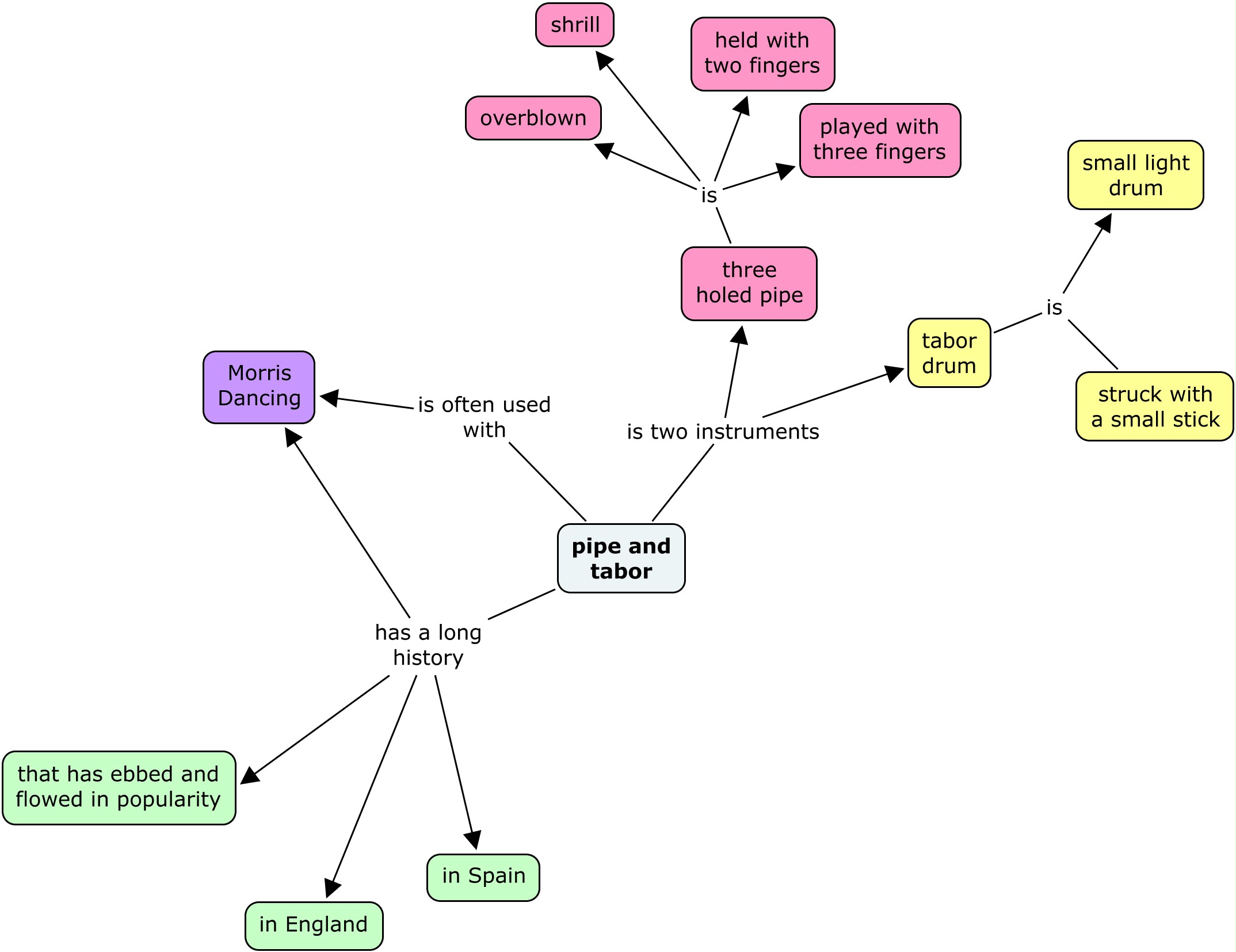
To get started with creating a personal curriculum map simply phrase the learning as a question and begin to build a concept map. In the above example I state that I want to learn to play the pipe and tabor and I begin to hang other nodes around the question. Put all you already know about the subject as nodes around the question. This should be enough to identify a few skills to begin your learning. For the time being, however you imagine the concept map is correct. The most important thing is to begin capturing the idea and what you already know. This concept mapping will be described in more detail in a future post. Stay tuned...

Saturday, January 14, 2012

Kickstarter Success

Back in May 2011 I contributed to my first Kickstarter project, Computational Thinking Illustrations. And this week I received my benefit for contributing; signed by the artist, prints of the created images. I completely agree with the goal of this project; to create some cartoon images to help teach computational thinking. In my opinion, computer science skills are neglected by K12 education, these images will assist as open educational resources.


I'd like to thank Benjamin Chun and Tim Piotrowski for bringing this kickstarter project to completion. Way to go Ben and Tim.

Thursday, January 05, 2012

The implementation of AID

I have many examples of using Agile Instructional Design (AID) over the last five years. Approaching my learning design using agile techniques is just what I do. This approach was developed by combining my 10 years experience using Agile software development techniques, my years of being an adult educator (both on-line and off) and my graduate studies in education and information technology. Whenever I take on instructional design / learning systems architecture projects I use agile techniques. Below is a list of project that I believe provide excellent examples of AID or have benefited from Agile techniques to get to completion.

Examples of Agile Instructional Design 

Personal examples
I am always looking for opportunities to learn. These become learning projects both big and small. My focus is in three main areas; (though I wont turn away from an opportunity that emerges).
  1. Folk music and dance
  2. Adult learning approaches and practices
  3. Learning Systems Architecture / Software Architecture
I follow through on all steps within AID with these personal learning projects. I envision the journey, I plan my approach, I build content and context, I test and review my materials, I assess my depth of learning, I stabilize the end result and I deploy and engage all materials I create during my learning. I iterate often when I am on a learning journey.

All of this activity can been seen across my blogs, wikis, social media, discussion engagements, etc. The best way to follow along or review what I have done is by reading my blog or drilling down on the links found within many of my projects.

WikiEducator
WikiEducator is an exemplar for using AID when building a community of practice. There was no official ID methodology when WikiEducator was founded or as the learning content continues to be built. The people who learn most from working within WikiEducator are the learner participants who are using, reusing and building content (this supports the AID idea that learners are the Instructional Designers). When considering the AID steps they have been applied very well within WIkiEducator. This was not by design, but by what worked best for this dynamic learning community working toward building free learning content for the commonwealth countries. WikiEducator was envisioned and continues to be evangelized by Wayne Macintosh who, working with the Commonwealth of Learning, founded WikiEducator. The building of WikiEducator has been very iterative and has, not by design, followed the Agile Instructional Design (AID) approach. This is how I see WikiEducator has followed AID;
  • Its approach to envisioning curriculum (or learner) development has been twofold; first it had a handful of knowledgable educators and technologists, lead by Wayne Macintosh, to create learning content and modules within the collaborative environment of a wiki. As soon as the domain names were registered and the on-line resources (mediawiki platform) were available, content began to be developed. Essentially this small goup of founders became the stewards of the WikiEducator community of practice. Second, it allowed small groups of learners / instructional designers to create their own micro-wikis hosted within the WikiEducator platform. The success of the envisioning is due to being aware of the activities within the wiki to adjust and support the areas of greatest growth and success. WikiEducator envisioning supported the strength of self-organization.
  • The planning of wikiEducator oscillates between the exemplary benevolent dictatorship of Wayne Macintosh and the self-organization of its board members and micro-wiki groups. The planning process was very good at adjusting to areas of need and forming partnerships with domain experts. The planning process did amazing work in supporting all the micro-wiki curriculum / content developers. WikiEducator allows the planning process to influence its envisioning.
  • The build of content, curriculum and programs was most often put into the hands of self-organizing groups who worked together to create what they felt would best meet the needs of the learner. In some situations, existing content was utilized and improved upon. The content licensing scheme was. and is, seen as an important attribute of build success. The build process of learning modules also was allowed to influence the technical platform decisions of WikiEducator as a whole, this allowed the overall platform to improve and assisted greatly in setting technical direction. Learners were also engaged early in the build process to become creators, user and re-users of content.
  • Given the wiki environment the stabilization and deployment becomes a part of the build process. All content is immediately available to the learner community as soon as it is saved to the wiki. This creates amazing opportunities for learner engagement and self-organization. And allows the learner content to be improved and adjusted to suit a changing knowledge domain.
Even though there was no formal Instructional Design methodology utilized by WikiEducator, many of the content development practices within WikiEducator are great examples of an Agile approach. Reduce the rituals and empower the community.

Murder, Madness and Mayhem
In 2008, a University of British Columbia course (SPAN312) took it upon itself to integrate the coursework with Wikipedia and the UBC course curriculum. The course set out to create content (wiki pages) focused on Latin American Literature, with the goal of getting a page promoted to be a wikipedia featured article. The course far exceeded this goal. More than three wiki pages were featured (which is a huge accomplishment) and over eight pages were identified as good articles.

I consider this project as a good example of Agile Instructional Design for it exemplifies success when a vision is created and quickly engaging the learners to become the content creators / instructional designers. The plan was loose with well articulated success criteria and assessment approach. The learners were left responsible to build the content. To stabilize the materials and deploy them to the live environment. Similar to WikiEducator using the wiki to publish blurs the process of build, stabilization and deployment.


Continuing Legal Education of British Columbia
There were two particular projects build during my time with CLEBC that took an Agile approach and both had considerable success. There two projects were; CLETV and Search.

The CLETV project was tasked with creating an on-line live streamed episodic legal education "talk show". Each episode would include discussion with legal experts on a particular legal issue. The process of creating and deploying this video learning environment included a number of technical and pedagogical iterations. The technical iterations were to resolve issues around the capture and broadcast of video in a format well suited for the internet. The pedagogical iterations were to find a format and screen layout to encourage learner engagement and to ensure the time spent engaging with the video learning could be used toward required professional development credits. The elements of AID that were present within this project were;
  1. quickly getting a product to the learner so we could assess success, and improve the technologies chosen
  2. choose the minimum screen elements (software widgets) to allow quick deployment and begin to get live learner feedback regarding engagement
  3. test early and often within the development process to reduce stabilization time
  4. build upon successes and use open formats to enable re-use of saved video elements
  5. continually improve the product through learner and stakeholder engagement
The Search project was tasked with upgrading the existing CLEBC search to improve search times, include additional information sources and implemented a federated and faceted search. Search is an important tool for inquery based learning approaches as is provides access to information through both direct querying and focused browsing of information. This search project took a more traditional approach with additional elements of Agile. It was more traditional in that the internal project team spent time requirements gathering, investigating technologies and approaches and sourcing out vendors to implement the solution. It was also traditional from an instructional design perspective as it wasn't looking to innovate greatly, but stayed with proven approaches to inquiry. The agility came in via a pragmatism; traditional approaches can become very ritualized, they will often take the "correct" path rather than an immediate simpler solution. The project sought out ways to quickly learn what it required to make sound business decisions and committed to a vendor with proven search technology and approaches. Agility came into this project through;
  1. seeking the minimum solution which would provide success
  2. engaging end-users and stakeholders when making user experience design decisions.
  3. problem solving around the design of facets and in reconciling the taxonomy within search results
This post has been dedicated to providing implemented examples of what I consider Agile Instructional Design (AID). All of the projects (with the exception of Murder, Madness and Mayhem" the 2008 edition of SPAN312 facilitated by UBC) I have been directly involved. The common thread through-out all of these projects is the implementation of learning through the use of current and emerging on-line technologies. I strongly believe that using Agile / Lean techniques when designing learning and implementing the on-line technology to support this learning is how all instructional (or learner) design will occur in the future. Learner needs and knowledge domains change too quickly for traditional instructional design techniques to keep up and to keep the learning content current. Technology and social media changes to quickly for Agile and Lean software development techniques not to be adopted for technology based instructional design projects.

Sunday, December 25, 2011

Happy Christmas to all, and to all a good night!

Merry Christmas to all my clients, business associates and blog followers, who I also consider my friends within this amazing global village we live and work. As many of you know I am currently on a nine week leave traveling Thailand and learning the Thai language with my Family. This is a very special time that will intermittently continue as my youngest son was born in Thailand. I want to send thanks to all of you;
  • To my clients for providing amazing opportunities to use my skills and knowledge and to grow as a professional.
  • To my business associates for the support and wisdom you provide when I struggle and have success.
  • To my blog followers, for you motivate me to keep posting and to explore my profession more deeply.

Christmas 2011 at Baan Rai Tin Thai Ngarm, Mae Rim, Thailand.


Thank-you all! I look forward to returning to Vancouver in the new year and to continue working and communicating with you all. Have a very Merry Christmas and a Happy New Year. May this year bring you much success and good fortune.

Wednesday, December 14, 2011

100 posts

IMG_2084 I started 2011 with the goal of 100 blog posts. I have accomplished this goal with close to 90 posts within this critical technology blog and a further 40 posts within my Thailand travel blog. I started this 100 post journey due to my renewed belief that blogging is one of the key online technologies that assist in life long learning. In brief, it is about exploring an idea (in writing) while researching, reflecting and getting input from others on the ideas. All adult learners should be blogging all the time. It deepens learning!

What lessons did 100 posts provide?
I ended up exploring a group of subjects really deeply, and for me they spanned a number of related subjects.
  • Homebases and outposts - a look at the relationship between social media and your organizations website.
  • Networked and Open PhD #nophd - working towards a PhD from outside the institutions.
  • Cloud computing - a technical look with accompanying implementations toward establishing a cloud presence for your organizations.
  • Open Educational Resources (OER) - frequent musings, discussion prompted posts and research regarding the increasing amount of OER.
  • Pedagogical approaches - Mostly focused on adult learning and inquiry based approaches.
  • Inspired Learner Series - inspired adult learners are everywhere... and how they learn and support their learning inspires me.
  • Resist Copyright - we need to push the boundaries of fair-dealing / fair-use within the learning context! We need more case law for this, if we don't use fairness we may lose it.
  • Director of IT - the role of CTO and Director of IT is becoming increasingly important. Finding good references toward the responsibilities of these roles is equally important.
  • Mastery of Music - I started to deepen my learning of folk music through learning an instrument. This will be a long and importnant journey to my life. I hope the documenting of this journey serves as an example.
  • Book Reviews - I read books, some I will write reviews. Writing a review deepens my understanding of its content. And provides others an insight into these books.
  • MVC and 3-tier architecture - this series of posts is me getting technical and sharing my experience about good software architecture.
The subjects of posts can emerge from nowhere
I found it interesting how the subject matter of a post or a series of posts would come out of nowhere. Just an idea, a conversation or reading someone else's post, comment or tweet. And in some situations they could become an in-depth investigation of a subject.

All posts should be started, some will atrophe
Any idea for a post can be a good idea, or maybe not. I felt it was important to capture all ideas, do a little work on them and through time they would either become a full post or atrophe and get deleted as a "candidate" post.

Quirky fun can keep it lively
Keeping a blog lively for yourself and others keeps readers returning and keeps you engaged in writing. I found the occasional quirky post rejuvenated my desire to write.

Posts may be small and unrelated
Like the quirky posts I also found it necessary to post for the sake of posting. Sometimes a simple idea or fleeting thought became a short post. And the short post became a longer post... which then became a series of posts. My post on Personal Learning Ecologies has become just this... no idea is a bad idea, until it has atrophed and fallen away.

Feedback comes from many sources
One thing I have found is that to have people comment on blogs is not as frequent as it was in the past. Feedback and contribution can come from GooglePlus, Facebook, Twitter, LinkedIn, email and yes, even a face-to-face conversation. Stay aware of the many social media where commenting and feedback can occur. I often made reference to new posts on all of these different social media. It really is the feedback you are after, for it is the guidance and prompting that assists in your deepening of knowledge.


And yes, I will try and write 100 blog posts in 2012...

Sunday, November 27, 2011

Vacation Schooling

My family is currently on a well deserved two month vacation in Thailand. And during this vacation we have committed to "home" schooling the kids. I'd rather call what we are doing as "vacation" schooling. As the environment provided by being in another country, with another language and different culture provides many opportunities to take our children's regular curriculum and adjust it to our surroundings. The benefits and approaches available as we vacation school our children I see as follows;
  1. The benefit of taking the classroom outside
  2. Utilizing the many different K1 workbooks available at a different pace than a classroom with 24 other children
  3. Learning vicariously through the kids (traveling with kids opens doors otherwise not even available)
  4. Applying the lessons in both English and the local language (particularly, counting, math and polite social interactions)
  5. The ability to be more physical (particularly in having two active boys)
IMG_1896
Lucas stacking chairs in Chiang Mai in both English and Thai.


related thoughts on global socio-political-economics
Our world is in the midsts of a global power and economic shift. I have no doubt about this and I often ask myself the best way to prepare my children for a world where the original G7 no longer hold the power and the money. And other countries (China, India and southeast Asia) are the future of the global economy. I often wonder how my North American children will compete with a billion strong reasonably well-educated multi-lingual workforce born out of the developing world. Well... if they can speak a language or two and understand the cultures from these regions, they may do fairly well. Time will tell...

Thursday, November 17, 2011

Engagement, Language Learning and Analytics

My family and I are traveling in Thailand as a part of our commitment to raising our adopted son Kai. Over the last two days we traveled from Vancouver to Chiang Mai in northern Thailand. One of the main goals for this trip is to begin developing our Thai language abilities. Being immersed has reminded me that language learning is really hard and best done when you engage the learning content often and at regular small intervals.

1stNight

Something that happened yesterday was the random meeting on the pool deck with a fellow named Peter Lutes, a lecturer with Kagawa University. He is in the process of setting up a dual degree program between Chiang Mai. Thailand and Kagawa, Japan. An interesting part of our conversation was regarding Learning Analytics and their growing importance toward blended and online learning.

All this got me thinking about Learning Analytics and the growth of this relatively new idea within education. In simple terms this idea is how to use ALL the meta-data that can be "harvested" from a learners online activities to improve the online learning experience, deepen learning and encourage completion. A small while back David Wiley put together an excellent post about applied learning analytics with great use of a google chart gadget.


To see this interactive visualization (play with it here). In the end I was thinking about how this applies to my current language learning task? What I took from David Wiley's post is that frequent and meaningful engagement with the learning content assists greatly with achieving results. And the neat thing about learning analytics is that this can be measured from the beginning and all through a course in great detail. In particular, with online courses all this detail data is available from log files and other data capture embedded in the software used during the online learning experience. If teachers can closely monitor the engagement they can intervene sooner so students are encouraged to engage and therefore achieve better results.

So... what does this have to do with language learning? Engage often, track my engagements, use a variety of approaches and don't stray from being disciplined in my practice.