Friday, March 11, 2011

Reflections on Software Quality

There is no avoiding software testing, and no matter at what stage of the software development life-cycle you are, testing will happen. Over the last 25 years I have shipped a lot of software, this ranges from COBOL through to PhP and many programming languages in between. I have worked on medical, insurance, financial, DRM, websites, Mainframes, Minis, UNIX, Mac, PC... whatever, the list goes on. During this time I have learned teams ship and test software differently. I wouldn't say their is one right way to do it, it just needs to be done! The extreme of this could be Google, they ship their software as beta. Essentially, they have their customers test their software, or at least let them know it is still a work in progress. This isn't to say Google doesn't do testing before they release to beta, they do. The other end of the spectrum would be medical or the military, where a bug could be fatal. Needless to say they test their software exhaustively before they ship. The main point being is if their is a bug in the software, it will eventually show itself. The question then becomes how much effort do you put into testing before you unleash your software upon your customers / users? This is an interesting question for it also aligns with your brand and what level of quality is associated with your brand. Google can release beta software and they seem to be doing alright as a company... people are used to them as an innovator and the idea of using beta software is a part of their brand. Your company may be associated with high quality, reliability and works first time, so releasing software with bugs may not be the best approach.

The great thing is that software testing is a mature practice and their are many options available to organizations who are involved with shipping software. There are many testing frameworks, approaches and standards available. I see there are two themes with software testing; the first being the traditional that was born out of some of the big quality standards like ISO and CMMI. And the second that came from the agile approach of developing software. I have experience within both themes, and my preference is with the Agile / Automated approaches.

CMMI is subscriptive not prescriptive. In other words it is a set of guidelines where your organization needs to have or create the practices that fit the guidelines. CMMI doesn't tell you how to do it (cause that depends on organizational culture) it just says that you need to do these things if you want to achieve a certain amount of maturity in relation to your organizations software development capability.

In my mind, Agile testing means automated testing. The idea being that testing is as automated as it can be and is built into the software development life cycle. In some situations an automated test suite is built before coding of the software has begun. Another would be while the software is being built a dedicated Quality Assurance (QA) team builds automated tests and works in concert with the developers to test as features are being buit, this is my preferred approach. All this is known as test driven development. The cool part of this is a projects can have thousands of automated tests and if a software build makes it through all the tests it will automatically be migrated to quality assurance for the next round of testing to begin. If the test suite fails everyone knows immediately and can address the issue based upon the knowledge of what code changes were most recently done. It can be very motivating to developers to have such a mature development environment.

No matter where your organization sits with all this, thorough testing needs to be done. And having testers who can as closely model end-users would be preferred. If your not that thorough during your software development process your users will quickly let you know where the flaws can be found. Hopefully, your organizational brand will not be negatively impacted by these user discovered flaws.

Wednesday, March 09, 2011

Daughters first radio interview as a musician

Wow!!! I am one proud parent! My Daughter (Ana Rose) was interviewed on CJSF 90.1 FM. She had (with other rock campers) the opportunity to discuss Girls Rock Camp Vancouver and to play some of her own and Kerplunks music. If you want to listen to the radio show in its entirety point your mp3 player at either of these two links, or download the mp3s and load them to your iPod.

http://www.cjsf.ca/vanilla_archives/2011_March_08_19_00.mp3
http://www.cjsf.ca/vanilla_archives/2011_March_08_19_30.mp3

Love you Ana Rose! Keep learning outside the institution!

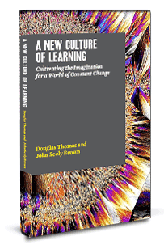
A New Culture of Learning


"A New Culture of Learning: Cultivating the Imagination for a World of Constant Change", Douglas Thomas and John Seely Brown.

Just finished reading the new book from Douglas Thomas and John Seely Brown. It pretty much captures it for me, the whole idea of learning as play and following your bliss (or passion) while pursuing learning is exactly how I see it. If you have been following my blog over the last while and the anchoring of my self-directed "nophd" you will know I firmly believe in the value in learning through following your passion. Outside of the institution it would be a herculean task to complete a PhD without a strong internal motivation. Not to say it is easy from within the institution, just their are structures to help with getting to completion when in the institution. If you are a life-long learner and considering scholarly pursuits this book is a must read for all adult learners; and parents who are wondering best how to prepare their children for a future of constant change.

I have been a follower of John Seely Brown since his co-authorship of the article "minds on fire". This article galvanized my change of career when I brought together 15 years of information technology work with 8 years being college and university faculty. The reason I bought the book was I caught wind of the difference between a collective and a community and how a person learns within the collective. And how a person within a collective is different than a person within a community. Essentially, the person serves the community and the goals of the community where a collective has many participants and the people are served by the collective. This is an important difference to the motivations behind engagement. From the life-long learner perspective, finding a collective where your interests are strongly aligned is a blessing and a great support for your learning.

The book also touches upon inquiry and the fun that can be had when asking questions and gaining new knowledge. And how inquiry really focuses on the gaining of knowledge rather than the outcome. You know, its the journey not the destination kind of thinking. This inquiry part resonates for me as I often refer back to the Progressive Inquiry Model when I am thinking and writing about online and learning 2.0. I still see Progressive Inquiry as the first writings about pushing beyond constructivism and provides a model for the activities that go on within connectivist learning. It is the connections that are created within the "progressive" inquiry where the knowledge is gained, developed and grown.

Thomas and Seely-Brown make use of the word indwelling, which originated from Michael Polanyi. I found the use of the word indwelling as new for me. Though I have thought about it often, particularly as I have been thinking about my "nophd" and how it could take a great deal of time to gain the expertise to have a PhD depth of knowing. And this mastery of a subject occurs through a prolonged study of a subject. For me I recognize this and aspire to master folk music and dance over the next period of time, whether it be 10 or 30 years. As adult learners I believe this is the playfulness and ease which is found as one attains indwelling that will assist in success. All good!

Where I found the book could have elaborated more is in how this thinking could be applied in institutional environments. Over the last few years I have been very critical of institutionalized learning and recently I have been thinking more about all this great work with the new approaches to learning and rarely do I read about how they could alter and enhance institutionalized learning. I thought the book was going to get into it for it touched upon the number of hours students spend on campus and how much "free" time they have outside the classroom. I see this time as being open to be occupied by this kind of learning, the free flow of exploring ideas and following those subjects which excite the learner, even if they are on campus.

I loved the story this book told. It did a great job of setting the stage and followed up with a succinct and powerful description of how people are and will be learning in the 21st century. A great read for all the life-long learners who want to add approaches and understanding to their learning.

Saturday, March 05, 2011

Consolidation of blogs

A month ago I decided to move my website hosting all over to rackspace and this has been progressing very well. Changing hosting providers is not a small task as I have my own domains and those of a couple of clients also hosted with netnation. The hosting provider move will require the following steps;
  1. Contact clients, tell them of the move
  2. Assist clients with their move as we agree
  3. Review my services and develop migration strategy
  4. Consolidate my blogs
  5. Create rackspace instance
  6. Move bit.bc.ca with focus on creating and testing email services
  7. Move endeavours.com with focus on email services, mysql, php, REST APIs, and Drupal
  8. Move rawsthorne.org with focus on website and email services
The move of docudance went very well, and in the process a new developer released a completely reworked version of the site. It looks great!

I have also moved my first blog (2004 - 2007) from blog.rawsthorne.org to have all the post a part of this criticaltechnology blog. There was not an export service from my original blog so this took some effort. It was time well spent as I got to review my past writings. Quite interesting to again read my thinking from six to eight years ago. The main themes and standout posts are;
  • The importance of software quality on technology start-up success
  • The formation of my ideas around ICT4D and how it should be driven from the village out
  • The creation of a Learning Systems Architect job description
  • A whole lot of thinking about Agile software development and how to manage small teams
  • Prediction of SEAMLESS LEARNING

The next phase of the migration is to create my new rackspace instance. Oh, the technical fun begins...

Thursday, March 03, 2011

Internal corporate blogging

With such large numbers of knowledgeable and skilled people retiring, wouldn’t it make sense to have them blog (or contribute to a wiki) every day as a part of their job description. They would create postings about the work they do and the wisdom they have before they leave the building for their retirement. Once in a blog or wiki all this knowledge could then be indexed by the internal indexing / search engine and it wouldn’t be lost.

Tuesday, March 01, 2011

Sir Isaac Newton and Lorenz's Butterfly

Oh the wonders of Morris Dancing. I came to a deeper understanding of one of our dances over the last week. The dance is known as Lorenz's Butterfly. I actually find it one of our most beautiful dances, this is due to its dynamic flow and simplicity.  It is also the only dance I know how to call. Here is a version danced by Bogart's Breakfast;


What gave me a deeper understanding was initiated by my watching this outstanding BBC production titled; Complexity - Secret Life of Chaos, and the reading of some amazing scientific minds;


    So what really got me thinking about how all this fits together is how the dance has four dancers ganging up on one dancer, dressed as the devil. I see the four dancers being Alan Turing, Edward Lorenz, Boris Belousov and Robert May all beating up on Sir Issac Newton signifying the death of the Newtonian scientific view. And therefore giving birth to a new science that includes Chaos Theory... The dance has the following moves which signify the following themes;
    1. Opening - ganging up on Newton.
    2. Chorus - exchange of ideas.
    3. Round the gardener - scientific inquiry within a focused area of study.
    4. Chorus - further exchange of ideas.
    5. Flutter - the birth of a new theory.
    6. Chorus - further exchange of ideas.
    7. Lines - the communication of a new theory.
    8. Chorus - further exchange of ideas.
    9. Exit - the setting free of the new theory.
    So there you have it. A Morris dance interpreted as scientific discovery or is that scientific discovery interpreted as a Morris dance, or is that a small jig that sets off the wonders of a whole chaotic Ale... Oh the magic of it all.

    Friday, February 25, 2011

    Networked and Open also means Collaborative

    This is what the Networked and Open PhD (NOPhD) is all about. It is about working with others in an open and collaborative way so everyone deepens their knowledge on a shared subject domain. The great part would be if everyone who is in the collaborative cohort aspired to develop a PhD level of knowing within the subject they share a passion. Due to the networked (and collaborative) aspect of the NOPhD I believe a number of people in the cohort need to make it to the PhD depth of knowing, otherwise it couldn't be considered networked. So I have faith and begin to encourage (and hopefully inspire) the people around me (virtually and otherwise) who are interested in this pursuit of developing a deeper knowing of Folk Music and Dance. And those interested in pedagogy, technology and life-long learning; for I will be drawing on these skills and knowledge as I build upon this anchor subject.

    So what exactly does this look like? Well why don't I describe my week and how certain events fit into the networked and collaborative;
    1. On February 24th I committed to Folk Music and Dance as the anchor subject for my "nophd". This decision was assisted by my network.
    2. I did some searches on the history of Morris dance and the instruments used, I knew of and was looking for a whistle type instrument played in one hand. I discovered the pipe and tabor was what I had been looking for. I found few sites and ordered some pipes and some books. During these transactions I made contacts, exchanged emails and have added a couple more people to my network directly involved with my chosen subject area. They offered assistance if I request.
    3. I also found a couple of groups online, including one in facebook. So I asked a couple of questions and already have replies. It was even suggested that I start with learning Good King Wenceslas. So once I get the scales down and am feeling comfortable with the fingering I will start with this song. I need to trust the suggestions of my network.
    4. I also had an email exchange with the whistle blower in our Morris side and he is jazzed about having a pipe and tabor in the group and is also interested in learning the instrument.
    After discussion it would seem I can adjust flute scores to the pipe.


    So there you have it. Five days after committing to Folk Music and Dance as the anchor subject for my Networked and Open PhD I already have begun engaging three people in my new online learning community and have made face to face contact with another who is interested in my journey. Ahhh... self directed and collaborative learning at its best.

    Monday, February 21, 2011

    Networked and Open PhD (#nophd)

    So I've committed to using "nophd" as my hashtag rather than "onphd".
    Why? for a number of reasons;
    1. NoPhD has a better likelihood of becoming a meme than OnPhD.
    2. What I am doing is thumbing my nose at the PhD. Because I believe it is no longer relevant for the adult life-long learner. Particularly, given I have no intention of becoming an academic.
    3. What I am doing is No PhD, because I see the PhD as an academic brand.
    4. In this endeavour I believe the Networked part is much more important that the Open part. So the N should come before the O.
    5. I like the humorous side of calling it a NoPhD, even though it means Networked and Open.
    6. I'm doing this because I want to serve as an example (maybe even an inspiration). I want to show how a person using many corners of the available technology and pedagogical approaches can deepen their knowing in a chosen subject area. I want to become a case study in developing a PhD level of understanding in the open while drawing on my network and collaborating with others with similar interests. I also want to help others do the same. I don't want No stinkin' PhD!

    Sunday, February 20, 2011

    Pipe and Tabor

    So my first steps toward "nophd" begin. I have ordered a couple of pipes from the taborers society. And I have purchased a couple of books from Kelischek Workshop for Historical Instruments.


    I also have a recently burned CD of our Morris sides popular music and I will be loading this into my Ableton live based studio. Here I will begin to record my musical learning, I will record my first attempt at playing the pipe so we have a baseline to my progress.

    I have also joined the Pipe and Tabor group on facebook, and this already seems to be connecting me to my new learning network. All good!

    Saturday, February 19, 2011

    An anchor subject for my Open PhD

    My poll results are pointing me toward developing a mastery of folk music and dance while also deepening my knowledge around pedagogy, technology and life long learning. And these results are fine with me, as I believe having an anchor subject or activity is a pedagogically solid approach to give my research and activities a subject of interest (an anchor). Therefore, I will be applying what I know in regards to pedagogy, technology and life long learning as I develop a mastery of folk music and dance. I believe it is going to be a fun journey to develop Open Educational Resources within this realm.
     
    I really like where all this went. I was forced to think about completion and what it would take. The personal conclusion I drew was that exploring pedagogy, technology and life-long learning could not sustain me as a subject. Its what I do for a living, and I do it fairly well already with a proven track record and mastery. For me it really comes down to passion toward the subject of study, particularly if you are going to be self directed. I believe this will be true for most people endeavouring toward an Open PhD outside of the motivations inherent with doing a traditional PhD within a traditional institution.

    I really appreciate the people who responded to my poll and put the energy into thinking about the question I was asking.

    Thursday, February 17, 2011

    Manage your online reputation

    When doing an Open PhD or pursuing some form of life-long learning or academic study people will often speak of getting the degree, diploma or some certificate. I can see the value in having these from a recognized institution, but, in the end I consider it credentialism and no competition for good reputation management. If you are in pursuit of recognition for your life-long learning or academic study I suggest the better route would be a good reputation management strategy, rather than incur the cost and time of pursuing a credential from a recognized institution. In the age of the social graph, reputation is more important than credentials and will increasingly be used in securing jobs and showing an expertise in a subject area. I believe University credentials will decrease in value over the next 15 years and beyond.

    Build an understanding;
    Create a good understanding of online reputation management, the two queries that yield good reference toward this are;
     Regularly practice the following;
    1. Follow the home-base and outpost approach, post everywhere, post often.
    2. After reading a post or article and you have a comment, make it, and in the author profile link back to your home-base.
    3. As soon a you become aware of a new social media site be sure to secure your name on the site, have your profile refer back to your home-base.
    4. Write, produce, create resources that have some weight and add to the discussion within your chosen subject area. Be thorough, frequent, reference others and create quality!
    5. Set up Google Alerts on your name and other keywords in your chosen subject; monitor these.
    6. Review your traffic statistics, get a sense of why people are coming to your resources, and which keywords they are getting them to you.

    The goal;
    The goal of all this is to have the people you consider experts within your chosen area of study begin to follow you and make comment on your works. These people become your Personal Learning Network!

    Wednesday, February 16, 2011

    Polling widgets in blogger

    If you use blogger adding a poll to your blog is easy. And the way it is implemented allows polls to be associated with the whole blog or just a single post. The same poll can be used in multiple posts while the poll results stay the same.

    This can be done by adding the poll gadget to your blog from the blog design mode. While creating the poll take note of the title as you will use this to find the poll in your blogs source code.


    Once you have added the poll to your blog you will need to view the source code and find the iframe that contains the poll. The code for the poll will look something like what is displayed below, what you are after is within the iframe tags. The important part is the display number as this identifies your particular poll, in this example it is "1642576544783516899". So you can display the poll in any post as long as you use the same iframe syntax and the id number refers back to the poll as stored in blogger.

    <h2 class='title'>The fat cat sat on the </h2>
    <div class='widget-content' id='widget-content'>
    <iframe allowtransparency='true' frameborder='0' height='180' name='poll-widget1642576544783516899' src='http://www.google.com/reviews/polls/display/1642576544783516899/blogger_template/run_app?txtclr=%23634320&lnkclr=%23e2a059&chrtclr=%23e2a059&font=normal+normal+100%25+Helvetica%2CArial%2CVerdana%2C%27Trebuchet+MS%27%2C+Sans-serif&hideq=true&purl=http%3A%2F%2Fcriticaltechnology.blogspot.com%2F' style='border:none; width:100%;'></iframe>

    If you no longer want the poll displayed as a gadget on you blog page (but still within the post) you can delete it from within blogs design mode and the poll will still remain in the blog post. This is due to the id number.

    Tuesday, February 15, 2011

    Influence my journey toward an Open PhD

    If you were to follow someone online who is going to invest in documenting the process of developing a new area of knowing for themselves would you rather watch them in the area of;
    1. Pedagogy, technology and life long learning
    2. Develop a mastery of folk music and dance (while learning a musical instrument)
    3. Building traditional in-shore wooden boats
    Keep in mind that the process will be extensively documented with the goal of creating Open Educational Resources to support the knowledge building and to encourage others to join the journey, if they are so inclined.


    Would you rather follow me doing an Open PhD on


    Monday, February 14, 2011

    A new area of knowing

    So I continue on my path toward an Open and Networked PhD and in my last post I was musing about what am I doing and what is the point and all that navel gazing type of activity. I believe this navel gaze is an important step; for it will confirm my commitment to this journey and remove the doubt that I have chosen the correct subject area that will engage me enough to completion. Completion is very important. The first two questions from my previous post are about mastery and my chosen area of study. These two questions are;

    1. A PhD is about mastery and do I want to further master something I am already a master?

    I'd like to think I have a mastery of pedagogy, technology and life long learning. Now this isn't saying there isn't more I could learn in these areas, but I do have the following education and experience in these areas;
    • An undergrad degree (with honours) in Technology; a Bachelor of Technologies with specialty in database management.
    • 20 years professional experience working on and building information technologies. My responsibilities in this profession are broad, best to look at my linkedin profile.
    • Masters of Education with specialty in Information Technology. 
    • Eight years teaching adults at the College and University level; an additional three years teaching online and being deeply involved with the early stages of WikiEducator.
    • Involvement in the release of eight software initiatives during this year alone. My involvement has been architect / project manager / database administrator / even programmer over all or some of these initiatives. Each of these initiative shows a mastery of pedagogy, technology and life long learning.
      1. Progressive video assessment; AIM language professional
      2. Content level single sign-on; a RESTful API enforcing authorization to learning content
      3. Legal Search; a federated and faceted search over seven information silos
      4. Taxonomy cleanup; once federated the taxonomies required alignment
      5. Online TV; an episodic online streaming of talking heads with focus on a specific legal subject
      6. Practice Manuals
      7. Engagement Questions; encouraging a depth of learning using existing video recourses
      8. Online community; CLEOnline & AIM language professional

    2. I'd rather master something new (and therefore, fun), as I would otherwise become bored (see item 1). Should my Open and Networked PhD build on what I already know or should I develop a completely new area of knowing?
      I must choose personal areas of study that will sustain me for the next 30 years. And that's not sustain me financially, but sustain me spiritually, creatively and emotionally. For me that is not doing an Open PhD on pedagogy, technology and life long learning; its doing an Open PhD in either folk music and dance or traditional wooden boat building. I am absolutely enamored by both these subjects and I would like to develop a mastery of both. This would sustain me, and I am internally motivated to master both these subject areas. This is the carrot I require to complete.

      If you were to follow someone online who is going to invest in documenting the process of developing a new area of knowing for themselves would you rather watch them in the area of pedagogy, technology and life long learning or watch them develop a mastery of folk music and dance or building wooden boats? Keep in mind I will document my experience by using all I know in pedagogical approaches and technology. I will also engage experts in my chosen area whenever they make themselves available.

      Would you rather follow me doing an Open PhD on

      Yes, it all sounds like a lot of work, but what else am I going to do over the next 30 years?

      Thursday, February 10, 2011

      On doing an OpenPhd

      Yesterday, I was re-reading a 14 month old post about executing on an Open PhD written by a friend of mine, Dan Pontefract. It was good to read the comments so many months later and think about what was being said. I really appreciated the comments from practicing academics, in particular Richard Smith. I have the greatest respect for Richard due to his focus on supervising people through to completion in their graduate studies. I even know of him assisting people from other institutions in their completion. People who know my work know that I spent some time studying and facilitating workshops on completion and supervision when out at Memorial University of Newfoundland. The point is that completion rates aren't as good as they should be and Richard is a champion in assisting people to completion. When Richard wrote of the carrot that was going to get you through to completion I thought deeper about my field of study and if my self created carrot would get me to completion, regardless if the study was Open or otherwise. Anyhow, It's all good. As I continue to pursue the idea of an Open and Networked PhD (ONPhD) the re-reading of Dan's post (and its comments) really got me thinking about my Open PhD. The questions it prompted are very necessary and fundamental for me at this beginning stage of the ONPhD;
      1. A PhD is about mastery and do I want to further master something I am already a master?
      2. I'd rather master something new (and therefore, fun), as I would otherwise become bored (see item 1). Should my Open PhD build on what I already know or should I develop a completely new area of knowing?
      3. Currently, I am pursuing an Open PhD because I want to increase my reputation in my chosen profession, does this make sense? Is this the best (and only) way to increase my reputation?
      4. This pursuit is also about creating a virtual research lab to deepen my understanding (I'm predominantly a kinesthetic learner) of online self direct life long learning, and sharing what I learn/do along the way. Is wrapping it in the concept of a PhD really necessary? Isn't a PhD mostly about research, being a recognized expert, becoming a university professor, getting interviewed on CBC?
      5. Is an ON PhD, as currently being discussed, really that different than a traditional PhD? Isn't the disruption just a way to get out of paying fees and being aligned / restrained by the academy?
      I have complete faith I am exactly where I am supposed to be in my pursuit. I am committed to furthering my learning / education / knowledge beyond that of a Masters level. I know much of my studies will be in the realm of pedagogy, technology and life long learning cause that is what I do for a living. But does that mean it is a good idea for me to pursue an ON PhD in pedagogy, technology and life long learning? This reflection is an important step in this pursuit - more to come on this topic... and thanks to Richard for prompting this reflection.

        Thursday, February 03, 2011

        Tagging for community of practice

        Over the last few weeks I have been thinking about, and discussing, a couple of tags within the folksonomy for an Open PhD. The main discussion has been with Leigh Blackall regarding the use of 'openphd' vs. 'onphd'. There are a number of themes within this discussion important to the Open PhD, in particular, the tagging approach in general. These themes influence the choice of a tag and how it is used.
        1. the tag should become the meme (or identifier) for all those inspired by or engaged in this activity. This does not exclude the use of other tags (or words) that become a part of the folksonomy.
        2. tagging builds the Community of Practice (CoP) folksonomy. A tag and its 'surrounding' tags become a part of the folksonomy within the community participating in the subject area containing the tag (or word). This is also a semantic web issue. Its like adding reference points to the knowledge shared within a CoP. It is important to recognize the Open PhD movement is a CoP.
        3. tags should also resonate with how you personally organize data in your head. (your contribution to the folksonomy) It is this like mindedness (or common tags) that further connects the CoP.
        4. tags are global, community aligning and individual all at the same time. The tag can be referenced through your profile or through the communities or global folksonomy. Your personal tags are a subset of the global. see the difference here;
        http://www.delicious.com/tag/openphd
        http://www.delicious.com/prawstho/openphd

        All this comes back to the use of these two tags;
        openphd - which seems to have become the meme for the Open PhD, it's obvious why.
        onphd - which is meant to represent the Open and Networked PhD. This makes more sense as a tag for the Open and Networked PhD, for what we are doing will rely heavily on our social / learning network.

        So what is my approach within all this?
        I'm going to use both tags, openphd because it has become how I think about what I am doing and I believe it has become the meme regarding the Open PhD; networked and otherwise. I am also going to use onphd for items I come across that are reference toward the open and networked aspect.

        Note: What do I mean by surrounding tags. These are the tags that become words within the folksonomy shared by the CoP.

        Wednesday, February 02, 2011

        Building my home base on rackspace

        I'm moving all my domains over to rackspace and will firmly establish them as my home base. The sites include the following;
        • rawsthorne.org - this is my personal site and will be used to host my personal profile and all published content and links for my Open PhD
        • endeavours.com - eventually this will host the site for the massively collaborative assessment system (or some other domain name, TBD)
        • bit.bc.ca - Bowen Institute of Technology, this will be the instance pointing at the blended learning / community of practice site where people can work toward of becoming a Solutions Architect / Learning Systems Architect.
        Why the move away from netnation for my hosting? For a few reasons;
        1. Cost. Cumulatively netnation costs me about $400 per year, I believe I will have my dedicated cloud server for about $100 per year to start.
        2. Features. I was building some PhP/MySQL software a while back and I ran into challenges in altering the .hosts file to support a RESTful API I was building. Even after contacting netnations technical support they couldn't help me. I ended up using rackspace, their support was awesome.
        3. Cloud based servers. I firmly believe in cloud based approaches and if I can host multiple sites with the ability to expand for close to $100 per year, why wouldn't I move.
        Honestly, I really don't think netnation will mind that I move. I exhausted the discussion with the features I required. The features I required are to enable a RESTful API with a specific domain name. It requires some customizations to configuration files at the server level. Netnation were not willing to support the customizations I was requesting.

        Sunday, January 30, 2011

        My changing tagging strategy

        There are five main themes to the work I will be doing while completing my OpenPhd. And each of these themes need to be tagged so they can be referenced by myself and others. The five tags I will use with be;

        Why would someone want to follow these tags?

        1. they are a follower or contributor to the open phd movement (yes, I'm calling it a movement)
        2. they are a solutions architect, systems architect or enterprise architect or aspiring to be any of these roles and want to learn more or have another view on architectural issues.
        3. they are a business person wanting to gain a greater understanding of technology architecture, business processes, the vocabulary and best practices within this realm.
        4. they are a learning systems architect or educational technologist or aspiring to be either of these roles and want to learn more or have another view on architectural issues.

        Saturday, January 29, 2011

        7 releases in the next 8 months

        2011 is going to be a significant year for my consulting practice. About 10 years ago I made the conscious decision to complete a Masters of Education in Information Technology. I really wanted to bring together my software development career with my teaching career. I really wanted to shift my living to building educational technology and create educational content. I really think this year is going to be an accumulation of that decision, and that really excites me. I believe I need to cerebrate! I will celebrate each accomplishment as it is completed. And when I say completed, it has gone live on the internet and is available for consumption.

        The first of these releases is a project that started late in 2009. I was asked to come in and assist with the initial design, architecture and partner selection for a peer based video assessment site for language learners. So, one year later the site goes live and I believe we have done something quite innovative when it comes to peer based mentorship and creating a community of practice platform. I believe the innovation is mostly around the use of video within the site and within the peer-mentorship practice. This is a beautiful site focused on professional development of teachers, put together for AIM language Learning and built by AppNovation Technologies. As a further endorsement of my work and now the site is going live I have been asked to do follow-up work to assess the depth of learning and value proposition being provided by the site. This is exactly the kind of work I was hoping to achieve when I brought my technology back-ground together with my love of learning.

        Home bases and Outposts

        Recently I have been thinking about how social media and hosted content relate to the organization, a companies internet presence and personal projects. This has come up for two reasons; 1. thinking about the brand and community building for a client and 2. because I have started my OpenPhD. What's important is where the content gets hosted within these realms; do you have it on a company or personal website that you are in control? Or do you put it on a shared service like facebook, wikipedia, blogger, etc... This decision is well articulated in the idea of home bases and outposts.


        For organizations / companies the home base is important so you don't lose control over your content and your brand. Content stored elsewhere can be moved, more easily copied and deleted. The policies around your content are not yours, they are the policies from the shared service. Putting content on the shared service makes sense when you are wanting to attract attention and drive traffic back to your own site. Usually, the content put on the shared service is a copy of what you have stored on your own site(s). Essentially the outposts attract attention and drive traffic back to your business (or home base).

        For myself attempting the significant endeavour of an OpenPhD needs to have an online presence I have control over the content, how it is referenced and the ability to add and alter the software features around my content. This was apparent when I wanted to use delicious to bookmark my readings and references but couldn't reference delicious bookmarks in my Wikiversity profile due to the platform not supporting JavaScript. So, in the end I will build up my personal website to be my home base and refer to all other locations as outposts.