Showing posts with label nophd. Show all posts

Saturday, March 09, 2013

Book Review: Buccaneer Scholar

This book hit a home run for me in many ways;
  1. it chose a buccaneer (sailing) theme
  2. it told a good story with good imagery
  3. it challenged the status quo in education with personal evidence
  4. it provided a map to the self-directed learner
  5. it recognized the importance of organizing your learning goals
  6. it offers the adult learner an alternative
  7. it shows a life can be great, with amazing achievements, without a formal education
  8. it is inspiring to think what James has achieved through self-education
What Buccaneer Scholar did best is got to the root of it all by driving home the point that scholarship is about learning, personal learning. True scholarship is not about the certificates and institutional recognition but about learning new things, deepening your own knowledge, and being able to take on new challenges due to your ability to learn, with little or no guidance. In the end learning is about personal fulfilment, personal commitment, finding a satisfactory way to make a living, and honouring your life's journey!

Thanks James!

Tuesday, February 26, 2013

OnPhD: Identify your domain of study

This is the blog post describing completion of the second task of the OnPhD candidacy challenge. In this post I describe my domain of study and provide a potential PhD thesis statement.

This sentence and slide stack (with audio) should answer questions 1 thru 6.
My domain of study is the union and intersection of the educational technologist, the solution architect and the self-directed adult learner (heutagogue). The intersection of these three topics encourages the study of personal learning ecologies, the technology stack and distributed computing that supports personal learning, and the devices and user experience that best suits the self-directed learner.


These two sentences provide a potential PhD thesis statement.
The ability to validate and cluster all the events of life-long learning, regardless of their origin, will provide the required alternative to emancipate the self-directed learner from the limits of traditional accreditation. This shift will enable every learner, regardless of approach, to pursue learning with the same level of recognition as learners in traditional institutions.

To do: The completion of this task exposed a gap in my knowledge. I need to do a bunch of research on Heutagogy. From this reseach I will build another concept map, but this work will become a part of my OnPhD.

Monday, February 25, 2013

The Solution Architect

This concept map is a compliment to the previously posted "Educational Technologist" post. These two concept maps together provide the visuals for my identified domain of study as I work through the P2Pu challenge to declare my OnPhD candidacy. This concept map contains the two related concepts of Solution Architect and Information Technology (IT) Architect. Many of the skills and knowledge for the solution architect are a part of the overarching role of IT Architect. It is my intention to seek a research domain that occurs within the intersection of Education Technologist and Solution Architect. I believe bringing greater architectural discipline to the educational technologist role will assist greatly in growing this important role within the rapidly innovating educational space.

Tuesday, February 12, 2013

Learning theories, frameworks, and approaches

So I'm building a concept map for my application of candidacy for the Open and Networked PhD program with Wikiversity and P2Pu. The related P2Pu challenge requests a creative work that describes your area of study. My areas of study are self-directed life-long learning approaches (Heutagogy) and software architecture. One of the concept maps I am creating attempts to answer the question "what is life-long learning?" I started to visualize the terms;  pedagogy, andragogy, heutagogy, behaviorism, cognitivism, constructivism, and connectivism. I began to struggle with how these terms relate to each other within a concept map... so this micro learning journey began and inspired this blog post. How best do I visualize the connections and relationships among all these terms?

I read, I reflected, and I settled upon two main categories for the following reasons;

1. Approaches to teaching and learning
This set of terms describe ways of teaching and learning. And they describe how a person can learn and provides ways to plan and conduct learning.
  1. Behaviorism - a large amount of repetition to achieve the desired action.
  2. Cognitivism - sequenced learning. Learning is a determined journey, that with direction desired learning can be achieved.
  3. Constructivism - a persons learning is built upon previous learnings and knowledge. New learning are put into place based on this previous knowledge.
  4. Connectivism - knowledge is stored in your friends, the information appliances and the objects around you.
  5. Others - there are many other approaches, but I see the above four as the most generalized set
  6. Inquiry - I'd also include inquiry based approaches, cause they work really well... IMO.
2. How I perceive the learning theories
All of the theories are about how humans learn (or can be taught, depending on your perspective). I believe the biggest factor in applying learning theory is age. I do believe children learn differently than adults. I also believe adults can learn a lot from how children learn.
  1. Pedagogy - how kids are educated [taught or learned (let's say K12... could overlap into higher education and before kindergarten)]
  2. Andragogy - directed education strategies for adults
  3. Heutagogy - self-directed learning by adults (strategies for the adult to learn without the direction of others)
So there you have it, three theories and six approaches... I do believe that all six approaches can be used within each of the three theories (with varying degrees of success). All this reading and reflection influenced the organization of my concept map to look as follows; more on this to come...

DRAFT Knowledge Domain for the Educational Technologist v0.2


Tuesday, January 15, 2013

OnPhD: Describe your learning history

I am in the process of declaring my Open and Networked PhD (OnPhD) candidacy. After some discussion with a few like minded people, and the input from a couple of existing PhD's, it was agreed that declaring candidacy for a PhD was important. The idea of creating a P2Pu challenge for declaring OnPhD candidacy seemed like a great way to get started.

This is the blog post describing completion of the first task of the OnPhD candidacy challenge.

Informal and formal learning
Publishing and research projects

Sunday, December 02, 2012

Confessions of a badge addict

I'm fully into moderating a two week seminar series on digital badges. The seminar has far exceeded my expectations, the dialogue is outstanding and the participants are more than I could have dreamed of. 


When I was responding to one of the discussion threads I realized I am a badge addict. I have badges from more sources than anyone I have met during my last eight months of exploring and discussing digital badges.

In my youth I earned badges from at least five different sources. As show here I have badges from; Scouting, YMCA leaders and swimming, Red Cross, Canadian Particip-Action, and Canadian Yachting Association. I always knew what the criteria was and planned out my earning of the badge(s). And I don't recall ever just being given a badge. I looked forward to the events when I received my badges. I think I now know why I am so commited to furthering the idea of digital badges... and most of my efforts are in a volunteer capacity... this is all good!

I also spent time in organizing my badges, at first they remained sewn onto the scout sash or another appropriately wearable piece of clothing. I wore them with pride. When i was in my teens (I was into stitching) I moved all my badges onto a single piece of fabric and displayed it on my wall. I organized them by issuing organization. Now they exist in an old brown leather covered box and they are one of the things that stays with me as I move house, change cities. I'm not a big believer in keeping stuff (IMHO, it just clutters ones life), but the fact that these badges remain as one of the things that stays with me, implies I continue to attach importance to these achievements...

http://scope.bccampus.ca/mod/forum/view.php?id=9010

If you want to join in the two week seminar series on digital badges, feel free to jump in, introduce yourself, add to the discussion or just follow along. You would be very welcome!

Thursday, November 29, 2012

The essential tasks for understanding digital badges

Over the next two weeks I will be facilitating a seminar series and two lunch-and-learns focused on understanding digital badges and how they can be deployed and issued to learners of all kinds. The seminar series will take place in SCoPE and begins on December 1st. Feel free to join in...

http://scope.bccampus.ca/mod/forum/view.php?id=9010

Over the first week I will be working through a number of tasks to help build understanding of digital badges and the resources available and required to be able to issue badges to learners (institutional and otherwise).  For an idea of the tasks feel free to review the six described here;

Task 1: The merit badge
1. Identify a merit badge you earned during your lifetime.
What did you have to do to earn it? Did you earn more than one badge? And were they awarded by the same organization?
2. Describe how you displayed the merit badge(s).
If you earned more than one badge, did you display them together? Did you display badges from different organizations together?

Task 2: The digital badge
3. Identify the digital and internet technologies best suited to create a digital merit badge.
How would you create the digital file (image) of the badge? Is it possible to keep people from copying the badge without having earned it?
4. Describe the technologies that could be used to attach (or reference) the learning to the badge.
Is there more than one way of "attaching" learning criteria to a badge? Would this criteria attribute differ from a learners evidence of fulfilling the criteria? Could a badge criteria change through time?

Blooms Rose
Task 3: Identifying the curriculum
5. Identify the completion criteria for any badge you have earned (traditional or digital).
Did you have to complete a series of tasks? Did you have to prove mastery of a skill? How was the mastery described? Was the badge knowledge based, how was the knowledge domain described as a learning criteria?
6. Describe a hierarchy or network of badges.
Does a single badges stand on its own or is it best associated with other badges? Do badges cluster in and around knowledge domains? Do badges exists in hierarchies or networks or both? What other patterns can an collection of badges exist?

Task 4: Go earn some badges already!
7. Identify a variety of sites that issue badges.
Spend some time to find two or more sites that issue badges. Are these event based badges or learning based badges? Do the badges exist on their own or are they a part of a hierarchy or network? Earn some badges and figure out how they are displayed. Were the badges easy to earn? How easily can they be displayed outside of the site where you earned the badges? Display your badges or send the link to a friend.
8. Describe the skills, knowledge and curriculum the badges represent.
Can you easily describe the criteria for earning the badges you just completed? Were they part of a bigger curriculum? Were the badges more commercially oriented? Would displaying the badges attract other to earn the badges or participate in related learning?


Task 5: Building the digital badge(s)
9. Identify the visual elements that best describe the learning represented by a specific badge. 
Does the learning represented by the badge have a de facto standard image. Are there elements of your group, team, organization or institution that also need to be part of the badge? Are there visual elements that are well suited to the badges target learners?
10. Describe the skills and knowledge required to design and create the digital badge(s).
Does your team or organization have resources familiar with creating graphics? Are the resources familiar with the design, branding and layering of images? If your badges start showing up all over the internet do they promote a strong organizational brand? Why does this matter?

Task 6: Defending the digital badge
11. Identify as many objections to digital badges your organization or group may offer that keeps them from further exploring digital badges.
Are the objections focused on current accreditation approaches and why badges shouldn't to be integrated into existing courses, programs, etc? or are they focused on areas of opportunity? Do the objections include new and emerging technologies and pedagogical approaches? or are they focused on the traditional? Where do most objections come from?
12. Describe the different ways badges can be used for the institutional learner, peer-based learner and the self-directed life-long learner.
How do the three learner types described differ when it comes to accreditation. Does each different context / environment offer different opportunities for the issue of badges? What activities outside of courses and programs offer the opportunity to issue badges? Do badges offer things other than just accreditation? How can these be leveraged? Could peer evaluations be represented by badges? Could an independent learner prove competency with a collection of related badges from different sources?

Task 7: Deploying the digital badge(s)
13. Identify the internet technologies required to deploy the digital badge(s).
Think of this in non-technical terms; do you need a location to store descriptions and images? Where / how would you store the association of a badge to each earner? Are there security or information privacy issues you need to consider? Try and describe each of these in non-technical language with as much detail as you can.
14. Describe the skills and knowledge required to develop and administer the software and technical environment required to host digital badges.
Could you be non-technical and successfully deploy digital badges? Can you find any of the self-service digital badge issuing sites? Do any of these free digital badge systems insulate the non-technical person from the technology required to issue digital badges? If technology skills and knowledge are required can they be identified?


Friday, June 24, 2011

The nature of the work

I recently posted more of my thoughts regarding the independent / self-directed learner and their use of fair-dealing when utilizing educational resources, copyrighted or otherwise. In that post I spoke to the six-factors to consider with fair-dealing. One of these factors, "the nature of the work" is where my claim to use all materials with reckless abandon falls down...  
Particularly, when the nature of the work has been created for the independent / self-directed learner?

So what kind of resources do I believe fall into the category of "created for the independent / self-directed learner"?
  • Resources created specifically for professional development. Mostly, these resources are created for the independent / self-directed learner. And the nature of the work is servicing this groups learning needs while making a few dollars (not-for-profit and otherwise).
  • Sample exams and testing resources; (GMAT, LSAT, Certification Exams, Etc). All these exams and testing resources are, in general, created for the individual in preparation for exams / tests.
  • All self-help books (Spiritual, Physical, Emotional, Intellectual, Other). Go get the book from the library, or buy it if you are using most of it. If your going to copy or publish a paragraph or section into your blog or some other social media, be sure to provide attribution. Otherwise, we are back to private study... remember, the dealing needs to be fair.
  • I'm sure their are others... I'll list them here when I think of them or others comment with their suggestions.
So there you have it. My exception to learning with reckless abandon and claiming fair-dealing. If you are using a resources as an independent / self-directed learner and the resource was created for the independent / self-directed learner I'd suggest you consider honoring the copyright. Then of course, if you copy a paragraph or two, or an image from these resources and put them on your blog, provide some review or your thoughts  from a learning perspective were back to private study. Always remember to link back to the resource and give attribution. Obviously, there comes a point where it all becomes a little grey... that is why we need some case law on an independent / self-directed learner claiming fair-dealing when using copyrighted materials.

Tuesday, June 14, 2011

Fair-Dealing Case Law

Many of my recent posts have touched upon copyright as it relates to the self-directed learner and their use of copyrighted materials as educational resources. I believe this is an important issue for the adult learner. Therefore, I continue to look for case law related to this important issue in adult education. To date I have found no case law which includes an independent / self-directed learner using copyright materials for their private study. I believe it is important to define what I mean by independent / self-directed learner. An independent / self-directed learner is a person who is using any and all resources (copyrighted or otherwise) available to them while learning outside of any formal education program or institution. The independent / self-directed learner chooses subjects that interest them. They explore and learn all they can in the subject using all available resources (regardless of source). This independent / self-directed learning is also supported by the pedagogical practices of writing, reflection and discussion; therefore, leading to the use of the internet as a public publishing platform which also deepens the individuals learning. All of what the independent / self-directed learner does should be considered research and private study.

Recently, I was re-reading an article written by Michael Geist speaking to the issues around Bill C-32. It gets close to discussing the issue of fair-dealing as it relates to the individuals use of copyright materials. I say close cause it doesn't speak of an individual but of students within educational institutions. This is as close to case law on the independent / self-directed learner within fair-dealing I can find. What stood out for me within the Geist post and embedded ruling were three main themes;

First theme:
The two part test; where first, the dealing needs to fall into one of the following categories to be considered fair;
  • research;
  • private study;
  • criticism;
  • review; or
  • news reporting
I believe an independent / self-directed learner is engaged in research and private study, even review. This then takes us to the second part of the test, where the dealing is considered for its fairness via the following six factors, this is how I see these six apply to the independent / self-directed learner;
  • the purpose of the dealing;
  • its private study; not hard to convince a judge, if what you are doing is genuinely research and private study.
  • the character of the dealing;
  • its personal-improvement, professional development, self-directed learning done under your own initiative; again, not hard to convince a judge, if what you are doing is genuinely research and private study.
  • the amount of the dealing;
  • you will only ever be copying any resource once, maybe twice. Your not copying for your own profit but your personal learning; again, its research and private study.
  • alternatives to the dealing;
  • there will be alternatives, but as an independent learner you want to read, listen to, watch as many resources on the subject to deepen your understanding; again, its research and private study.
  • the nature of the work; and
  • If the resource was specifically created for and to be sold to the independent / self-directed learner, then it may be a good idea to pay for it rather than find another way to access it. So here is an exception... Wow. I didn't expect that. If the resource wasn't specifically created for the independent / self-directed learner then use it.
  • the effect of the dealing on the work.
  • I believe that your use of a resource and your public reference to the resource from within your private study will attract more people to the resource. In most situations this is good for the publisher of the resource.
Second theme:
The use of the table (found on page 10) describing how materials could be copied, and how all parties agreed that as long as the copying was within the first three approaches it should be considered fair-dealing. In my opinion, this is a significant endorsement for the independent / self-directed learner to use educational resources with reckless abandon as it falls within research and private study. I'd strongly suggest you reference the source when using these resources for your learning. Beyond that, go wild, learn with reckless abandon!


Third theme:
The distinction of education vs. private study was further clarified (on page 19). And fell in favor of the independent / self-directed learner;
The adjective "private" is intended to exclude from fair dealing the commercial use of copyright protected material that has no educational value. I fail to see how the word "private" should be equated with "non-commercial". "Private study" presumably means just that: study by oneself. If Parliament had wished to exclude only commercial exploitation it could have used words to the effect of "non-commercial" or "not for profit". A large and liberal interpretation means that the provisions are given a generous scope. It does not mean that the text of a statute should be given a meaning it cannot ordinarily bear. When students study material with their class as a whole, they engage not in "private" study but perhaps just "study".
This document contains much more description of "private study", and in my opinion further supports the independent / self-directed learner. As this federal court of appeal points out, it depends on the facts of each case. Therefore, we need more fair-dealing rulings, particularly with the independent / self-directed learner.

Thursday, June 09, 2011

MUSIC 101: Ableton Live and the Pipe and Tabor

So I've been reflecting upon my learning of the pipe and tabor and how it has stalled in its progress. Not that I have stopped learning how to play the instrument for I believe my approach toward its mastery is also a big part of my learning. I have learned a number of important lessons, its just the lessons do not have me actually playing the instrument, what I have learned about is my approach to learning the instrument.

My lessons learned are as follows;
  1. I need feedback. I need to also train my ear and it is difficult without any actual musical reference.
  2. For me, learning the instrument is also in learning the songs, their melody, and lyrics (if available).
  3. I need a quiet place to practice that won't disturb the family
My deliberate practice;
  1. Get the Ableton based studio working with the new MIDI keyboard so I can listen to the songs on the piano, then play them on the pipe.
  2. Be able to record my practice so I can listen, get feedback and train my ear. 
  3. Use Abletone in Live mode where I could listen and play along, while also recording.
  4. Iterate between playing the music on the piano and then playing it on the pipe.
Next Steps;
  1. Finish configuring Ableton Live 8 to work with the new Oxygen 25 MIDI keyboard
  2. Become proficient with Live 8 to record my sessions and listen live to my iterations between piano and pipe
  3. Memorize the lyrics to "Go enlist for a sailor"
Learning Outcome(s);
  1. I will be able to use a Digital Audio Workstation (Ableton) to record and playback the playing of a pipe and tabor while alternating this play with the MIDI keyboard.
  2. I will be able to sing "Go enlist for a sailor" in its entirety (this does not mean I will be able to sing it well)

Wednesday, June 08, 2011

My Deliberate Practice

After my reading of "Talent is Overrated" I will be including a deliberate practice approach to my learning of the pipe and tabor. I will bring a more deliberate practice to much more of what I do. For the time being a deliberate practice will have me reflecting upon my learning where I focus upon what is holding me back. Until I have a foundation which to build upon I need to create my broad and stable base for my musical study. Keep in mind I should be considered a beginner musician. Many of my coming posts will be the writings about this deliberate reflection. My reflections will include;
  1. recent lessons learned - a candid review of my most recent learnings
  2. the actual practices - where I believe I need the most practice
  3. next steps, and - what I am going to do to facilitate the practice
  4. learning outcome(s) - the specific outcome(s) of my learning

Saturday, June 04, 2011

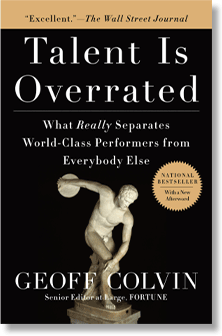
Book Review: Talent is Overrated

If you ever find yourself saying you can't do something because you don't have the talent... or you don't believe you could take your ability to the next level... read this book! This book does an excellent job of dispelling the myths around needing talent do become an exemplary performer. The main theme in the book is in exploring deliberate practice, and there have already been a number of good reviews of this 'talent is overrated' book and exploring / applying approaches of deliberate practice. So feel free to explore these for yourself.

Early in the reading of this book I enjoyed exploring the myth of talent and deepening my understanding of deliberate practice. My personal reflection fell into two themes, and what stood our for me was;
  1. As a parent, how I can encourage my children to strengthen their abilities for what they love. And how they can approach practice in an efficient and valuable way to increase their abilities.
  2. As a professional, how it is important to trust the expertise people have developed over the years and allow their multiple intelligences to emerge in the workplace by not getting in their way. I often find senior personnel getting in the way of peoples intelligences. A person who has over 10,000 hours of practice is going to intuitively know things that other are not. We need to trust this for ourselves and for others.
As I moved into the later chapters I began to understand how this book becomes a management consulting book focused on good leadership. The book deep dives into the value of deliberate practice in management training for organizations who want to remain leaders in their field. We have entered into a knowledge based economy where command and control based organizations will not survive; there is too much to know and no one individual can keep up. Staying competitive is a shared responsibility among all the employees and building great leaders and exemplary knowledge workers is key to this. As I read this section of the book it became painfully apparent that working for an organization that does not encourage leadership training and deliberate practice among its employees is a poor career decision for those who stay with such an organization. In the end each individual is responsible for their own skills and knowledge, having a deliberate practice around continued professional development is paramount for ongoing career success, working for organizations that overtly support this is important.

As the booked moved into its closing chapters it looked at how deliberate practice is also great for teams; in particular, how teams of individuals are different than teams of collectives. A group of individual top performers is often outperformed by a collective of people where the deliberate practice includes many team focused activities. As a technologist I was very attracted to the chapter describing deliberate practice and innovation. The book looked deeply into the eureka moment and how it rarely exists, most great innovation comes from years of hard work within a given subject area. Ideas are built upon one another and discoveries are often slowly baked to completion.

I believe this book will affect me for many years to come. It will impact the way I parent and how I encourage my children to pursue the things that interest them. It will change the way I practice and learn about the things I am interested, and having read the book I will never be able say I don't have the talent. When it comes to the workplace, and working in small teams, I will draw on this book as a reference in building a strong and healthy workplace with teams who have broad and focused abilities, and how those attributes can be encouraged. If you want a book to draw upon when taking on tasks that seem out of reach, this would be an excellent book to start.

Thursday, June 02, 2011

Personal Learning Ecology

I was prompted by a very interesting tweet the other day. Nancy White asked the question "What was the difference between a Personal Leaning Network (PLN) and a Personal Learning Ecology (PLE)". This question got me thinking and I have reflected upon it often in the last few days. One thing that jumped out from this reflection is to add the Personal Learning Environment to this question.
This is how I define these three related ideas;
  • Personal Learning Network is global and includes wherever your network reach extends, all resources are available (these resources can be; filtered or unfiltered, human, digital, printed, or otherwise). It is important to consider everything in your network that can contain or process knowledge and provide skills acquisition or understanding as a part of this network. Your PLN is very broad.
  • Personal Learning Ecology is more geographically related... the learning objects are what is available in the "local area" or within easy reach (digitally or otherwise). Items in the learning ecology are what come available as the learner goes through their day and are the items in which the learner has built their knowledge. These objects have the ability to be viewed through multiple intelligences and consumed using multiple tools. They are the things that are on the current learning path and not too far out in the persons network. What is in the ecology is a subset of your PLN and these items are very easily accessible through multiple modalities at the right time. Often it is the objects that are right in front of you during your learning that are most important, its the "when the student is ready the teacher will come" idea. And with PLEcologies the teacher can come in many forms. Depth and breadth is also important, therefore when the learning opportunity presents itself it needs to be explored in its entirety.
  • Personal Learning Environment is the full extent of the tools used to gather knowledge and deepen understanding. This PLE is more technology based and includes all your devices, approaches and collaborative technologies.
An example:
I have taken it upon myself to develop an expert understanding of the Morris dancing and related folk music tradition with focus on learning to play the pipe and tabor. I've committed myself to this journey and for me its about getting to mastery, not the rate in which I get to mastery. I purposefully put myself in positions to learn more. I have been documenting my process in learning the pipe and tabor and regularly seek out opportunities to deepen my understanding of Morris dancing and playing these traditional musical instruments. I have felt this is slowing due to not getting the correct mentorship and feedback as I try to learn, and not knowing what is my next step toward deliberate practice is difficult. I continue to read books on the subject and attend festivals and face-to-face workshops to learn more. Recently two things have occurred that I consider show the difference between a learning ecology and a learning network.
  1. A while back I was searching for books in these subject areas. My emerging learning network on this subject pointed me toward a couple of books which I have begun to read. One of the books describes when learning the pipe and tabor it is good to do this by ear, and it is a good idea to practice while sitting at a piano so you can listen correctly to the notes as playing on the piano then play them on the pipe. This back and forth between piano and pipe will greatly assist in learning the tones that occur when over-blowing the pipe. Training the ear is important to learning the pipe. Even though the book(s) came via my network, it is the presence of these books close at hand that put them into my ecology.
  2. I have also been focused on learning a jig called "I'll go and enlist for a sailor". Some of the steps were eluding me. Over this last weekend I attended the Marlboro Morris Ale and was fortunate enough to meet John Dexter, who could teach me the jig. I was shown the steps in detail by a master of the dance, much of the mystery of the steps were demonstrated, they are no longer a mystery. All my reading of the dance, watching videos had prepared me well for this master / apprentice type session. I was ready to learn and the correct situation presented itself as I was on my learning journey. The Morris Ale became a part of my learning ecology.
These are both examples of how what was right in front of me from within my PLEcology is what I needed best. How this is different from the PLN is that I focused my learning on what was directly in front of me as resources instead of searching my broader network. Most often it is important to hold the faith that the right learning is available at the right time.

    Wednesday, June 01, 2011

    I'll go and enlist for a sailor


    One of the items that stood out for me while participating at the Marlboro Morris Ale was having John Dexter teach Joe and I the "I'll go and enlist for a sailor" jig. I have been wanting to learn this jig for six months now and have been watching video and preparing myself to play the tune on a pipe and tabor. I struggled with some of the basic steps of the jig and felt I needed some direct instruction; fortunately, John is an excellent teacher.

    I also found a number of good references to play this tune and found the sheet music.


    For instructional purposes I also found this video. Stay tuned as I take the dance apart, and video myself learning each piece... one day soon you may see me dance the whole jig.

    Tuesday, May 31, 2011

    Marlboro Morris Ale


    I spent the weekend dancing and playing music. I am a Border Morris dancer and will musically participate as a percussionist whenever the opportunity arises. The dancing was in six and eight person dances with the occasional mass dance (that's everyone dancing), the music participation was with playing an ugly stick. All this took place at the Marlboro Morris Ale. It was an amazing weekend.

    What stood out for me most was;
    1. The fantastic dancing from the youth at the ale
    2. That we danced at a number of care facilities
    3. The amazing meals, coordination and logistics
    4. The quality of singing during the open pub nights and during the day
    5. Singing "Pinball Wizard" as a shanty
    6. Having some "I'll enlist for a sailor" jig lessons
    7. Hanging out with some great friends and making new ones

    Thursday, April 28, 2011

    Thanks to WSIS for hosting this OER debate

    I want to thank everyone who has contributed to this oxford-style debate, both invited contributors and commentors. I also want to thank WSIS for creating the space for this event. Thank-you.

    I have listened and read David Wiley and Stephen Downes go "head-to-head" on this and similar topics in the past. And thanks to both of them for their boldness and thoroughness. After years of struggling with the issue of copyright and educational resources I believe it has never been so clear to me as it is now. Lurking upon and commenting within this debate has been an excellent personal learning experience. And is very well aligned with some of my current writings on the subject; http://criticaltechnology.blogspot.com/search/label/fair-dealing.

    What has emerged for me is as follows;
    1. There are two distinct views within this debate and I believe they have different and opposing interests.
      • Independent Learner (adult or otherwise): I consider this collective of individuals as the largest block of OER consumers and creators. In my opinion, from an educational resource consumer perspective, they can almost completely ignore copyright due to fair-dealing / fair-use (All they need to do is honour the BY). And > 70% want to contribute with a NC license. I appreciate Stephens reference to flickr on this. The independent learner (whether self-directed or institutionalized) is the target group for OER creation and consumption. All mass collaboration projects are examples of this, and its success. - I feel this group was under represented in this debate.
      • Institutional Faculty, Staff and Employees: This group is restrained by their being associated with large institutions (whether public, private, commercial, academic, govt; they are NOT independent learners) And they have to work within the guidelines (and legalities) of their institutions and cannot claim fair-use / fair-dealing. And cannot publicly encourage their students to claim fair-dealing / fair-use.
    2. both institutions and individuals should be left to decide the licensing scheme they would like to use by choosing one that would best support their values and mission. Dictating the licensing scheme keeps people from contributing to OER.
    3. we still need to be very weary of commercial interests impacting access to educational resources, cause they will come at it from many different directions. This Michael Geist post titled, "Q.Do Digital Locks Trump Educational Fair Dealing? A. Yes." pretty much sums it up for me. And is why I voted NO for OER to favour commercial use. http://www.michaelgeist.ca/content/view/5479/125/

    Suggestion: Next time a similar debate is run please invite a few copyright lawyers with differing views (include fair dealing / fair use perspectives) and invite a selection of independent learners from different age groups.

    Monday, April 25, 2011

    Ignore copyright, its research and private study

    With the fair-use and fair-dealing exceptions to copyright the independent learner can simplify their perspective when considering using copyrighted material for their research and private study. Other than attribution an independent learner can ignore copyright and use all available materials to learn with reckless abandon. These rather bold statements are based on common sense and not being able to find any case law that would lead me to a different conclusion. In Canada (and many other commonwealth countries) we have fair-dealing. Fair dealing allows limited and non-commercial copying for the purposes of research or private study, criticism, review, and news reporting.

    With extensive searches for case law on fair dealing I was unable to find any legal challenges where a self-directed independent learner was being sued because they used copyrighted material for their research, private study or review. To support my position I believe it is important to answer three questions and make four important observations;

    Questions:
    1. What is research?
    2. I particularly like this description of research for it includes the importance of communicating to others as being a part of research.
      Research is the systematic process of collecting and analyzing information to increase our understanding of the phenomenon under study. It is the function of the researcher to contribute to the understanding of the phenomenon and to communicate that understanding to others. - Leedy, P. D., & Ormrod, J. E. (2005). Practical research: Planning and design (8th ed.). Upper Saddle River, NJ: Prentice Hall.
      I also like the definition from the intellectual property office in the UK for it also stresses the importance of providing sufficient acknowledgment. And aligns well with my previous statement about attribution.
      http://www.ipo.gov.uk/types/copy/c-other/c-exception/c-exception-research.htm
    3. What is private study?
    4. After review of a number of definitions of private study I found them mostly to be very similar. It is quite clear that private study is an independent activity that includes reading, reviewing materials, writing and reflection. 
      ...in private study during term (not counting time in lectures, classes or supervisions). You should try to work out a regular plan for your week which leaves you several periods free for concentrated reading and writing. Work out in advance what you can reasonably expect to read in the time available, and when you need to stop reading and begin to organise your thoughts and write. - selected text from the definition of Private Study, Department of ASNC Anglo-Saxon, Norse & Celtic, University of Cambridge.
    5. What is review?
    6. There are many forms of review and they are all well described in the following Wikipedia article. What I particularly like about this Wikipedia article is that it includes many different forms of materials that can be reviewed. 
      A review is an evaluation of a publication, such as a movie (a movie review), video game, musical composition (music review of a composition or recording), book (book review); a piece of hardware like a car, home appliance, or computer; or an event or performance, such as a live music concert, a play, musical theater show or dance show. - Review. (n.d.). In Wikipedia. Retrieved April 25, 2011, from http://en.wikipedia.org/wiki/Review
    Observations:
    1. Learning is a social activity, and there is no shortage of research and evidence in support of this. Learning with reflection, particularly public reflection deepens learning beyond similar activities without the public reflection.
    2. A well learned and skilled population gives a nation competitive advantage in the global economy. Therefore, I cannot see a court challenge finding against a person using any / all available material (copyrighted or otherwise) when they are learning. Particularly, when they are open about their use and are mindful of the six principal criteria for evaluating fair dealing.
    3. Within a personal learning context and given fair-dealings / fair-use, licensing then becomes about protecting the institutions. And no institution (online or otherwise), or its employees or faculty, are going to suggest to its learner community (students) to ignore copyright and claim fair-use / fair-dealing. This suggestion, made broadly, would be a violation of fair-use / fair-dealing. It is also why the institutions advocate so strongly in favour of copyright (I'll hedge because their lawyers have advised them as such).
    4. We really need some case law on this! Given none exists I'll hedge this falls in favour of the independent personal learner, and all copyright holders who have considered legal action against an independent personal learner and sought legal advice have been advised against taking action due to fair-dealings / fair-use.
    Please keep in mind this is my position on this issue. I am a self-directed adult learner who believes learning is a social activity and by sharing publicly my learning I am deepening my learning, engaging in progressive inquiry and focusing my deliberate practice. I do not feel I am pushing the boundaries of copyright for I am consuming, reusing, referencing and mashing resources within the fair-dealings exception and we need some case law to provide guidance to this important issue of open educational resources, personal online learning and fair-use / fair dealings.


    Request for information:
    1. If you are an intellectual property or copyright lawyer I would appreciate your commenting on this post from the legal perspective.
    2. If you know of an intellectual property or copyright lawyer, please forward this post and request they make comment.
    3. If you know of any case law regarding an individual self-directed learner within a fair-dealing or fair-use suit please forward it along.

    Saturday, April 16, 2011

    MUSIC 101: Mastery of the Pipe and Tabor

    This is what I would consider mastery of the Pipe and Tabor!

    MUSIC 101: Introduction to the Tabor Pipe

    WEEK 1

    Activities:
    • With great excitement I received my new Tabor Pipe last week. I immediately unpacked it and gave one of the three pipes a quick blow. So wonderful to have it in my possession. I ordered three, because my friend Henrik (who is already a whistle blower) will be helping me learn the pipe and I figured I'd give him one in thanks.
    • I also transposed "twinkle twinkle little star" to the music sheets I created for my learning, this was a great help to get used to the holing as I learn to read music. I hope soon I will no longer need the sheet with the holing indicated and I can just read the music.
    • I spent a fair bit of time learning the piece and I can now play it from memory. I really enjoyed sitting on the beach a few days back and spend a good hour playing the tune.


    Recording:
    At the end of the week I recorded "twinkle twinkle little star"; yes, I've got a long way to go to be considered a master of the instrument. Consider this the base line to my ability to play the whistle... a recording of where I started.


    Reflection:
    I learned much this week; about music, about being a whistle blower and about my simple recording studio. My main lessons were;
    1. No matter how hard you try, your instrument has to be in the correct key for the song to sound right.
    2. Overblowing as a way to have all the notes from a three hole pipe is going to be part of the challenge.
    3. Need to remember / study music notation sooner than later.
    4. Writing out the sheet music is also a good learning activity.
    5. Spending time working with the music studio will pay huge dividends, and I'm best to start with audacity as my recording software and move to ableton when I I want more full music studio features. This is mostly due to the learning curve of ableton.
    If your an adult learner who has ever aspired to learn a musical instrument; be bold, begin it now. If you don't believe you have the talent I suggest you read; Talent is Overrated by Geoff Colvin.

    Cumulative commitment: 10.5 hours
    • 3 hours playing
    • 1 hour reading
    • 0.5 hour transcribing to sheet music

    Wednesday, April 13, 2011

    A home recording studio

    I am preparing to record my first musical piece on the pipe and tabor using the home music studio. The piece will be twinkle twinkle little star. To start, I believe it would be useful to describe the technology within the home studio and why we decided on the setup we have.

    Requirements:
    MIDI ports and cabling
    We had a generic set of music and audio recording requirements. Where the system would mostly be used for my daughter in her music recording and composition and for my recording of podcasts, screencasts and music recording. Our requirements were as follows;
    1. Works well with our existing Yamaha MIDI keyboard
    2. Records acoustic instruments, including voice
    3. Allows for multi-track music composition and includes a good suite of  built in instruments
    4. Total costs less than $1000.00
    Solution:
    We found ourselves an inexpensive desktop machine running Windows XP with a big HD and lots of RAM and a reasonable monitor and video card. We added a wireless card so we could attach the household wireless network without stringing any wires around the house. We chose a M-Audio FastTrack Pro as the main "hub" to attach all the components within our requirements. A strong benefit of choosing the M-Audio is it came packaged with Ableton Live a Digital Audio Workstation that provides all of the features (and more) than we require. After installing Ableton Live we were prompted to install the free upgrade, this included over 100 instruments. We also included an Audio-Technica microphone kit with both an instrument microphone and voice microphone. This mix of the M-Audio FastTrack Pro combined with Ableton Live, the Audio-Technica microphones and some MIDI and microphone cables provide us with all we need. And in the last six months my daughter has composed a number of pieces and managed to get an interview on a local coop radio station.

    M-Audio Fasttrack Pro and the mix of devices it can attach.


    Recommendations:
    If you do go down a similar path with this hardware and software configuration I strongly recommend you invest time in understanding the relationship between the system settings for your audio devices, your internal soundcard, the m-audio device and the Ableton Live software. Once you figure out how to configure these to work together with the USB connected m-audio device you will be able to better manage how all the devices work together. I know this seems like an obvious statement, but once I had a deeper understanding how these worked (beyond just getting it working) I was much better at utilizing all the individual components and was able to use other software within the whole setup.

    Audacity audio recording window
    Audacity:
    All my effort in putting this system together and understanding its configuration has paid dividends. With my working on a #nophd I am now back to creating podcasts, screencasts and slidecasts and my tool of choice is audacity for audio recording. It is a great opensource audio editor which I am already familiar. I really like the crispness and clarity recording through the new microphone configuration, it is much cleaner than using an internal microphone or an inexpensive headset microphone. Soon the decision will come if I use audacity or ableton live to record my musical efforts... expect a new post soon on this music recording topic.