In my efforts to better understand this issues tied to Cape Roger Curtis I configure a custom google search engine. This custom google search points toward the following three sites;
Please suggest other relevant sites by commenting on this blog to improve this custom search engine.
Wednesday, February 25, 2009
Tuesday, February 03, 2009
OER roadmap
I've been working on a wiki based open educational resource (OER) project for a couple of years now. I work on it because I feel very well aligned with the sites main page description;
We're turning the digital divide into digital dividends using free content and open networks.As an active contributor to this wiki I feel I have benefited greatly from contributing. As a contributor I believe I have learned more than any individual content consumers (though I have no data to back this up, its just a feeling). I have come to believe that contributing to OER is the best way to learn from OER. It is the act of finding existing OER and reusing it or building upon it. If the OER doesn't exist for your chosen topic, then you have the opportunity to learn and build a new piece of OER.
I am currently involved in more than one discussion about how to encourage people to collaborate in the creation of OER. This is an interesting subject for I believe a number of factors impact OER collaboration. These factors are;
- OER saturation
- Licensing models
- Platform
- Localization
How these factors impact the growth of OER is best described within what I see as the OER roadmap. The roadmap has four phases;
- Build-up - saturation of the subject areas from both an access (bandwidth, connectivity and platform) and localization (culture, language, etc.) perspective so that re-use is all that is left
- Reuse - deepening the accuracy and diversifying the learning approaches and through a licensing approach (CC-BY-SA) that encourages reuse
- Assessment - a maturing model of open access assessment (OAA1)
- Accreditation - a globally recognized model of open access accreditation (OAA2)
I still see OER at the very beginning of the build-up phase. And given the solitary preparation methods many teachers already use, it is still a long way off to have saturation. I do believe the day will come. The other three are currently being worked on, but are dependent upon completion of the first to become mature.


Sunday, January 25, 2009
Community Involvement
So I'm preparing for my interview with ZenBiz radio. I was approached by Bruce Stewart because of my activity in using social media in community based initiatives. I believe society is just getting going with using the internet as the platform for citizen led electronic government initiatives. There is a lot going on in this space right now, and the "coronation" of President Obama has really legitimized citizens being able to ask for openness and transparency (municipal, regional and national) and for this information to be available as an API via the internet. Bruce asked that I have a quiet space and a landline for the interview. He also let me know I should expect questions in four themes. This post is my preparation for this interview.
1) Who am I, my relevant background
I would say the biggest impact upon why I am becoming increasingly involved with citizen based initiatives is a value given to me by my parents. Its the value of leaving somewhere in a better state than when you arrived. In general, I just don't see the "collective" we doing that. I believe if we increase citizen participation in caring for our neighborhoods and localizing our needs then we will be much more sustainable. I also believe government transparency will assist in this considerably.
I also believe my technology and educator background combined with my work with Information and Communication Technology for Development (ICT4D) have also influenced me. I think my work with ICT4D has influenced me in how I think the "collective" we (in the developed world) expect to much. To be blunt I think in the west we have become lazy and are overly entitled. Its time we collectively stopped consuming so much and started being more grateful for what we have and put back.
Lastly, I believe this YouTube presentation by Hans Rosling really taught me the importance of access to data and the social change it can assist.
I am involved with citizen based electronic government because I believe;
With these beliefs what am I doing about it? When I reflect, I'm doing a fair amount. I continue as a contributor and council member for WikiEducator, and this experience has taught me a lot about self-organization. I am continually assisting organizations to be successful with social media, organizational learning and technology architecture. I have brought my understanding of all these things together by initiating the use of BOWEGOV as a tag / hashtag to tie everyone's work together. As with any community there are a lot of differences among the different people, groups, neighborhoods, etc. What else would you expect!?! I felt if we chose a social media (web2.0) approach that was technology agnostic and was platform independent it would have greater appeal. So with tagging people can use the client side tools (Mac, PC, Nokia, iPhone, Browser, Linux, Etc, Etc.) they want without the whole thing getting tied to a single technology platform (Wiki, Blog, Drupal, WordPress, MediaWiki, Google, Etc, Etc.). After some discussion with others we came up with the idea that the internet is the platform. So we're not tied to any single platform and as the internet evolves, innovates and improves so do we.
3) Reaction from the powers that be
The short answer, there has been no reaction. So far this initiative is only starting. We have contacted a couple of council members and had social conversations with the mayor about BOWEGOV tagging. Its a small town of 4000 so these conversations happen. I think it is way too early to expect any traction. The idea of using social media for government really got started around the same time as Obama became a democratic candidate Though their is earlier evidence of this, it really didn't get traction/acceptance till Obama. And the conceptual learning curve is steep for people indoctrinated into traditional forms of governing. I have sent an email to our municipal council (see related post). I think this email will be most useful to refer back to in a Kolb kind of a way. I believe the learning has started... when it gets traction is the unknown.
Recently I have been seeking ways to coordinate citizen based approaches in preparation to meeting with the powers that be. I think this needs to be a good experience in a more coordinated way. In my seeking I have found the visible government website. I really like how they describe themselves;
4) Citizenship involvement
On bowen Island we are fortunate in that we have a number of citizens active and involved in the community. And a lot of the efforts are toward influencing local politics (though this could be for better or worse). I believe it is a part of living in a smaller community. I do see it increasingly important that citizens start doing more for their neighborhoods. I believe that our current expectations for what our governments will provide is unsustainable. I believe citizens need to let go of government even sustaining the current levels of service. Services are going to become increasingly expensive and the tax dollars aren't there to increase service. What this means is that citizens have to become more active at a neighborhood level to offset the need for services.
On Bowen Island we have had a number of people starting using Web 2.0 technologies to gather and communicate information. Here are a few;
1) Who am I, my relevant background
I would say the biggest impact upon why I am becoming increasingly involved with citizen based initiatives is a value given to me by my parents. Its the value of leaving somewhere in a better state than when you arrived. In general, I just don't see the "collective" we doing that. I believe if we increase citizen participation in caring for our neighborhoods and localizing our needs then we will be much more sustainable. I also believe government transparency will assist in this considerably.
I also believe my technology and educator background combined with my work with Information and Communication Technology for Development (ICT4D) have also influenced me. I think my work with ICT4D has influenced me in how I think the "collective" we (in the developed world) expect to much. To be blunt I think in the west we have become lazy and are overly entitled. Its time we collectively stopped consuming so much and started being more grateful for what we have and put back.
Lastly, I believe this YouTube presentation by Hans Rosling really taught me the importance of access to data and the social change it can assist.
I am involved with citizen based electronic government because I believe;
- Citizen based initiatives are more sustainable
- The developed world needs to give more back (or take much, much less)
- Government transparency will be created from the grassroots
With these beliefs what am I doing about it? When I reflect, I'm doing a fair amount. I continue as a contributor and council member for WikiEducator, and this experience has taught me a lot about self-organization. I am continually assisting organizations to be successful with social media, organizational learning and technology architecture. I have brought my understanding of all these things together by initiating the use of BOWEGOV as a tag / hashtag to tie everyone's work together. As with any community there are a lot of differences among the different people, groups, neighborhoods, etc. What else would you expect!?! I felt if we chose a social media (web2.0) approach that was technology agnostic and was platform independent it would have greater appeal. So with tagging people can use the client side tools (Mac, PC, Nokia, iPhone, Browser, Linux, Etc, Etc.) they want without the whole thing getting tied to a single technology platform (Wiki, Blog, Drupal, WordPress, MediaWiki, Google, Etc, Etc.). After some discussion with others we came up with the idea that the internet is the platform. So we're not tied to any single platform and as the internet evolves, innovates and improves so do we.
3) Reaction from the powers that be
The short answer, there has been no reaction. So far this initiative is only starting. We have contacted a couple of council members and had social conversations with the mayor about BOWEGOV tagging. Its a small town of 4000 so these conversations happen. I think it is way too early to expect any traction. The idea of using social media for government really got started around the same time as Obama became a democratic candidate Though their is earlier evidence of this, it really didn't get traction/acceptance till Obama. And the conceptual learning curve is steep for people indoctrinated into traditional forms of governing. I have sent an email to our municipal council (see related post). I think this email will be most useful to refer back to in a Kolb kind of a way. I believe the learning has started... when it gets traction is the unknown.
Recently I have been seeking ways to coordinate citizen based approaches in preparation to meeting with the powers that be. I think this needs to be a good experience in a more coordinated way. In my seeking I have found the visible government website. I really like how they describe themselves;
VisibleGovernment.ca is a non-partisan non-profit dedicated to promoting the planning, funding, and implementation of online tools for government transparency in Canada.The visible government group has also recently hosted change camps to get local groups to start working toward this initiative. There will be a change camp in Vancouver on 28 March 2009. I believe all this work in creating transparency to government will have an impact. Even upon our local municipal government(s).
4) Citizenship involvement
On bowen Island we are fortunate in that we have a number of citizens active and involved in the community. And a lot of the efforts are toward influencing local politics (though this could be for better or worse). I believe it is a part of living in a smaller community. I do see it increasingly important that citizens start doing more for their neighborhoods. I believe that our current expectations for what our governments will provide is unsustainable. I believe citizens need to let go of government even sustaining the current levels of service. Services are going to become increasingly expensive and the tax dollars aren't there to increase service. What this means is that citizens have to become more active at a neighborhood level to offset the need for services.
On Bowen Island we have had a number of people starting using Web 2.0 technologies to gather and communicate information. Here are a few;
- http://www.onedaybowen.ca/ - a blog for citizens sharing ideas
- http://www.onedaybowen.ca/maps/roadstat.htm - a tool for keeping people informed about road conditions
- http://bowenroads.blogspot.com/ - a companion blog for road conditions
- http://www.bimbc.ca/ - the Bowen Island Municipal website
- http://www.google.ca/search?hl=en&q=bowegov - google search of BOWEGOV
- http://delicious.com/tag/bowegov - delicious tagging of BOWEGOV
- http://search.twitter.com/search?q=BOWEGOV - hash tag for BOWEGOV
Thursday, January 22, 2009
Dear Bowen Island Council
A number of Bowen Island citizens with interest in social media are beginning to put together online citizen led approaches toward increasing citizen participation in our neighborhoods and community. The belief behind this activity is that if citizen participation increases from a grassroots level more will get done and people will feel increased responsibility and connection to their neighborhoods and community. It is also believed that citizen based neighborhood activities are a step toward lessening our environmental impact (the 100 mile diet could be considered and example, http://100milediet.org). On bowen island there have already been activities where neighbors have taken the time and energy to complete projects for the good of their neighborhood. I can see these neighborhood activities increasing and current technology trends provide online tools to assist.
All the changes occurring with politics, social media and transparency creates unprecedented opportunities for communication and openness. I believe their is an opportunity for the Bowen Island Municipality to be an exemplar in using technology to bring openness to municipal government. A project is forming to support this kind of initiative, see visible government; http://visiblegovernment.ca/index.php
A simple example of how this could work, could be for Bob (and or other council members) give brief online conferences of the provincial and federal rules and policies for running a municipal gov't. I am sure their are many simple and important municipal administrative topics that could occupy a 15 - 30 learning experience for the citizenship of Bowen Island. Increasing citizens knowledge in such matters could help in understanding how tax dollars are spent, how BIM adminsitrative processes work, public works function, etc... DimDim (http://www.dimdim.com) is a free social media service that could be used for such an activity.
There is already a building knowledge base using social media. This is being facilitated with the use of tagging, in particular the BOWEGOV tag. If you were to click the following links you would see how this tagging approach is connecting knowledge and allowing people to engage in ways they feel comfortable.
1) A search on Google (a shared reference to information related to bowen e-government); http://www.google.ca/search?hl=en&q=bowegov
2) Delicious tagging (the beginning of a taxonomy for electronic government); http://delicious.com/tag/bowegov
3) Twitter (a number of brief conversations about bowen e-government and related issues); http://search.twitter.com/search?q=BOWEGOV
Where all this social media and transparency will go in relation to small municipalities is still to be seen, as it is still being "invented". I look forward to your support in building greater transparency and increasing citizen participation in local gov't. If you would like to discuss any of these topics further. Please do not hesitate to contact me,
peter@rawsthorne.org or any of the others connected to these activities.
All the changes occurring with politics, social media and transparency creates unprecedented opportunities for communication and openness. I believe their is an opportunity for the Bowen Island Municipality to be an exemplar in using technology to bring openness to municipal government. A project is forming to support this kind of initiative, see visible government; http://visiblegovernment.ca/index.php
A simple example of how this could work, could be for Bob (and or other council members) give brief online conferences of the provincial and federal rules and policies for running a municipal gov't. I am sure their are many simple and important municipal administrative topics that could occupy a 15 - 30 learning experience for the citizenship of Bowen Island. Increasing citizens knowledge in such matters could help in understanding how tax dollars are spent, how BIM adminsitrative processes work, public works function, etc... DimDim (http://www.dimdim.com) is a free social media service that could be used for such an activity.
There is already a building knowledge base using social media. This is being facilitated with the use of tagging, in particular the BOWEGOV tag. If you were to click the following links you would see how this tagging approach is connecting knowledge and allowing people to engage in ways they feel comfortable.
1) A search on Google (a shared reference to information related to bowen e-government); http://www.google.ca/search?hl=en&q=bowegov
2) Delicious tagging (the beginning of a taxonomy for electronic government); http://delicious.com/tag/bowegov
3) Twitter (a number of brief conversations about bowen e-government and related issues); http://search.twitter.com/search?q=BOWEGOV
Where all this social media and transparency will go in relation to small municipalities is still to be seen, as it is still being "invented". I look forward to your support in building greater transparency and increasing citizen participation in local gov't. If you would like to discuss any of these topics further. Please do not hesitate to contact me,
peter@rawsthorne.org or any of the others connected to these activities.
Monday, January 19, 2009
Sunday, January 18, 2009
Teaching with Web 2.0, long-tail applied.
I created a power point stack two years ago for a series of workshops I was providing to the faculty and graduate students of Memorial University. This stack has since been used a few times to assist in describing how the Web 2.0 can be used for teaching. Now, two years later I will be interviewed regarding the content of this presentation. Its the long-tail applied to teaching materials... Something I created years ago still has value today. Surprisingly, the presentation does not seem dated. Though, I would add tagging, micro-blogging and Communities of Practice (CoP). The interview is to be loosely based around a number of questions regarding this power point presentation. The questions and related answers are as follows;
Q) Define Web 2.0 and how it can enhance teaching?
A) I like Tim O'Reillys' definition of "What Is Web 2.0" and I particularly like the idea of the wisdom of crowds. I am often amazed at what I learn from my social network. In a nutshell I see Web 2.0 as the read / write web with access to the collective intelligence found within the people who participate in reading and writing to the web. I believe it enhances teaching by having the learners reflect more deeply than they would if the potential for being read by millions wasn't also a part of the web. I believe it is a big motivator in deepening knowledge by being articulate and researching more thoroughly. I believe the act of writing has positive impacts to learning. The web 2.0 also connects you to people who share interests and development of understanding. Many of these people cn become mentors and cohorts in learning.
Q) The "Teaching with Web 2.0" pdf is used for professional development workshops in Colleges?
A) Yes, I have used it a few times... Mostly with Memorial University in NL. It was used for both faculty and graduate level workshops.
Q) Social Constructivism, Progressive Inquiry and the accompanying image. How do these concepts relate?
A) I believe Social Constructivism is a variety of constructivism that emphasizes the collaborative nature of learning. Progressive Inquiry models itself on proven practices in building knowledge. It includes the knowledge of expertise and the importance of engaging this expertise as a learner builds knowledge. Social constructivism, progressive inquiry and the accompanying image all relate back to knowledge building is a social activity... that can be well facilitated by Web 2.0 technologies.
Q) What are the educational uses of blogging? And what are Mash-ups?
A) Exploring the educational uses for blogging is too big a question for a single post. I believe blogging (particularly when you consider mash-ups) should also be described with RSS. Really Simple Syndication (RSS) is the technical protocol behind blogging. A great way to explore blogging and RSS is through a pdf titled "Web 2.0 Ideas for Educators" written by Quentin D’Souza. This pdf also has many great suggestions of how to use blogging in teaching. Mash-ups are the idea of re-combining and modifying existing works to create a derivative work. This has traditionally been the realm of multimedia, yet it can be a very powerful tool for learners to dive deep into content and create something new and meaningful while learning along the way. I believe the idea of the mash-up in education has yet to be explored fully, I do believe the day will soon come where learners will use mash-ups to fulfill assignment requirements.
Q) Why did you bring David Kolb (see pages 12 & 14) into this presentation?
A)I really like the immediacy of Kolb's experiential learning and how it all starts with the first exposure to a subject. Even if the exposure is a glance at an image. The idea of using the poem was to show how a blog could be used with podcasting to encourage listening to, critiquing and writing poetry. And how that would be done with a Kolb based approach. It really is about tying Web 2.0 techniques to solid pedagogical practices. The second example I used was in using the periodic table and how the teacher could post a basic periodic table and engage the students in looking at the table and providing initial reactions through commenting on a blog or creating their own blog post. this would then continue into coloring the periodic table and further examining its contents. All of the experience with the periodic table would bring a greater familiarity and experience.
To build on these topics even further I would suggest everyone read the "Minds on Fire" article by John Seely Brown to be well aligned with how I also see social media, learning and all the related changes.
Q) Define Web 2.0 and how it can enhance teaching?
A) I like Tim O'Reillys' definition of "What Is Web 2.0" and I particularly like the idea of the wisdom of crowds. I am often amazed at what I learn from my social network. In a nutshell I see Web 2.0 as the read / write web with access to the collective intelligence found within the people who participate in reading and writing to the web. I believe it enhances teaching by having the learners reflect more deeply than they would if the potential for being read by millions wasn't also a part of the web. I believe it is a big motivator in deepening knowledge by being articulate and researching more thoroughly. I believe the act of writing has positive impacts to learning. The web 2.0 also connects you to people who share interests and development of understanding. Many of these people cn become mentors and cohorts in learning.
Q) The "Teaching with Web 2.0" pdf is used for professional development workshops in Colleges?
A) Yes, I have used it a few times... Mostly with Memorial University in NL. It was used for both faculty and graduate level workshops.
Q) Social Constructivism, Progressive Inquiry and the accompanying image. How do these concepts relate?
A) I believe Social Constructivism is a variety of constructivism that emphasizes the collaborative nature of learning. Progressive Inquiry models itself on proven practices in building knowledge. It includes the knowledge of expertise and the importance of engaging this expertise as a learner builds knowledge. Social constructivism, progressive inquiry and the accompanying image all relate back to knowledge building is a social activity... that can be well facilitated by Web 2.0 technologies.
Q) What are the educational uses of blogging? And what are Mash-ups?
A) Exploring the educational uses for blogging is too big a question for a single post. I believe blogging (particularly when you consider mash-ups) should also be described with RSS. Really Simple Syndication (RSS) is the technical protocol behind blogging. A great way to explore blogging and RSS is through a pdf titled "Web 2.0 Ideas for Educators" written by Quentin D’Souza. This pdf also has many great suggestions of how to use blogging in teaching. Mash-ups are the idea of re-combining and modifying existing works to create a derivative work. This has traditionally been the realm of multimedia, yet it can be a very powerful tool for learners to dive deep into content and create something new and meaningful while learning along the way. I believe the idea of the mash-up in education has yet to be explored fully, I do believe the day will soon come where learners will use mash-ups to fulfill assignment requirements.
Q) Why did you bring David Kolb (see pages 12 & 14) into this presentation?

A)I really like the immediacy of Kolb's experiential learning and how it all starts with the first exposure to a subject. Even if the exposure is a glance at an image. The idea of using the poem was to show how a blog could be used with podcasting to encourage listening to, critiquing and writing poetry. And how that would be done with a Kolb based approach. It really is about tying Web 2.0 techniques to solid pedagogical practices.
 The second example I used was in using the periodic table and how the teacher could post a basic periodic table and engage the students in looking at the table and providing initial reactions through commenting on a blog or creating their own blog post. this would then continue into coloring the periodic table and further examining its contents. All of the experience with the periodic table would bring a greater familiarity and experience.
To build on these topics even further I would suggest everyone read the "Minds on Fire" article by John Seely Brown to be well aligned with how I also see social media, learning and all the related changes.
Tuesday, January 13, 2009
Current events and BOWEGOV
I have recently been involved in a number of discussions about citizen led and electronic government. In one of these engagements I wrote the following reply to an email. I feel it was worthy of a blog post.
It is hard for me to disagree with most of what you say here. So I wont. I will tell you my story and what I am doing about community issues. Over the last few years my beliefs regarding centralized government have changed. I see Gov't as more concerned with getting re-elected and servicing special interests. They no longer serve the basic needs of citizenship. And with the environmental and economic realities we are all faced with we need to start living with less and think about becoming small, self sufficient communities (Neighborhoods). I also see most people more concerned about what they can get out of a system instead instead of what they can put into it. I believe history will look at the human species at the end of the 20th century at its most selfish and overly entitled. I believe the level of comfort we in the west have become used to is no longer sustainable. This dissonance of what we expect with what we can afford will cause infrastructures to increasingly fail. Our society can no longer afford garbage collection and street clearing like we have been used to... I believe this is just the reality of our time. I also believe there is a huge upside for people at all levels (mental, emotional, financial, spiritual...) to be more involved at a grassroots level with their neighborhood. In a way its all about love.
So what am I doing about it?
I try to put into the system more than I take out. This is difficult for it seems to go against the status quo. If something needs to be done i try to do it myself and if people show up to help, that is good. I try to be transparent with what i do by publishing it to the internet as public record and to attract interest. This is what I did with snow clearing in our cul-de-sac. I just started doing it, slowly I was making progress. Others joined in... eventually the municipality also helped. I am learning as much as I can about e-Gov't and self-sustaining communities. I have engaged the internet and others from Bowen who also use the internet to encourage self-sustaining activities and to look for ways the support each other in getting things done. I tag everything related to this with the BOWEGOV tag. This provides a way to begin building a body of knowledge. I choose tagging because it does not force people to use any single platform (the bowen forum is a platform) it gives people the freedom to choose how they engage and if they want their activities to become a part of the collective online Bowen Island intelligence, all they have to do is tag it with BOWEGOV. What comes of this tagging approach, i don't know... I do know it is an ongoing longterm project and i have faith positive results will build. I believe it is a positive step in the right direction. Only time will tell.
Thanks for engaging me.
It is hard for me to disagree with most of what you say here. So I wont. I will tell you my story and what I am doing about community issues. Over the last few years my beliefs regarding centralized government have changed. I see Gov't as more concerned with getting re-elected and servicing special interests. They no longer serve the basic needs of citizenship. And with the environmental and economic realities we are all faced with we need to start living with less and think about becoming small, self sufficient communities (Neighborhoods). I also see most people more concerned about what they can get out of a system instead instead of what they can put into it. I believe history will look at the human species at the end of the 20th century at its most selfish and overly entitled. I believe the level of comfort we in the west have become used to is no longer sustainable. This dissonance of what we expect with what we can afford will cause infrastructures to increasingly fail. Our society can no longer afford garbage collection and street clearing like we have been used to... I believe this is just the reality of our time. I also believe there is a huge upside for people at all levels (mental, emotional, financial, spiritual...) to be more involved at a grassroots level with their neighborhood. In a way its all about love.
So what am I doing about it?
I try to put into the system more than I take out. This is difficult for it seems to go against the status quo. If something needs to be done i try to do it myself and if people show up to help, that is good. I try to be transparent with what i do by publishing it to the internet as public record and to attract interest. This is what I did with snow clearing in our cul-de-sac. I just started doing it, slowly I was making progress. Others joined in... eventually the municipality also helped. I am learning as much as I can about e-Gov't and self-sustaining communities. I have engaged the internet and others from Bowen who also use the internet to encourage self-sustaining activities and to look for ways the support each other in getting things done. I tag everything related to this with the BOWEGOV tag. This provides a way to begin building a body of knowledge. I choose tagging because it does not force people to use any single platform (the bowen forum is a platform) it gives people the freedom to choose how they engage and if they want their activities to become a part of the collective online Bowen Island intelligence, all they have to do is tag it with BOWEGOV. What comes of this tagging approach, i don't know... I do know it is an ongoing longterm project and i have faith positive results will build. I believe it is a positive step in the right direction. Only time will tell.
Thanks for engaging me.
Wednesday, January 07, 2009
Ready or not, here they come!
I am still somewhat enamored by the six classifications that the forrester writers can up with for the different participants in social media. I believe this is a solid way to look at the community surrounding your business.
Ready or not, here they come!
Ready or not, here they come!
Monday, December 01, 2008
Tagging for Bowen Island e-Government
So my friend John and I have been discussing the idea of using the social media to engage our community about local government issues or even being subversive and getting community projects done without engaging the local government (now that would be progress, grassroots community building, hands on, fully accountable, by the community, oops I'm digressing). So we talked about platform, what platform should we use to facilitate e-Government? Should we use a wiki? some blogs? set up a space using ning or something? None, of these seemed appealing to me cause they are all a barrier to entry. How do we get people to engage in e-Government and leave them alone to use whatever tool(s) they wanted... If we did this how would we bring the community together... Ahhh, then it struck me lets get started with simple tagging. And not prescribe a platform, or in other words the internet is the platform.
So to get started I'm going to propose two tags and use them as you will, the two tags are; BOWEGOV and #BOWEGOV. So how do you use these tags?
So to get started I'm going to propose two tags and use them as you will, the two tags are; BOWEGOV and #BOWEGOV. So how do you use these tags?
- When ever you write something in a wiki, blog, social space like flickr, facebook, etc. embed the BOWEGOV tag into the text, at the bottom of the content or in the associated tagging field.
- Whenever you find something on the web related, or of interest, to Bowen Island Community Government use delicious to tag it. remember to use the BOWEGOV tag.
- And if you use twitter whenever you tweet something about Bowen Island Community Government use the #BOWEGOV hashtag.
Saturday, November 22, 2008
if you're not leading - it's free
A friend of mine suggested I use the tag line "if you're not leading - it's free". Now many aspects of this actually make sense for what I am wanting to do, but I don't believe the tag line is quite there. The ideas that I resonate with and should contribute to my tag line include;
- If you're not leading - it's free
- Web 2.0 is the gaming console for business
- Doing more with less
- Capture of tacit knowledge is business intelligence
- The reduction of rituals creates a better solution
- Nimble approaches flatten the organization
- The technology is easy, it's the process that's hard
Thursday, November 20, 2008
Why does it matter?
With the current global economic restructuring it becomes very important to do more with less. It is becoming increasingly important to be organizationally nimble while increasingly deliver quality and effectiveness. These organizational attributes will be the way forward. The ability to communicate internally, locally, regionally and internationally with inexpensive and detail rich methods are available within social media and web 2.0 technologies. What I do helps organizations develop the skills and approaches to capture and communicate knowledge using these technologies. What I do helps organizations be more information effective, move quickly into utilizing these knowledge rich tools and, therefore, be better prepared for the coming competitiveness, creativity and flatness of global economics.
* This question is being posed as an exercise created from a previous post on this blog.
* This question is being posed as an exercise created from a previous post on this blog.
Wednesday, November 19, 2008
This is what pushed me over the edge.
So I have worked as an architect in computer systems for over 10 years. I have held many titles in this role; technical architect, systems architect, end-to-end architect and enterprise architect. The technical or business focus of the role is what changes from title to title. Over the last five years I have used agile approaches within architecture and as Web 2.0 technologies mature and become increasingly accessible, a less ritualistic and agile approach to architecture makes increasing sense. I also believe architecture should be an involved part of the development culture and should be more pragmatic and aligned with agile methods. This approach creates an order of magnitute increase in communication from within the development team and with all the external stakeholders. The Web 2.0 toolset provides this increase in communication with the added advantage of providing a searchable repository for the communication. Essentially these tools replace the overly ritualized document creation that takes place in traditional architectural approaches and also creates a searchable repository that contains both the explicit and tacit knowledge in and surrounding the architecture. All good.
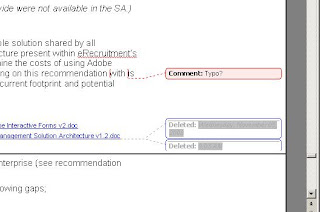 So what happened the other day that sent me over the edge... I was spinning around in the traditional document creation process and I was reviewing some changes and I came across this gem (see image). Somebody took the effort to make the comment that there was a typo. Now I can see the positive side of this in that the document quality was increasing but I couldn't believe the non-collaborative approach. My perspective was if this was in a wiki the typo would have been corrected by the first person to find it and the built-in wiki versioning would have captured the change event. The amount of cognitive cycles saved by only the finder making the change would have held big benefits. For I wouldn't be looking at it and thinking about it, the change would have been made at source of discovery. In my mind this is a micro example of the positive and cascading effects that using Agile and Web 2.0 approaches within architecture could have. Massively collaborate on developing the architecture as needed, let the technology and social media record the history and the tacit knowledge found in the related discussion.
 So what happened the other day that sent me over the edge... I was spinning around in the traditional document creation process and I was reviewing some changes and I came across this gem (see image). Somebody took the effort to make the comment that there was a typo. Now I can see the positive side of this in that the document quality was increasing but I couldn't believe the non-collaborative approach. My perspective was if this was in a wiki the typo would have been corrected by the first person to find it and the built-in wiki versioning would have captured the change event. The amount of cognitive cycles saved by only the finder making the change would have held big benefits. For I wouldn't be looking at it and thinking about it, the change would have been made at source of discovery. In my mind this is a micro example of the positive and cascading effects that using Agile and Web 2.0 approaches within architecture could have. Massively collaborate on developing the architecture as needed, let the technology and social media record the history and the tacit knowledge found in the related discussion.
Tuesday, November 18, 2008
Enterprise Architecture and Web 2.0
I'm going to be spending a fair bit of my time over the next while developing curriculum around how Web 2.0 technologies have become a required tool for enterprise architecture (EA). There are a number of influences to this newly formed realization;
- Agile (and nimble) approaches are becoming a must have for enterprise architecture.
- Documentation heavy approaches overly ritualize a process that can be duplicated and greatly improved by using wikis.
- The deep dive technical discussions that influence and describe architecture are better captured on video and with photos of the whiteboard.
- The best place for architecture should be embedded in the development culture. It cannot be mandated.
- Good enterprise architects are really hard to find. And most are attracted to emerging approaches and technologies. (there architects for god's sake)
- With all the belt tightening going on, architects need to be able to do more with less. [so get rid of the costly (and useless) rituals]
- a company, business, organization, or other purposeful endeavor; an undertaking or project, especially a daring and courageous one; a willingness to undertake new or risky projects; energy and initiative; an active participation in projects
en.wiktionary.org/wiki/enterprise - A system of business endeavor within a particular business environment. An enterprise architecture (EA) is a design for the arrangement and interoperation of business components (eg, policies, operations, infrastructure, information) that together make up the enterprise's means of operation. [ICH].
www.balancedscorecard.org
Monday, November 17, 2008
What do I do?
 I utilize Web 2.0 technologies to facilitate corporate learning, professional development and to support K12 students in developing connectivist learning skills. I encourage people to use the tools of social media and the resources from the internet cloud to capture knowledge both explicit and tacit. I believe these approaches to knowledge capture are beginning to extend the tools for Business Intelligence and Knowledge Management. I agree with Brown and Adler that understanding is socially constructed and that the Web 2.0 provides the participatory media to facilitate this social construction of understanding.
* This question is being posed as an exercise created from a previous post on this blog.
Saturday, November 15, 2008
Learning Environments (DIY)
I believe the concepts within these two images need to be thought about as anyone explores the use of Web 2.0 technologies for learning;
Progressive Inquiry

Personal Learning Environments

Progressive Inquiry

Personal Learning Environments

CMS Toolbox or Trap?
I like this article... It is part of the growing dialogue about using CMS for learning. And how they actually limit learning and course creation. Here are a couple of good quotes from the article;
the standardized nature of integrated commercial systems is limiting pedagogy.
Web 2.0 applications that encourage social construction of knowledge (Wikispaces, BubbleShare, Ning) are freely available and may provide more creative instructors with better options than any LMS currently available.
Who am I?
I'm a person who is enamored by Open Educational Resources (OERs) and free cultural works. I believe that utilizing web 2.0 and collaborative technologies is emerging to be the most effective approach to learning, life-long learning and professional development.
* This question is being posed as an exercise created from a previous post on this blog.
* This question is being posed as an exercise created from a previous post on this blog.
Friday, November 14, 2008
The Brand Gap
I came across this slideshare stack and felt it would be a good thing to look it through.
I came across three important questions;
I came across three important questions;
- Who are you?
- What do you do?
- Why does it matter?
- What are you?
- What lessons do you provide?
- Why do they matter?
Thursday, November 13, 2008
Commoncraft does a great job of explaining Web 2.0
Commoncraft really has created a good set of videos to understand the web 2.0 and all the related technologies. They also do a good job of keeping up with the new technologies as they mature and gain popularity.
Good introduction to Web 2.0
Even though this video was created a couple of years ago it still covers the subject very well. It goes through all the main concepts within the read write web.
Thursday, October 02, 2008
6:48.68 vs 0:32.36
It was just getting way to frustrating. Wanting to just quickly check my email between tasks, somewhere between putting some finish to the new windows and picking up the boy from pre-school. Booting the computer, then loading Outlook and hitting send/receive, was no longer something I could do between tasks. So I got into the habit of doing the quick check on the cell phone. Then I started to wonder what is the difference in time? So here are the timings, and the cell phone could have lapped the PC 12 times;
Laptop (6:48.68 minutes)
Laptop (6:48.68 minutes)
- press the ON button
- load XP
- login
- load Outlook
- press Send/Recieve
- press the ON button
- load Symbian
- load mobile gmail app
- accept network login
Sunday, September 28, 2008
WIkiEducator Quality Assurance
I formally announced the first draft of the WikiEducator (WE) featured works in the google group. After a considerable amount of discussion in May 2008 WE decided upon a number of aspects for the Quality within WE. The three main themes are;
Items 1 & 2 have progressed the most with some conceptual work being done by reviewing eMM from a WE perspective. I intend on reviewing the eMM again to add criteria to the featured projects and featured institution. You can see how this will fit when you review the respective featured works. I plan on providing further depth to how the eMM fits with all this in the near future.
I'd really like if people could review and provide discussion around these five featured works;
I also created a portal called the Quality Assurance Framework. The purpose of the portal is to provide the foundation (or framework) for all the QA initiatives within WE.
Please take the time to review and provide feedback. Please participate and participate often!!!
Items 1 & 2 have progressed the most with some conceptual work being done by reviewing eMM from a WE perspective. I intend on reviewing the eMM again to add criteria to the featured projects and featured institution. You can see how this will fit when you review the respective featured works. I plan on providing further depth to how the eMM fits with all this in the near future.
I'd really like if people could review and provide discussion around these five featured works;
I also created a portal called the Quality Assurance Framework. The purpose of the portal is to provide the foundation (or framework) for all the QA initiatives within WE.
Please take the time to review and provide feedback. Please participate and participate often!!!
Friday, September 05, 2008
Should twitter based spammers be called spitters
Today I become fed up with someone I was following on twitter. I started following them and the tweets I got were great and full of nuggets every now and again. Then all of a sudden they started tweeting at an increasing amount. And they weren't the personal musings you'd expect but links to here, re-tweets to this... It was obviously no longer a single person. They became spam in my tweet stream, they filled up my tweets page, how annoying. So I no longer follow them... This did prompt the question in my mind, what is a twitter based spammer called? I figure it should be spitter!
Tuesday, June 03, 2008
Most EduPunks are paid by the establishment
I have been taken by this EduPunk term. I grew up in the 70's and associated with the music scene of that time. I listened to the Sex Pistols, I still look back at the depth of rebellion Sid Vicious incarnated. I have mind blowing memories of Joey Shithead and the Skulls [before they became DOA (our most famous Vancouver punk bank)] playing during my high school graduation year. No true Punk would consciously take money from the establishment they rebelled against. Yet, this current set of EduPunks mostly work for traditional established education institutions. I strongly suggest you trace most people writing about and considering themselves EduPunks back to where they derive there livelihood. They are not EduPunks! They are masquerading as Punks, and as long as people clutter up the blogosphere claiming to be EduPunks while also being paid by the establishment can only perpetuate these flawed traditional education structures. If they were true Punks they would leave their day jobs and use their mindshare to disrupt the structures they claim to be rebelling against. Hypocrites the lot of them!!!!
Thursday, May 22, 2008
Do bounties work?
The "work" I am doing with WikiEducator is in trying to fill out the the multimedia resources available for OpenOffice / Ubuntu learning. We had offered a $1500 CDN bounty for each 3 -5 minute multimedia component developed. This seems like a good offer, but I wonder if the idea of OER and wiki collaboration includes the concept of money. I always believed that OER and wiki authorship was a volunteer activity. And when you throw $$$ into the mix everything becomes skewd...
Thursday, May 08, 2008
ScoPE [SOF2008]
This looks to be a very good conference; Shaping our Future: Toward a Pan-Canadian E-learning Research Agenda. I look forward to meeting people online.
Wednesday, April 23, 2008
Nature is a CC-BY-SA
I just finished reading a classmates post which is titled "The truth according to wikipedia". Their post embeds a great video about wikipedia and the Web 2.0 and where all this free knowledge could be going. The post and the video had some very interesting points. What it really got me thinking was; I really don't believe any of the main points get to the nut of the issue, which is, the keepers (of the last 100 years or so) of the current truth got us into the current mess of consumerism, inequitable capitalism, non-sustainable consumption of the earths resources, etc... It's no wonder there is a movement in redefining the truth and taking truth away from the current ideology. IMHO the current truth is deeply flawed and needs to be rewritten. The new truth needs to build sustainability into its core, the new truth needs to build the natural environment into its core. This idea is well discussed in a podcast/video by Dr. David Orr titled "the end to education". The new truth needs to make the stand that the natural environment is a CC-BY-SA, and not to be exploited and "owned" by the few. The natural environment was created before human arrival and should not be consumed by a truth that if you innovate nature, you not only own your innovation you also have rights to the nature you based your innovation upon. Nature is a CC-BY-SA. We live in a truth that allows companies like Monsanto to "steal" nature and make it their own and then try to sue those who have treated nature as an open resource. It's time to rewrite the truth. Flatten it out, share it, have us all accountable (and attributable) to take care of it, its a matter of our survival. This is why truth needs a collaborative rewrite so it is no longer controlled by the few who want to perpetuate an ideology (or truth) that is deeply flawed. Everything that was on earth before human arrival should have a Share-Alike license.
Tuesday, April 22, 2008
WEEK 7: Bowen Island, BC, CANADA
For this weeks activity I took a photo from the window of my house, recorded a short description of the photo using audacity, save the audio file to an ogg format and uploaded both these digital objects to the wiki commons.
- The photo: TheLionsVancouver.jpg
- The audio: BowenIslandView.ogg
- The location: Longitude: -123.347626 latitude: 47.570178
Tuesday, April 15, 2008
WEEK 6: IMHO, Canada is beautiful!
It never stops to amaze me the number of top quality and creative photos that exist on flickr. All the licenses combined add up to over 65 million photos. WOW.
This weeks activity forced me to revisit GIMP and to take a deeper look at the features already available with flickr (in particular, picnik). I still believe that GIMP is the best photo editor available (open source or otherwise). And using it to alter and improve photos is free and easy. The number of GIMP tutorials available on YouTube is impressive.
I went for a walk with my son Lucas and took some photos of our beautiful island paradise. From the photos I chose the best ones and uploaded them to flickr than I edited (mostly cropped) them with picnik. I believe the results of our Bowen Island walk-about are pretty good.
I also managed to upload a file to MediaWiki Commons. The photo is of the Battery in winter from the families one year stay in St. John's Newfoundland.
This weeks activity forced me to revisit GIMP and to take a deeper look at the features already available with flickr (in particular, picnik). I still believe that GIMP is the best photo editor available (open source or otherwise). And using it to alter and improve photos is free and easy. The number of GIMP tutorials available on YouTube is impressive.
I went for a walk with my son Lucas and took some photos of our beautiful island paradise. From the photos I chose the best ones and uploaded them to flickr than I edited (mostly cropped) them with picnik. I believe the results of our Bowen Island walk-about are pretty good.
I also managed to upload a file to MediaWiki Commons. The photo is of the Battery in winter from the families one year stay in St. John's Newfoundland.

Tuesday, April 08, 2008
WEEK 5: An Adult Wikimedia?
The work of the wikimedia foundation is exemplary when it comes to free culture, openness and creating free content. And the relationship among the wikimedia projects, OER and education IMHO will be a growing and deepening endeavour. Much of what other course participants have said this week points out why the wikimedia foundation has had such success;
Where do I see the future of wikipedia, OER and education? That is a big question, that has many parts;
- Anika points out that wiki contributors are learners, collaborators, producers and researchers all at the same time.
- I agree with susanne when she mentions that the line between student and teacher is blurring and that much of learning will be self-directed. The Wikimedia projects contribute a lot in this capacity.
- I'm happy that Luca pointed out the importance of having free media assets and how wikicommons is building this.
- And as Daudi said, the internationalization and translation of wikipedia is impressive. Particularly given it this is a volunteer effort.
- I really appretiated Juha's critical appraisal of different Wikimedia projects. The inclusion of the longtail was important, and if through time wikipedia articles become watered down?
- Kieth really got into it and I was glad he brought up the issue of context and localization. This is where I see wikipedia doing good work for it allows (even encourages) localized versions.
Where do I see the future of wikipedia, OER and education? That is a big question, that has many parts;
- First, I see wikipedia as a struggling teenager right now. It is trying to find it's adult persona; financially, and ideologically. Where it ends up in the next few years will determine how it will align with the OER movement and with Education in general.
- Second, I believe all the WikiMedia projects need to go mobile. IMHO it is the mobile user community that is the road ahead, particularly in regards to OER and Education. We have over 1.3 billion coming of age in the developing world, and easily accessed OER based education is the key.
- Third, As some of you may have read I believe that for OER to become successful it needs to include assessment and accreditation. I believe WikiMedia needs to create WikiAssess (or something similar).
Friday, March 28, 2008
WEEK 4: Open Access Assessment and Accreditation
I found this week postings quite amazing. I found myself very aligned with all that Nichthus said and appreciated the perspective provided in the conclusion. In my mind a free culture is about honoring everyone and all positions and perspectives; this includes the closed and proprietary. I've been a follower / fan of Lessig’s work for some time now, and i think what he has done for copyright is a significant human contribution. And the reality / changes he is offering is well overdue in terms of copyright law...
I find this weeks exploration of copyright, licensing and OER happens at the right time in the progression of this course and all the readings got me thinking deeply about the similarities and differences of Open Content (Wikipedia), Open Source and OER. In particular, I spent considerable time thinking and discussing the Bissell / Boyle article. In their article they write about the success of Wikipedia and Open Source and the slower progress of OER. They offer three items to bring OER to a closer level of success that Wikipedia and Open Source have had. I believe they have missed a couple of aspects within the openness of OER, and it is missing these aspects they have missed identifying what is required to bring OER to the same level of success as these other two.
To explore this I believe we need to look at the permission required for accessing the domains of these three open initiatives. Neither Wikipedia nor Open Source has constraints to their domain. These two have complete openness from a technical, content, social, and bureaucratic (administrative) perspective. OER has openness to the technical, content and social, but is closed to the bureaucratic. What I mean by closed to the bureaucratic is that the assessment and accreditation is still closed. People can access all the open learning content that is available as OER but they still have to go through a bureaucracy to be assessed and accredited. I believe that until we have Open Access Assessment and Open Access Accreditation (OAA) OER will be severely restrained and should be renamed Open Learning Resources (OLR), because education includes assessment and accreditation. See an associated Google group discussion for further insight into my belief on the need for OAA.
I find this weeks exploration of copyright, licensing and OER happens at the right time in the progression of this course and all the readings got me thinking deeply about the similarities and differences of Open Content (Wikipedia), Open Source and OER. In particular, I spent considerable time thinking and discussing the Bissell / Boyle article. In their article they write about the success of Wikipedia and Open Source and the slower progress of OER. They offer three items to bring OER to a closer level of success that Wikipedia and Open Source have had. I believe they have missed a couple of aspects within the openness of OER, and it is missing these aspects they have missed identifying what is required to bring OER to the same level of success as these other two.
To explore this I believe we need to look at the permission required for accessing the domains of these three open initiatives. Neither Wikipedia nor Open Source has constraints to their domain. These two have complete openness from a technical, content, social, and bureaucratic (administrative) perspective. OER has openness to the technical, content and social, but is closed to the bureaucratic. What I mean by closed to the bureaucratic is that the assessment and accreditation is still closed. People can access all the open learning content that is available as OER but they still have to go through a bureaucracy to be assessed and accredited. I believe that until we have Open Access Assessment and Open Access Accreditation (OAA) OER will be severely restrained and should be renamed Open Learning Resources (OLR), because education includes assessment and accreditation. See an associated Google group discussion for further insight into my belief on the need for OAA.
Monday, March 24, 2008
Open Access Accreditation
I want to discuss if people think it is possible to create an international accredited institution that could give me a graduate level degree based on my completion / creation of OER (and related published research)? Maybe the international institution is a social network with a top quality reputation. i.e. if your level of scholarship is recognized by this “institution / social network” then it is considered the same as a PhD from Athabasca University… lets call it Open Access Accreditation… Isn’t this the natural progression from connectionist (see siemens) approaches?
It would seem that an institution like UNESCO or ICDE is where this could start and with the writing coming from these institutions regarding OER they (I believe) should be addressing the issue. I’ve been reading papers from these institutions for a while and everything still assumes the OER are utilized within existing institutions and existing courses and existing programs and in the end you still have to pay for assessment and the credential. In particular, the roadmap from the OLCOS http://www.olcos.org/cms/upload/docs/olcos_roadmap.pdf seems to be a deep dive into all this, yet they still assume loads of affiliations and partnerships with existing Universities. Essentially you still have to pay to get assessed and credentialed even though you are using OER created by someone only loosely affiliated with the university granting the credential. Why?
You could assume a PhD is the equivalent of 2-3 years of full-time work, for easy math lets 5000 hours. Let’s say I am prepared to work 16 hrs a week for 46 weeks a year for seven years (5152 hours total). And during this time I create a solid amount (potentially a complete Masters degree amount) of OER (with accompanying collaborative research papers) on WikiEducator and Wikiversity. Shouldn’t I be able to take all this work and be given a PhD? Universities provide honorary doctorates; why not use this same structure to offer a PhD to someone who completes what I previously suggested? Or would the reputation I created on WikiEducator and Wikiversity by collaboratively creating a PhD effort equivalent in OER be the same as having a PhD? In fact could this not be the new PhD? And in the end I would have saved myself the 40k - 100k $ that I paid to an institution for a credential (not including 5152 hrs of lost salary). And I could do all this in a truly self directed manner without having to be “supervised” by a tenured academic. When I know that most of my supervision is going to come from the social network anyway…
Or maybe what I am asking is; what role does the graduate level university play in a Connectivist world filled with quality OER, hard work and an active social network?
It would seem that an institution like UNESCO or ICDE is where this could start and with the writing coming from these institutions regarding OER they (I believe) should be addressing the issue. I’ve been reading papers from these institutions for a while and everything still assumes the OER are utilized within existing institutions and existing courses and existing programs and in the end you still have to pay for assessment and the credential. In particular, the roadmap from the OLCOS http://www.olcos.org/cms/upload/docs/olcos_roadmap.pdf seems to be a deep dive into all this, yet they still assume loads of affiliations and partnerships with existing Universities. Essentially you still have to pay to get assessed and credentialed even though you are using OER created by someone only loosely affiliated with the university granting the credential. Why?
You could assume a PhD is the equivalent of 2-3 years of full-time work, for easy math lets 5000 hours. Let’s say I am prepared to work 16 hrs a week for 46 weeks a year for seven years (5152 hours total). And during this time I create a solid amount (potentially a complete Masters degree amount) of OER (with accompanying collaborative research papers) on WikiEducator and Wikiversity. Shouldn’t I be able to take all this work and be given a PhD? Universities provide honorary doctorates; why not use this same structure to offer a PhD to someone who completes what I previously suggested? Or would the reputation I created on WikiEducator and Wikiversity by collaboratively creating a PhD effort equivalent in OER be the same as having a PhD? In fact could this not be the new PhD? And in the end I would have saved myself the 40k - 100k $ that I paid to an institution for a credential (not including 5152 hrs of lost salary). And I could do all this in a truly self directed manner without having to be “supervised” by a tenured academic. When I know that most of my supervision is going to come from the social network anyway…
Or maybe what I am asking is; what role does the graduate level university play in a Connectivist world filled with quality OER, hard work and an active social network?
Wednesday, March 19, 2008
WEEK 3: Shoulders of Giants
During this weeks task we had a look at a number of sites / references that set the philosophical foundation for OER. The sites we visited include;
During the age of Enlightenment people began to recognize that they had the freedom to use one's own intelligence. This really sums up this time in history. It's hard to believe that at times in our history we didn't realize we had such power. The frightening part is that in some parts of the world there are people who still haven't caught on to this or are so oppressed that they don't have the freedom.
When it comes to the Shoulders of Giants I really like the quote
The Library Movement is an essential part of having an educated and literate population. Having free access to books and the support in how to use the books raises us all up. And having ways to further the library movement will increase the global populations ability to enter into the dialog required to increase our shared abilities to be good stewards of the planet.
As I read further I found this description in the Popular Education reading;
Gosh, with this definition of Folk High School I see it as the definition of a Personal Learning Environment;
Conclusion
When I consider all these writings, and I consider the trajectory they have created I really like the future that I see. It seems to me that we are heading toward a place where the world is flat and people are engaged in adding knowledge to the collective of people on the planet. And whether that addition is for self or other it doesn't matter cause the tools and approaches we use benefit us all...
- Enlightenment - The Age of Enlightenment
- Science and "standing on the shoulders of giants"
- Library Movement: Origins of the public library as a social institution
- Free Adult Education: Popular Education and Folk High School
- Free Software Movement
During the age of Enlightenment people began to recognize that they had the freedom to use one's own intelligence. This really sums up this time in history. It's hard to believe that at times in our history we didn't realize we had such power. The frightening part is that in some parts of the world there are people who still haven't caught on to this or are so oppressed that they don't have the freedom.
When it comes to the Shoulders of Giants I really like the quote
If I have seen a little further it is by standing on the shoulders of GiantsThis ties so many things together, it is the acknowledgment that whatever we do, we draw on the past and by drawing on the past we can see further to the future.
The Library Movement is an essential part of having an educated and literate population. Having free access to books and the support in how to use the books raises us all up. And having ways to further the library movement will increase the global populations ability to enter into the dialog required to increase our shared abilities to be good stewards of the planet.
As I read further I found this description in the Popular Education reading;
Popular Education may be defined as an educational technique designed to raise the consciousness of its participants and allow them to become more aware of how an individual's personal experiences are connected to larger societal problems. Participants are empowered to act to effect change on the problems that affect them.I like this a lot for it really connects individuals to the larger and implies a responsibility to effect change. This is what I consider a theme behind OER and the larger open movement... Empowering people to act!
Gosh, with this definition of Folk High School I see it as the definition of a Personal Learning Environment;
The character of folk high schools differs from country to country, but usually such institutions have the following common features:Last, and certainly not least, we had the reading of the Free Software Movement (FSM). This section can get into some heady thoughts and as I drilled down into some of the supporting links I got the feeling that this chapter is far from done. I mean when I read about the Library Movement and the Age of Enlightenment, I see these items as historically complete, they still influence our lives and the cities we live. But the Free Software Movement isn't done, it isn't historically complete, it still has some change and "maturing" to do. Nonetheless, this movement is having a big influence on much of what is going on... When I consider that Microsoft (IMHO, the farthest away from FSM) engaging a collaboration with eclipse then I realize that the FSM is having an influence and that fundamental changes to the FSM are still afoot.
- A large variety of subjects
- No final exams
- Focus on self-development
- Pedagogical freedom
Conclusion
When I consider all these writings, and I consider the trajectory they have created I really like the future that I see. It seems to me that we are heading toward a place where the world is flat and people are engaged in adding knowledge to the collective of people on the planet. And whether that addition is for self or other it doesn't matter cause the tools and approaches we use benefit us all...
Saturday, March 08, 2008
WEEK 2: Introduction to Wikiversity
This week we are exploring either LeMill or Wikiversity. We need to set ourselves up to be a contributor to one of these OER sites by creating a profile. We also need to contribute to an area of interest by contacting the editors, contributing to an existing resource and create a new resource.
My Profile
My Wikiversity profile is a work in progress as I have bigger plans for my work here (and will post this later). This wikiversity profile does link to my web portfolio site. To view my MediaWiki profile go to my profile on WikiEducator.
My Notification
I began by investigating materials for how to get started in programming with PhP. I found a number of introductory programming resources. Nothing that provided OER for how to set up the development environment. The lessons I found were lessons on beginner programming with different languages, nothing how to set up the software development environment to start the actual programming. So I posted a question on a couple of talk pages. The question was;
My New Resource
As eluded to in my notification, there seems to be the requirement for a course on setting up a software development environment. Now this may be only my need, but I will assume that as I develope out the course it may attract some attention. We shall see... I created a new Wikiversity page within the Computer Programming topic called "Creating a Development Environment". Let's see what interest this draws...
Conclusions
It would seem success within Wikiversity comes from engagement. I couldn't find a place to sign-up for membership or contact this particular person to become an auther for a particular school. I guess the idea is to just jump right in, keep going and wait for feedback and the engagement from others.
My Profile
My Wikiversity profile is a work in progress as I have bigger plans for my work here (and will post this later). This wikiversity profile does link to my web portfolio site. To view my MediaWiki profile go to my profile on WikiEducator.
My Notification
I began by investigating materials for how to get started in programming with PhP. I found a number of introductory programming resources. Nothing that provided OER for how to set up the development environment. The lessons I found were lessons on beginner programming with different languages, nothing how to set up the software development environment to start the actual programming. So I posted a question on a couple of talk pages. The question was;
I posted this question to the following two talk pages;
getting a development space
I'm wanting to get into programming PhP, there seems to be a number of good open access courses for intro to PhP and further. What I am looking for is a course on how to set up the development environment. Can anyone point me to such a course? -- Prawstho 17:19, 8 March 2008 (UTC)
http://en.wikiversity.org/wiki/Topic_talk:Computer_programming
http://en.wikiversity.org/wiki/Talk:Web_design
My New Resource
As eluded to in my notification, there seems to be the requirement for a course on setting up a software development environment. Now this may be only my need, but I will assume that as I develope out the course it may attract some attention. We shall see... I created a new Wikiversity page within the Computer Programming topic called "Creating a Development Environment". Let's see what interest this draws...
Conclusions
It would seem success within Wikiversity comes from engagement. I couldn't find a place to sign-up for membership or contact this particular person to become an auther for a particular school. I guess the idea is to just jump right in, keep going and wait for feedback and the engagement from others.
Thursday, March 06, 2008
WEEK 2: Existing OER projects
I’ve been familiar with all these open education projects for a while;
When I was looking at all these open education projects I was asking myself, which one I would use if I was developing a new course or program. And what was important to me is that I am familiar with the technology (publishing and course development tools) and that the project embraces a licensing scheme that I am happy with. The licensing scheme is important as it encourages or restrains the reuse of my work. I was pleasantly surprised to see that all the projects have embraced a CC license of some sort. So I felt comfortable that I could work with all sites. Being familiar with the technology pushed me toward Wikiversity. I am already familiar with using MediaWiki to publish content and find it an effective tool for developing courses online.
- Open University (UK) Open Content Initiative
- Rice Connexions
- MIT OpenCourseWare
- LeMill.net
- Wikiversity.org
When I was looking at all these open education projects I was asking myself, which one I would use if I was developing a new course or program. And what was important to me is that I am familiar with the technology (publishing and course development tools) and that the project embraces a licensing scheme that I am happy with. The licensing scheme is important as it encourages or restrains the reuse of my work. I was pleasantly surprised to see that all the projects have embraced a CC license of some sort. So I felt comfortable that I could work with all sites. Being familiar with the technology pushed me toward Wikiversity. I am already familiar with using MediaWiki to publish content and find it an effective tool for developing courses online.
OER - Two important and relevant views
This 2006 stream speaks to what MAY be coming with OER.
This more recent 2008 stream that looks at the reality of the sharing we need to enjoy what the previous stream spoke of...
This more recent 2008 stream that looks at the reality of the sharing we need to enjoy what the previous stream spoke of...
Models for sustaining OER
Stephen Downes wrote a good article on approaches to sustaining OER. It's a good read if you have the time. http://ijklo.org/Volume3/IJKLOv3p029-044Downes.pdf
WEEK 1: Ilkka has created a valuable contribution
I found this paper by Ilkka filled with a very good description of OER and some very important statements about OER and it influence on education. I really appreciated the historical references and how OER is tied to the Open Source movement. Tuomi (2006, page 4) makes the important observation that “When educational processes and objectives qualitatively change, new systems are needed for measuring their performance and benefits.” This stands out for me because I am seeing change in much of education and I see OER as one of the influences. I also believe this is important for it recognizes that we need new approaches to measuring performance and benefits within the use of OER.
Pedagogical Benefits
Ilkka also does well in pointing out the pedagogical benefits of the Open Source movement where he speaks of how “The informal communities of practice that develop open source systems have produced some of the leading software engineers of today. In some cases, open source projects seem to clearly outperform traditional formal educational models in their capability to create expertise and skills.” I share the constructivist belief that one of the best ways to learn something is to have to teach it. So having people develop OER and be a contributor to a global OER repository may be the best way for them to learn the subject. Being involved in a community of practice focused upon the developing OER for a subject domain may well be the best way to learn the subject.
Context Area
As I got further into the paper my appreciation for its depth increased. The introduction of the three areas (page 25) really got me thinking and I began to wonder if there was a fourth area, the context of the resource. Or does context fall into the social? It doesn’t seem to in the paper. Either way the three areas are valuable, though I believe context needs to be considered an area itself.
Levels of Openness
The three levels of openness are also very thought provoking and Openness II makes me wonder if there is the need for a new type of global institution that grants formal degrees after working through (or creating) a number of OER courses.
The fountain
I really like the visual of the open fountain and when it comes to education where knowledge can be shared and created in large numbers of learners from a single source really is a fountain. How this will be recognized within the concept of the commons and the idea of academia and commercial endeavour will be interesting to be a part of.
More on Context
As the paper came to a close with the five points of view I again began to wonder where learning context fits within these views. I believe there is room for one more view that would sit between learner view and teacher view. It would be the contextual view – context of learning (the what/where/how/language/culture/localization of the OER being utilized). I believe this idea is reinforced at the top of page 33 where Ilkka speaks to how the resources are consumed in qualitatively different markets.
My Conclusion
I found this paper a great introduction to OER and all the issues which surround this amazing topic. I did find the paper did require a level of technical understanding with regard to the subjects of frameworks, SCORM, etc.
Pedagogical Benefits
Ilkka also does well in pointing out the pedagogical benefits of the Open Source movement where he speaks of how “The informal communities of practice that develop open source systems have produced some of the leading software engineers of today. In some cases, open source projects seem to clearly outperform traditional formal educational models in their capability to create expertise and skills.” I share the constructivist belief that one of the best ways to learn something is to have to teach it. So having people develop OER and be a contributor to a global OER repository may be the best way for them to learn the subject. Being involved in a community of practice focused upon the developing OER for a subject domain may well be the best way to learn the subject.
Context Area
As I got further into the paper my appreciation for its depth increased. The introduction of the three areas (page 25) really got me thinking and I began to wonder if there was a fourth area, the context of the resource. Or does context fall into the social? It doesn’t seem to in the paper. Either way the three areas are valuable, though I believe context needs to be considered an area itself.
Levels of Openness
The three levels of openness are also very thought provoking and Openness II makes me wonder if there is the need for a new type of global institution that grants formal degrees after working through (or creating) a number of OER courses.
The fountain
I really like the visual of the open fountain and when it comes to education where knowledge can be shared and created in large numbers of learners from a single source really is a fountain. How this will be recognized within the concept of the commons and the idea of academia and commercial endeavour will be interesting to be a part of.
More on Context
As the paper came to a close with the five points of view I again began to wonder where learning context fits within these views. I believe there is room for one more view that would sit between learner view and teacher view. It would be the contextual view – context of learning (the what/where/how/language/culture/localization of the OER being utilized). I believe this idea is reinforced at the top of page 33 where Ilkka speaks to how the resources are consumed in qualitatively different markets.
My Conclusion
I found this paper a great introduction to OER and all the issues which surround this amazing topic. I did find the paper did require a level of technical understanding with regard to the subjects of frameworks, SCORM, etc.
Tuesday, March 04, 2008
Lawrence Lessig Free Culture Video
In my opinion this video is an accumulation of Lawrence Lessig's work. It shows his historical depth regarding the issue of freedom and copyright, it shows his outstanding presentation approach, it provides a roadmap to those who want to engage and it tells of the importance of this issue to our future and our children's lives. For all those interested in the free culture and creative commons movements it is a must watch video.
Peter welcomes everyone to composing OER
Hello all participants, I am very excited about this wikiversity course. I have had an interest in OER and all things open and free for a while now and over the last 18 months have been focusing on OER within completing a Master of Education (IT). I live on the west coast of Canada on an Island that is one hour from Vancouver. I am interested in this course for I believe that if we are going to create all the OER to meet the global and developing worlds needs for curriculum it will have to be done by a large participatory and collaborative group. I believe this course will cover most, if not all, the topics important to understanding the development of OER. I also believe that after this course I will be able to further the message of OER and speak to most questions that could be asked regarding OER. If you want to get a greater idea of who i am please visit my web site at http://www.rawsthorne.org or view my wikieducator profile at http://wikieducator.org/User:Prawstho
Monday, December 31, 2007
Buy only what you NEED
This is something that has kicked around in my head for many years and i try an practice it every day... This 20 minute flash video explains why.
Saturday, December 29, 2007
Composing free and open online educational resources
I just signed up for this course about developing OER. It is very similar to what I was proposing in my paper titled "Utilizing Open Educational Resources for International Curriculum Development". I believe this will be an excellent course as I have been following the work of Teemu for a while. He also posted a comment to one of my blog posts a while ago. So it would seem the seven degrees are reducing...
Wednesday, December 05, 2007
The OER4D Program
So I finished another paper and put it over on my academic blog. The paper is more of a proposal for a new university level program about utilizing OER for development. Or in other words it is an Open Educational Resource (OER) about how to create, eruse and alter existing OER. I believe a course like this is overdue. So I've written this proposal and if all goes well, I hope to start building the resource in the new year.
Tuesday, February 06, 2007
Why a Learning Systems Architect?
So I was prodded into making a defense for my new role of Learning Systems Architect… Here is my rant of a response, enjoy.
Nobody apparently needs!?! Everybody needs! They just aren’t aware of it yet. But they should be, and will be. What sort of organization? Any organization engaged in the knowledge based economy and want to encourage their employees to self construct knowledge and thrive within their organization. See John Seely Brown; http://www.johnseelybrown.com/speeches.html#digitalage The organizations internal pain would be
Thanks again for prodding me to clarify… Please, prod me again. This is known as socio-constructivist learning. It is a core theory that a Learning Systems Architect builds a learning eco-system…
Nobody apparently needs!?! Everybody needs! They just aren’t aware of it yet. But they should be, and will be. What sort of organization? Any organization engaged in the knowledge based economy and want to encourage their employees to self construct knowledge and thrive within their organization. See John Seely Brown; http://www.johnseelybrown.com/speeches.html#digitalage The organizations internal pain would be
- employees seeking more interesting opportunities elsewhere,
- a general erosion of an organizations ability to identify and create new knowledge at an ever increasing rate…
- let your mind wonder…
Thanks again for prodding me to clarify… Please, prod me again. This is known as socio-constructivist learning. It is a core theory that a Learning Systems Architect builds a learning eco-system…
Monday, February 05, 2007
Learning Systems Architect
Learning Systems Architects perform some or all of the following duties:
- Collect and document user’s requirements and develop logical and physical specifications
- Liaise with clients, product managers and senior management regarding the feasability and design of product development
- Research, evaluate and synthesize technical information to design, develop and test computer-based learning and instructional systems
- Develop data, process and network models to optimize architecture and to evaluate the performance and reliability of designs
- Ensure that performance, scalability and extensibility requirements of the product are gathered and met
- Plan, design and co-ordinate the development, installation, integration and operation of computer-based learning and instructional systems
- Assess, test, troubleshoot, document, upgrade and develop maintenance procedures for operating systems, communications environments and applications software
- May lead and co-ordinate teams of information systems professionals, interactive media developers and instructional designers in the development of courseware and integrated information systems
- May research and evaluate a variety of learning management systems, interactive media software products and software frameworks.
- A bachelor’s degree, usually in computer science, computer systems engineering, software engineering or mathematics
- Post-secondary education and experience in education and learning theory within K12, adult and life long learning.
- A master’s or doctoral degree in a related discipline(s) may be required.
- Experience as a computer programmer and software designer is usually required.
Tuesday, January 09, 2007
New Job Description
I am looking for a new job. I have just spent a year in St. John’s Newfoundland on a paternity leave and doing some instructional design and workshop facilitation. My family has now returned to Vancouver. I have fired up my networking engine and have begun to send out emails and contact people I know in Vancouver. One of those people; Troy Angrignon after receiving an email from me asked for me to be more specific to what I was looking for. I know what I am looking for; I’d like a job as a Learning Systems Architect. A formal job description of a Learning Systems Architect doesn’t exist, so I am going to write it myself. After some reflection and some google searches I came across a few web pages that I will use as reference to build this job description;
- The Canadian National Occupational Classification site; http://www23.hrdc-drhc.gc.ca/2001/e/groups/2173.shtml
- The Learning Systems Architecture Lab; http://lsal.org/
- A Senior Architect position description I pilfered from
desire2learn (I wish they had an office in Vancouver); http://www.rawsthorne.org/docs/SeniorArchitectDesire2Learn.pdf - A description of a Learning Technology Systems Architecture
(LTSA) put together by the IEEE; http://www.edutool.com/ltsa/04/index.html
Monday, January 08, 2007
Recording a Lecture
I’ve been giving some thought to recording lectures using a voice recorder and lapel mic. Once you get past the argument of whether you believe this is a good idea or not, here are a few suggestions;
Having lectures posted as MP3’s, slides and lecture notes provides the ability for students to review and reflect after the lecture. This provides a new way for students to deepen their learning.
- Number and Title your slides and refer to the title or number during the lecture - this keeps listeners on the same slide
- Re-state all student questions before answering them.
- Pause your recorder when a large pause occurs due to an activity.
Having lectures posted as MP3’s, slides and lecture notes provides the ability for students to review and reflect after the lecture. This provides a new way for students to deepen their learning.
Thursday, January 04, 2007
I’ve chosen Ubuntu
I’ve chosen Ubuntu linux as the OS for this Moodle project. Why Ubuntu? A number of reasons;
- There has been a lot of positive buzz about Ubuntu on slashdot and other locations
- Getting started is really easy, I also visited the redhat, suse and BSD sites and found the Ubuntu site provided the easiest UI. (I believe a products website / UI says a lot about the product.) I will also admit it was a toss up with OpenBSD…
- I like the idea of supporting a Linux product from the African continent
- I like their idea of a version specifically for education
- Their support seems to be consistent and integrated across versions and releases
Thursday, December 21, 2006
My Journey to Moodle and Beyond
I knew this day would come. I am beginning the build up of my Moodle Server. I have been watching the LMS / CMS space for a number of years now and I knew I would be taking the leap into an FOSS solution. I’ve always been partial to Moodle for it seemed the purest FOSS available and it has always grounded itself in constructivist pedagogy. What really pushed me to commit to Moodle was this report from Idaho State University. So follow along if you like, I’m starting with the build up of a LAMP server, then I will follow up with the Moodle install… from there who knows. I do know that I have been forming some strong opinions regarding where the VLE should be going.
Tuesday, December 19, 2006
Memorial Workshops
I added a summary page of the workshops I facilitated while working with the Instructional Development Office of Memorial University. These workshops focused on the pedagogy of Web 2.0 (blogs, podcasts, wikis, tagging and social software).
Thursday, December 07, 2006
CKMS4D
I've got through my first draft of this CKMS4D paper. But after getting some feedback it seems I need to focus for another while or so to have it be a stronger offering. I still figured I should get this first release out and see what, if any, feedback I may get.
Wednesday, December 06, 2006
Web 2.0 is very significant
I stumbled across this document "The Disruptive Force of Web 2.0: how the new generation will define the future". It certainly captures a view into the youthful future. When you add to this the projections of youth global population we have a very interesting and exciting road ahead. I've included here my thoughts regarding this speech;
Much of the current technology innovation was developed by people in their early 20's (Google, Linux, Skype, Microsoft, many others). It is clear that the young will continue to build the future.In my mind all this builds toward a global education system. That will be very social and very self-directed. The idea of socio-constructivism at a global level.
The current wave of the Web 2.0 is very disruptive; online social networking is not neutral, content proliferation is un-monitored and therefore stresses the importance of media literacy, VOIP is turning telecom sideways or even upside down, IP and copyright is being questioned at many turns. All of this, of course, has two sides. A global social network with an easy flow of un-monitored content accompanied by cheap telecom and an ability to mash-up new works is exciting, and potentially very democratizing.
It is the growth of mobile services that are having the greatest impact. This 'speech' talks about what the Web 3.0 will look like. And with the growth of mobile devices I believe it will fall within this mobile space. And the globalization and 'hopefully' democratization that will occur could be a big step in the right direction.
Monday, December 04, 2006
UNESCO Podcasts
I am really looking forward to the results of this UNESCO project. The idea of participatory video (PV) is quickly growing and a highly successful form of activism and community development. As the price of ICT countinues to drop and the developing world has increased access it is only a matter of time that the transparency of the developing world issues will be impossible to deny or ignore. I hope that these PV efforts will increase the dialogue among all planetary inhabitants. Or even if it only creates a dialogue within the community to make things healthier, that is good.
Monday, November 13, 2006
Odeo Setup
I’ve created a document describing the odeo (http://www.odeo.com) set up process. I believe it to be a good read. If you want to read this document just follow the link.
A book by the same name

I've run across a book by the name 'Critical Technology'. It seems to be in the same subject area as this blog so I felt it was a good idea to make reference.
Sunday, November 12, 2006
Resources can also be free
Another approach to having storage capacity is to use free Web 2.0 capacity. To do this I will use odeo to host the sound files and bloglines to aggretate all the RSS feeds set up by odeo. This setup process is described in this one page document.
Thursday, November 02, 2006
Indigenous Knowledge is paramount
I've been a Canadian for over 40 years, and I have often heard, via the popular news services, of the strife and horrors occuring in Haiti. This 53 second video from YouTube is the first time I've had an insight into why Haiti suffers as it does... It certainly gets me thinking about the value of YouTube and similar services. It also makes me realize that these type of services are breaking down the intermediary of the news networks.
This video also provides a sample of indigenous knowledge. I'm assuming Louis-Henri is Haitian, and that he is working with his internal indigenous knowledge to work toward solutions.
This video also provides a sample of indigenous knowledge. I'm assuming Louis-Henri is Haitian, and that he is working with his internal indigenous knowledge to work toward solutions.
Circles of Change
This is an example of what I would see in a CKMS. It captures a community level activity and provides a learning activity. It is grassroots and driven by the members of the community. Think of the possibilities of having a CKMS within this communtity. Those so inclined would use digital technology to create videos, capture stories, record community events and store them on the CKMS. These stories would be availabe over the communities wireless network.
Where is the computer hardware going to come from? see Computer Aid International
Where is the wireless network going to come from? see Wireless Network in the Developing World
Where is the software going to come from? see Free and Open Source Software at the United Nations
Where is the computer hardware going to come from? see Computer Aid International
Where is the wireless network going to come from? see Wireless Network in the Developing World
Where is the software going to come from? see Free and Open Source Software at the United Nations
Subscribe to:
Posts (Atom)